
As-is home sale paperwork is the collection of legal documents, disclosure forms, and closing instruments that formally transfer property ownership without any seller warranty or repair obligation. Selling a property as-is does not mean selling without documentation. It means selling with a specific set of documents that protect both parties and satisfy state and federal law. Homeowners who understand these requirements close faster, avoid legal exposure, and walk away with fewer surprises. This guide covers every document you will handle, the disclosure rules you cannot skip, and the steps that keep your transaction on track.
What documents make up the as-is home sale paperwork package?
The as-is sale contract is the foundation of every transaction. It contains the as-is clause or addendum, which formally states that the buyer accepts the property in its current condition and the seller has no obligation to make repairs. This clause shifts repair risk to the buyer but does not eliminate the seller's legal duties. Think of it as a warranty waiver, not a liability shield.
The seller property condition disclosure form is the second critical document. Most states require sellers to complete a standardized form listing known material defects. Illinois, for example, mandates a Residential Real Property Disclosure Report with detailed questions covering structural issues, water damage, and mechanical systems. State forms vary significantly, so confirm which version applies to your county before you sign anything.

Federal law adds another layer for older homes. Any property built before 1978 requires a lead-based paint disclosure package, including a signed warning statement and the EPA pamphlet "Protect Your Family from Lead in Your Home." Failure to comply can result in civil penalties up to $37,500 per violation. This requirement applies regardless of whether the home is sold as-is or with full warranties.
Closing documents complete the package. These include the warranty deed (which transfers title), the Closing Disclosure or HUD-1 settlement statement, payoff letters from your mortgage lender, and IRS Form 1099-S to report gross proceeds from the sale. If your property is part of a homeowners association, a condo resale package or HOA disclosure is also required and must be ordered well in advance.
| Document | Description | Who Provides It |
|---|---|---|
| As-is clause or addendum | States buyer accepts property condition with no repair obligation | Buyer's agent or attorney drafts; both parties sign |
| Seller disclosure form | Lists known material defects; state-specific format | Seller completes; varies by state |
| Lead-based paint disclosure | Required for pre-1978 homes; includes EPA pamphlet | Seller provides; buyer signs before contract |
| Warranty deed | Transfers legal title to buyer | Title company or closing attorney prepares |
| Closing Disclosure or HUD-1 | Itemizes all closing costs and credits | Escrow or title company prepares |
| IRS Form 1099-S | Reports gross proceeds for tax purposes | Closing agent files; seller receives copy |
| Payoff letter | Confirms mortgage balance to be paid at closing | Seller's lender provides |
| HOA or condo resale package | Discloses association rules, fees, and financials | HOA or management company provides |
Pro Tip: Order your payoff letter and HOA resale package the same week you accept an offer. These documents often take longer to arrive than sellers expect, and delays here are a leading cause of postponed closings.
How to comply with seller disclosure requirements in an as-is home sale
As-is clauses eliminate repair obligations but do not override statutory disclosure requirements. This is the most misunderstood aspect of selling properties as-is. Sellers frequently assume that writing "as-is" in the contract means they do not have to say anything about the home's condition. Courts have consistently rejected that interpretation.
You must disclose every known material defect. Material defects are conditions that would affect a reasonable buyer's decision to purchase or the price they would pay. Common examples include foundation cracks, a history of flooding, roof leaks, pest damage, faulty electrical panels, and HVAC systems that no longer function. If you know about it, you disclose it. The as-is language does not change that obligation.
Timing matters as much as content. Disclosure forms must be delivered before the buyer is legally bound by the contract. Handing over a disclosure form at the closing table is not compliant. Most states require delivery during the inspection or due diligence period, and some require it before the purchase agreement is even signed. Missing this window can give buyers grounds to void the contract.
The legal risk of getting this wrong is serious. Active concealment or misrepresentation invalidates as-is protections entirely. Courts can award damages including full rescission of the sale, attorney fees, and punitive penalties. Selling as-is does not protect a seller who lies or hides a known problem.
Here are the key steps to stay compliant with disclosure requirements:
- Complete the state-specific seller disclosure form in full. Do not leave fields blank or write "unknown" for conditions you are aware of.
- Deliver the disclosure to the buyer before they are contractually obligated. Document the date of delivery in writing.
- Attach the disclosure form as an exhibit to the purchase contract. Integrating disclosures into the contract as exhibits strengthens enforceability and protects you after closing.
- For pre-1978 homes, provide the signed lead warning statement and EPA pamphlet before the buyer signs the purchase agreement.
- Keep signed copies of every disclosure document in your records for at least three years after closing.
For a detailed look at what real estate disclosures require in Northwest Indiana, Nwibuyers has published a practical breakdown specific to the Portage market.
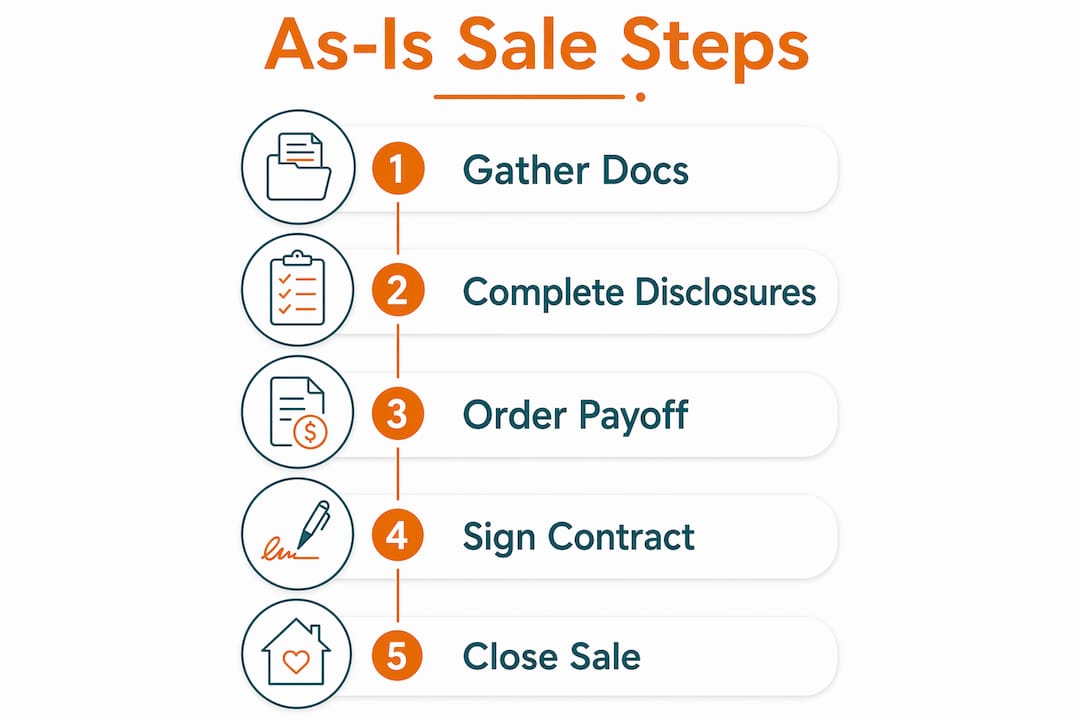
Step-by-step guide to managing paperwork for a fast and legal as-is home sale
Speed in an as-is sale comes from preparation, not shortcuts. Sellers who gather documents before they receive an offer close weeks faster than those who scramble after signing. Title problems cause an estimated 25% of closing delays, and most of those problems are preventable with early action.
Follow this sequence to keep your transaction on schedule:
- Gather baseline documents immediately. Pull your mortgage statements, property tax records, any existing title insurance policy, and records of permits pulled for renovations. These are not optional extras. Buyers, lenders, and title companies will ask for them.
- Order a title search within the first week. Title work typically requires 10 to 14 business days. Ordering early surfaces any liens, easements, or encumbrances that need to be resolved before closing.
- Request your payoff letter from your lender. Payoff letters have expiration dates, usually 30 days. Request one as soon as you have a signed purchase agreement.
- Complete and deliver your seller disclosure form. Use your state's official form. Deliver it to the buyer before they are bound by the contract and attach it as an exhibit to the real estate sale agreement.
- Provide the lead-based paint package if your home was built before 1978. Include the signed warning statement and proof that the EPA pamphlet was delivered. Keep copies of both.
- Review the as-is purchase agreement carefully. Confirm the as-is clause is present, that the closing date is realistic, and that any contingencies are clearly defined.
- Coordinate with your escrow officer or title company. They will prepare the Closing Disclosure, warranty deed, and settlement statement. Provide them with accurate payoff figures and legal descriptions promptly.
- Confirm IRS Form 1099-S reporting obligations. Your closing agent typically files this on your behalf, but verify it is being handled. Incorrect or missing tax reporting causes penalties and complications.
Pro Tip: Hire a real estate attorney to review your as-is sale contract and disclosure forms before you sign. Attorney review fees in Indiana typically run $300 to $600 and can prevent disputes that cost far more to resolve.
Sellers who want to understand the full picture of closing costs in Portage will find a detailed breakdown of what to expect on the settlement statement.
Common mistakes and troubleshooting with as-is home sale paperwork
Most as-is sale complications trace back to a small set of recurring errors. Recognizing them in advance is the most efficient way to avoid them.
The single most damaging mistake is failing to disclose known defects. Sellers sometimes believe the as-is clause gives them cover. It does not. Courts treat active concealment as fraud, and the financial consequences routinely exceed the cost of any repair the seller was trying to avoid.
A close second is misunderstanding what as-is actually means for inspections. Buyers retain the right to inspect the property in virtually every as-is transaction. The as-is clause governs the seller's repair obligation, not the buyer's right to information. Sellers who refuse inspections or treat them as irrelevant often lose buyers unnecessarily.
Here are the top five paperwork pitfalls and how to avoid them:
- Missing or late payoff letters. Request your payoff letter the same day you accept an offer. Confirm the expiration date and request an updated letter if closing is delayed.
- Incomplete legal descriptions on closing documents. Pull your property's legal description from your deed or county records and provide it to your title company at the start of the process.
- Seller disclosures not attached as contract exhibits. A disclosure form sitting in a separate email thread has weaker legal standing than one formally incorporated into the purchase agreement.
- Skipping lead-based paint compliance on pre-1978 homes. This is a federal requirement with significant penalties. Missing the timing of lead disclosures is a frequent compliance failure, even among experienced sellers.
- Ignoring lender requirements for the buyer's financing. Even in an as-is sale, if the buyer is using a mortgage, the lender may require certain property conditions to be met. Cash buyers eliminate this variable entirely.
Pro Tip: Create a single folder, physical or digital, containing every signed document from the transaction. Store it for at least three years. If a dispute arises after closing, organized records are your strongest defense.
Key takeaways
Successful as-is home sales require complete disclosure forms, a properly drafted as-is sale contract, and closing documents prepared early to prevent title and payoff delays.
| Point | Details |
|---|---|
| As-is does not mean no disclosure | Sellers must disclose all known material defects regardless of the as-is clause. |
| Federal lead rules are non-negotiable | Pre-1978 homes require a signed lead warning statement and EPA pamphlet before the buyer signs. |
| Early document prep prevents delays | Order title searches and payoff letters immediately after accepting an offer to avoid the 25% of closings delayed by title issues. |
| Attach disclosures to the contract | Incorporating disclosure forms as contract exhibits strengthens legal enforceability after closing. |
| IRS Form 1099-S is required | Gross proceeds from real estate sales must be reported; confirm your closing agent is handling this filing. |
What I've learned from watching sellers get this wrong
After working through dozens of as-is transactions in Northwest Indiana, the pattern I see most often is sellers who treat "as-is" as a magic phrase that removes all responsibility. It does not. What it actually does is remove the obligation to fix things. That is a meaningful protection, but it is a narrow one.
The sellers who close quickly and cleanly are the ones who treat disclosure as an asset rather than a liability. When you hand a buyer a thorough, honest disclosure form early in the process, you build credibility. Buyers are less likely to walk away or demand price reductions when they feel they have been given the full picture. The sellers who hide problems or leave disclosure forms vague are the ones who end up in renegotiations, or worse, in litigation after closing.
The other thing I have seen cause real damage is underestimating the paperwork timeline. Payoff letters, HOA packages, and title searches all have their own lead times. Sellers who treat these as afterthoughts routinely push their closing dates back by two to three weeks. In a cash transaction where the buyer is ready to close in five days, that delay is entirely self-inflicted.
My honest advice: get your documents in order before you list or accept an offer. Know what your state requires on the disclosure form. Understand the lead paint rules if your home was built before 1978. And work with a title company or attorney who has done this before. The paperwork for an as-is sale is not complicated, but it is specific. Getting it right the first time is always faster than fixing it later.
— Daniel
How Nwibuyers simplifies your as-is home sale
Selling a home as-is involves real paperwork, and managing it alone adds stress to an already demanding process. Nwibuyers handles the documentation side of as-is transactions every day in Northwest Indiana, from disclosure coordination to closing documents.

When you work with Nwibuyers, you receive a cash offer without needing to make repairs, stage the home, or manage open houses. The process is built for speed, with some sellers closing in as little as five days. Every required document is handled transparently, so you know exactly what you are signing and why. If you are ready to skip the paperwork headaches and get a fair offer on your home, request your cash offer today.
FAQ
Does selling as-is mean I don't have to disclose anything?
No. As-is clauses remove repair obligations but do not eliminate disclosure duties. Most U.S. states require sellers to disclose all known material defects using a state-specific form, regardless of as-is language in the contract.
What is included in as-is home sale paperwork?
The core documents include the as-is purchase agreement, seller property condition disclosure form, lead-based paint disclosure for pre-1978 homes, warranty deed, Closing Disclosure or HUD-1, payoff letters, and IRS Form 1099-S. HOA resale packages are also required when applicable.
Can a buyer still inspect a home sold as-is?
Yes. Buyers retain the right to inspect properties sold as-is in nearly all transactions. The as-is clause governs the seller's repair obligation only. It does not restrict the buyer's right to conduct inspections or request information.
How early should I start gathering documents for an as-is sale?
Start before you accept an offer. Order your title search and request a payoff letter the same week you sign a purchase agreement. Title work alone takes 10 to 14 business days, and delays in this step are among the most common causes of postponed closings.
What happens if I forget to include the lead-based paint disclosure?
Failing to provide the required lead-based paint disclosure for a pre-1978 home can result in civil penalties up to $37,500 per violation under federal law. Deliver the signed warning statement and EPA pamphlet before the buyer signs the purchase agreement, and keep proof of delivery in your records.