
A cash buyer simplifies an estate sale by removing the two biggest obstacles in any property transaction: financing delays and repair demands. When you are settling a loved one's estate, the last thing you need is a buyer whose mortgage falls through at week six. 28.8% of U.S. homebuyers paid all cash in March 2026, which means the market for this type of transaction is deep, competitive, and well-understood by buyers and sellers alike. For estate heirs and executors in Northwest Indiana, understanding the cash buyer estate sale process is the difference between a clean, fast resolution and months of carrying costs, family disputes, and uncertainty.
How cash buyers speed up estate sales compared to traditional methods
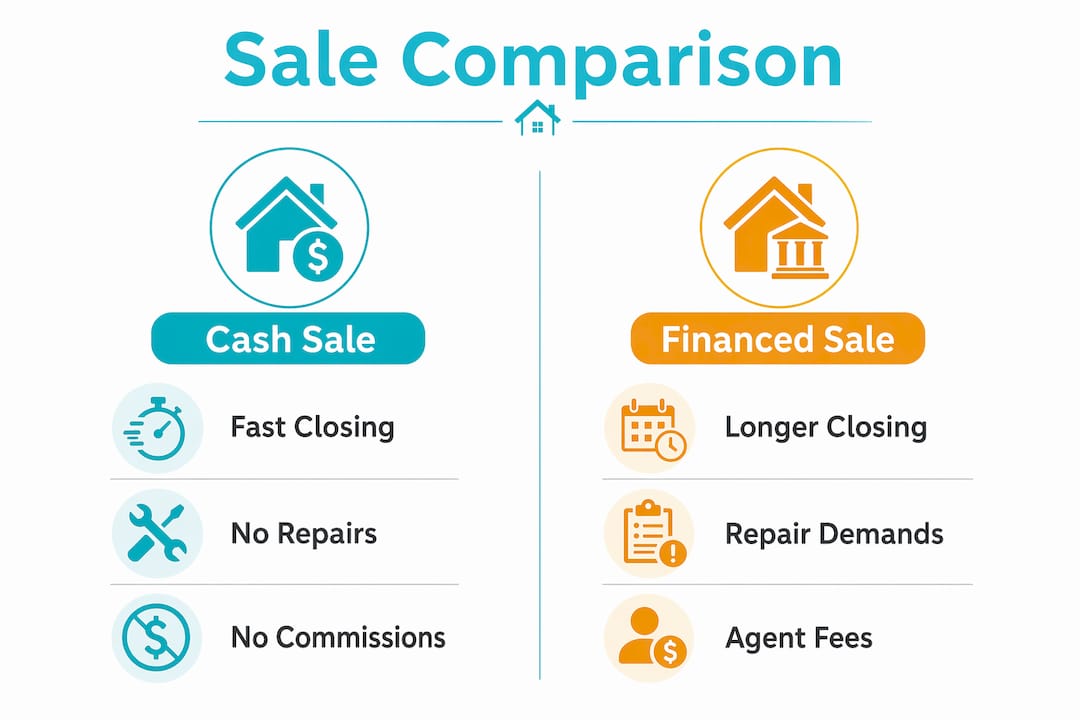
The single most measurable benefit of selling to a cash buyer is closing speed. A cash sale closes in 7 to 14 days, compared to 30 to 45 days for a financed sale. That gap exists because financed buyers require mortgage underwriting, a lender-ordered appraisal, and a chain of contingencies that each carry their own deadline and failure risk. Any one of those steps can stall or kill the deal.
For estate sales specifically, the timing pressure is real. Executors often carry property taxes, insurance premiums, and utility bills on a home that generates zero income. Every additional week in escrow costs the estate money. When a financed buyer's appraisal comes in low or their lender requests more documentation, the estate absorbs that delay financially.
Probate adds another layer. Court approval is required before any probate property can close, but once the court signs off, a cash sale wraps up in weeks rather than months. Executors who plan their sale timeline around the court schedule, not around a buyer's lender schedule, close faster and with far less friction.
| Factor | Cash sale | Financed sale |
|---|---|---|
| Closing timeline | 7 to 14 days | 30 to 45 days |
| Mortgage underwriting | None | Required |
| Lender appraisal | None | Required |
| Financing contingency | None | Standard |
| Deal fall-through risk | Very low | Moderate to high |
| Probate compatibility | High | Complicated by lender timing |
Pro Tip: If the estate is in probate, request your cash offer before the court hearing. That way, you can present a firm offer to the judge and close within days of approval rather than restarting the buyer search afterward.
What workload does a cash buyer remove for estate heirs?
Managing an estate property is labor-intensive, especially when heirs live out of state or are already managing grief alongside legal responsibilities. Cash buyers buy homes as-is, meaning the seller skips repairs, staging, open houses, and the uncertainty of repeated showings. That is not a minor convenience. It is the elimination of an entire project.

Consider what a traditional sale requires: a contractor assessment, repair scheduling, cleaning and staging, professional photography, and then weeks of showings where strangers walk through a deceased family member's home. For heirs, that process is emotionally exhausting and logistically complex. A cash buyer removes all of it.
Many cash buyers, including Dan Buys Houses, also handle contents removal and property cleanup after closing. That means heirs do not need to coordinate estate sale companies, junk haulers, and cleaning crews before they can list the property. The responsibility for contents and cleanup should be spelled out in the contract, but when it is, the estate can transfer the property in essentially its current condition.
Here is what a cash buyer typically removes from the executor's to-do list:
- Repair and renovation coordination
- Contractor bids and scheduling
- Staging and professional cleaning
- Open house preparation and scheduling
- Repeated showings and buyer feedback cycles
- Negotiating repair credits after inspection
- Managing a buyer's financing timeline
Pro Tip: Before signing, confirm in writing exactly which items the buyer expects to remain in the property and which they will remove. Ambiguity over furniture, appliances, and personal property is the most common source of post-sale disputes in estate transactions.
Are cash offers worth it? The real financial trade-off
Cash offers are almost always lower than what a fully marketed property might fetch on the open market. That is a fact worth stating plainly. But the more relevant question is what the estate actually nets after all costs are accounted for, and that number is often closer than it appears.
Cash buyers typically use a pricing formula: After Repair Value × 70% minus estimated repair costs. The 30% margin is not pure profit. It covers the buyer's renovation costs, holding costs during rehab, selling costs when they resell, and their own risk. Real-world offers range from 50 to 85 percent of after-repair value depending on the property's condition and local market.
Now compare that to a traditional sale. Agent commissions run 5 to 6% of the sale price. Add repair expenses, which on an older estate property can easily reach $15,000 to $40,000. Add holding costs: property taxes, insurance, and utilities for the 3 to 6 months a traditional sale typically requires. The gap between a cash offer and a traditional sale price shrinks considerably once those numbers are on paper.
| Cost category | Cash sale | Traditional sale |
|---|---|---|
| Agent commission | $0 | 5 to 6% of sale price |
| Repair and renovation | $0 | $15,000 to $40,000+ |
| Holding costs (3 to 6 months) | Minimal | $3,000 to $10,000+ |
| Closing costs | Often covered by buyer | 1 to 3% of sale price |
| Time to proceeds | 7 to 14 days | 60 to 120 days |
| Deal certainty | Very high | Moderate |
Cash buyers increase deal certainty by verifying funds upfront and removing lender approval from the equation. For an estate with multiple heirs waiting on their share of proceeds, that certainty has real financial value beyond the offer price itself.
Pro Tip: Ask any cash buyer for a written breakdown of how they calculated their offer. A reputable buyer will show you the after-repair value estimate, the repair deductions, and their margin. If they refuse, that is a red flag.
Key nuances to know before choosing a cash buyer for an estate
Selling to a cash buyer is not automatically simple. The simplicity depends on how the contract is written and whether the parties understand what "as-is" actually means in legal terms.
"As-is" does not automatically mean no inspections and no renegotiations. Contract waivers must explicitly waive inspection and appraisal contingencies to prevent a buyer from using inspection findings to demand a price reduction after the fact. Without those waivers, a buyer can conduct an inspection, find issues, and request credits or repairs even on a property marketed as-is. Executors should have a real estate attorney review the contract before signing.
Probate timing also requires careful coordination. Cash buyers speed closing only after court approval. If you accept an offer before the court hearing and the buyer's timeline is rigid, you may face pressure to close before you legally can. Planning the sale schedule around the court calendar, not around the buyer's preferred closing date, protects the estate.
There are also situations where a cash sale is not the right choice. Consider these scenarios carefully:
- The property is in excellent condition and in a high-demand market where a traditional sale would net significantly more after costs
- The estate has no time pressure and heirs agree to wait for a higher offer
- Multiple heirs disagree on price, and a court-supervised sale process is already underway
- The estate's primary goal is maximizing proceeds for a surviving spouse or dependent
Sellers should weigh priorities like speed versus net proceeds before committing to any offer type. A cash sale is the right tool for most estate situations, but not every one.
Key takeaways
A cash buyer simplifies an estate sale by eliminating financing delays, repair demands, and showing logistics, allowing executors and heirs to close in days rather than months.
| Point | Details |
|---|---|
| Speed advantage | Cash sales close in 7 to 14 days versus 30 to 45 days for financed sales. |
| As-is purchase | Cash buyers purchase without repairs or staging, removing the executor's renovation burden. |
| Net proceeds reality | Lower gross offers often net similarly after commissions, repairs, and holding costs are subtracted. |
| Contract clarity matters | Explicit waivers of inspection and appraisal contingencies are required to prevent renegotiation. |
| Probate compatibility | Cash sales work well in probate but must be timed around court approval, not the buyer's schedule. |
What I've learned from watching estate sales go sideways
I have seen estate sales drag on for eight months when they should have closed in three weeks. The culprit is almost never the property itself. It is the process: a financed buyer whose lender stalls, a repair list that grows once contractors start opening walls, or heirs who cannot agree on what to fix and what to leave.
The families who come to me after those experiences share a common regret. They spent more time, more money, and more emotional energy than they expected, and they ended up netting less than they would have from a well-structured cash offer. The math surprises people every time. When you put agent commissions, carrying costs, and repair bills on paper next to a cash offer, the gap is rarely as wide as it looks at first glance.
What I tell every executor I work with: your job is to settle the estate, not to maximize a single line item on a spreadsheet. Speed and certainty have real value when you are managing grief, legal deadlines, and family dynamics at the same time. The benefits of selling directly go beyond the check you receive at closing.
One thing I would caution against: assuming all cash buyers operate the same way. Ask for proof of funds. Ask how they calculated the offer. Ask who handles cleanup and what the contract says about contents. A buyer who answers those questions clearly and in writing is a buyer worth working with.
— Daniel
Sell your inherited property fast with Dan Buys Houses
Dan Buys Houses helps estate heirs and executors in Northwest Indiana sell inherited properties quickly, without repairs, showings, or agent fees. The process is straightforward: request an offer, review the numbers, and close on your timeline. Some sellers close in as little as five days.

If you are managing an estate and need a fast, certain resolution, get a cash offer today and see exactly what your property is worth with no obligation. You can also review how the process works step by step before you commit to anything. Dan Buys Houses serves communities across Northwest Indiana, including Crown Point, Highland, and Hobart.
FAQ
How fast can a cash buyer close on an estate property?
A cash sale closes in 7 to 14 days once an offer is accepted, compared to 30 to 45 days for a financed sale. In probate, closing happens quickly after court approval, often within a few weeks of the hearing.
Do cash buyers really buy estate homes as-is?
Yes. Cash buyers purchase properties without requiring repairs, cleaning, or staging. The seller skips renovation coordination entirely, though the contract should specify who is responsible for contents and cleanup to avoid disputes.
Will a cash offer net less money than a traditional sale?
A cash offer is typically lower in gross price, but the net difference shrinks once you subtract agent commissions of 5 to 6%, repair costs, and months of holding expenses from a traditional sale's proceeds.
What does "as-is" mean in a cash sale contract?
"As-is" means the buyer accepts the property in its current condition, but it does not automatically waive inspections or renegotiations. The contract must explicitly waive inspection and appraisal contingencies to prevent the buyer from requesting credits after an inspection.
Can you sell a probate property to a cash buyer?
Yes, but the sale cannot close until the court approves it. Executors should time the cash offer and buyer selection around the probate court schedule to avoid timeline conflicts and unnecessary pressure from buyers with rigid closing deadlines.