
Selling an inherited home is defined by three non-negotiable requirements: legal authority, probate clearance, and tax documentation. Understanding how selling an inherited home works before you list a single property prevents costly mistakes, delays, and personal liability for executors. The process of selling inherited property typically takes 9 to 18 months due to probate, compared to roughly 55 days for a standard home sale. That gap exists because courts, creditors, and co-heirs all have legal standing before you can close. This guide walks you through every stage, from securing Letters Testamentary to calculating your capital gains tax, so you know exactly what to expect.
What legal authority is required to sell an inherited home?
Legal authority to sell an inherited home comes from the probate court, the will, or a trust document. Without it, no title company will process the transaction, and any sale you attempt can be reversed.
Probate is a court-supervised process that validates the will, appoints an executor or personal representative, and confirms that debts are paid before property transfers. Most title companies require legal authority documentation before they will list or close on an inherited property. Skipping this step does not speed things up. It creates personal liability for the person who tried.
The two documents that confirm your authority are:
- Letters Testamentary: Issued when the deceased left a valid will. The probate court appoints the named executor and issues this document as proof of authority.
- Letters of Administration: Issued when there is no will. The court appoints an administrator, often a surviving spouse or adult child, to manage the estate.
- Trust documents: If the property was held in a revocable living trust, the successor trustee can sell without probate entirely.
- Joint tenancy or transfer on death deed: Both allow property to pass directly to the surviving owner or named beneficiary, bypassing probate court.
Executor authority depends on the specific language in the will, the scope of court approval granted, and whether the estate requires supervised or unsupervised administration. Some states give executors broad independent authority. Others require court confirmation for every major transaction, including the sale itself.
Pro Tip: Get certified copies of your Letters Testamentary or Letters of Administration from the probate court. You will need multiple originals because lenders, title companies, and real estate agents each require their own copy.

Executors who act without proper authorization risk personal liability if they sell estate property prematurely. Confirm your authority in writing before signing any listing agreement or accepting any offer.
How do taxes affect selling an inherited home?
Taxes on an inherited home sale are calculated differently than taxes on a home you purchased yourself. The federal tax code resets your cost basis to the property's fair market value on the date of death, a rule called the stepped-up basis.
The stepped-up basis means heirs owe capital gains tax only on appreciation that occurred after they inherited the property, not on the total gain since the original owner purchased it. If your parent bought a home for $80,000 in 1995 and it was worth $320,000 when they died, your basis is $320,000. Sell it for $335,000 six months later, and you owe capital gains tax on only $15,000. That is a significant tax advantage most heirs do not realize they have.
| Tax concept | What it means for you |
|---|---|
| Stepped-up basis | Your cost basis resets to the date-of-death market value, reducing taxable gain |
| Capital gains tax | Owed only on appreciation after inheritance; long-term rates apply if held over one year |
| Transfer taxes | State or county taxes due at closing; rates vary by location |
| Property taxes | Continue accruing until sale closes; unpaid amounts are deducted from proceeds |
| Federal estate tax | Applies only to estates exceeding $13.61 million in 2026; most heirs are not affected |
A formal date-of-death appraisal costs between $300 and $600 but creates the documentation you need to defend your stepped-up basis if the IRS questions your return. Without it, you are relying on informal estimates that will not hold up under audit. The appraisal also gives you a credible starting point for pricing the home.
Pro Tip: Hire a CPA who specializes in estate taxation before you close. The costs of selling a home, including agent commissions averaging 2.5% to 3% and additional closing costs of 1% to 3%, are deductible from your capital gains calculation.
Sale proceeds must first cover outstanding debts, taxes, and estate expenses before any distribution to heirs. The executor carries personal liability if creditor claims are ignored and funds are distributed prematurely.
What steps are involved in preparing and selling the inherited home?
The practical steps to sell an inherited house follow a specific sequence. Jumping ahead without completing earlier steps creates title problems, tax exposure, and deal failures at closing.
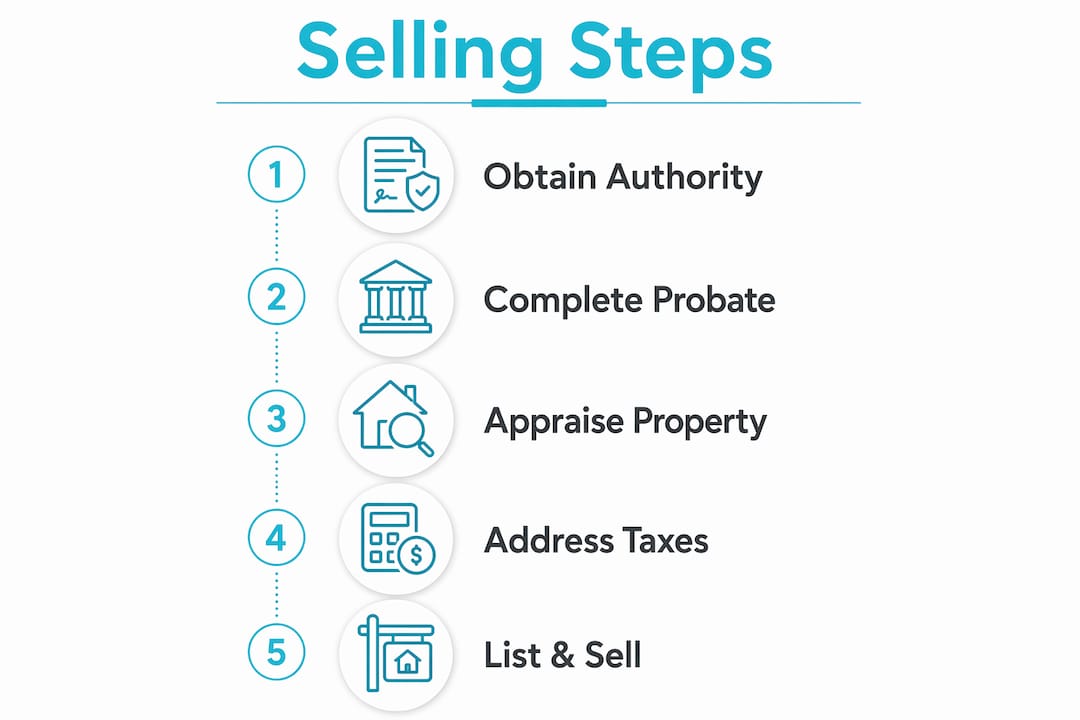
- Secure legal authority. Obtain your Letters Testamentary or Letters of Administration from the probate court before contacting any real estate professional.
- Order a preliminary title report. Unresolved title problems can delay or derail closing even when buyers are ready. The report surfaces liens, unpaid mortgages, and ownership disputes early.
- Contact the mortgage lender. If the property carries a reverse mortgage, contact the lender immediately. Heirs often overlook early lender contact to clarify payoff amounts and deadlines, which is critical to avoid foreclosure.
- Get a date-of-death appraisal. Commission a licensed appraiser to establish the property's fair market value as of the date of death. This document anchors your stepped-up basis and your listing price.
- Clear the contents. Handle estate contents through an estate sale, donation, or removal service before listing. A vacant, clean home photographs better and attracts stronger offers.
- Choose your sale method. You have three options: list with a licensed real estate agent, sell the property yourself (FSBO), or sell to a cash buyer. Each has different timelines, costs, and complexity levels.
- Manage condition and repairs. Decide whether to invest in repairs to maximize sale price or sell as-is. Inherited homes that have been vacant often need deferred maintenance addressed before a traditional buyer's lender will approve financing.
- Notify and confirm with the court. Some states require court confirmation of the sale price before closing, particularly in supervised probate. Confirm your state's requirements with a probate attorney.
Pro Tip: If the property has been sitting vacant, review the tips for selling a vacant home before listing. Vacant properties attract vandalism, insurance complications, and buyer skepticism that active preparation can prevent.
Selling to a cash buyer is worth serious consideration when the estate needs to close quickly, the property needs significant repairs, or probate is creating pressure to liquidate. Cash buyers skip the financing contingency that kills roughly 10% of traditional sales at the last stage.
How do multiple heirs impact the sale of an inherited home?
When two or more people inherit the same property, every decision requires coordination. The legal requirements for selling an inherited home with multiple heirs are stricter than most families expect.
The core challenges include:
- Unanimous agreement: In most states, all co-heirs must consent to the sale before the executor can proceed. One heir who refuses can block the transaction entirely.
- Buyouts: If one heir wants to keep the property and others want to sell, a buyout is the cleanest solution. A neutral appraiser sets the fair market value, and the heir who wants to keep the home pays the others their proportional share.
- Mediation: When heirs disagree but want to avoid court, mediation through a neutral third party is faster and far less expensive than litigation. Mediation is less costly than litigation, and partition auction sales often yield below-market prices that hurt every heir.
- Partition action: If mediation fails, any heir can file a partition action lawsuit. A partition action can force a sale with proceeds divided according to the will or state law. Courts take this seriously, but the process is slow and legal fees reduce everyone's net proceeds.
- Appointing a representative: Heirs can agree to designate one person as the decision-maker for the sale, which simplifies communication with agents, attorneys, and buyers without requiring every heir to sign every document.
For families dealing with selling a house with multiple owners, the most practical advice is to establish written agreements early. Document who has authority to negotiate, what sale price triggers automatic approval, and how proceeds will be distributed. Verbal agreements between grieving family members dissolve under financial pressure.
Key takeaways
Selling an inherited home requires legal authority through probate or trust documents, a date-of-death appraisal for tax purposes, and coordinated agreement among all heirs before any sale can close.
| Point | Details |
|---|---|
| Legal authority comes first | Obtain Letters Testamentary or Letters of Administration before contacting any buyer or agent. |
| Stepped-up basis reduces taxes | Your capital gains are calculated from the date-of-death value, not the original purchase price. |
| Title report prevents surprises | Order a preliminary title report early to surface liens, mortgages, or ownership disputes. |
| Multiple heirs require written agreements | Document decision-making authority and distribution terms before negotiations begin. |
| Cash buyers accelerate the process | Selling as-is to a cash buyer eliminates repair costs, financing contingencies, and extended timelines. |
What I've learned from watching families sell inherited homes
I have seen heirs make the same expensive mistake repeatedly: they list the property before probate closes because they assume the process is nearly done. It is rarely nearly done. Probate courts operate on their own schedule, and a buyer who has been waiting 60 days will walk when they realize closing is still three months away.
The second most common mistake is skipping the date-of-death appraisal to save $400. That decision can cost tens of thousands of dollars in unnecessary capital gains tax if the IRS challenges your basis. The appraisal is not optional. It is the single document that protects your tax position.
What actually works is getting a probate attorney and a CPA involved in the first 30 days, before you make any decisions about listing or repairs. Most heirs treat legal and tax counsel as a final step. Treating it as the first step changes the entire experience. You stop reacting to problems and start managing a process.
The families I have seen navigate this most successfully are the ones who communicate in writing, agree on a decision-maker early, and resist the pressure to rush. Probate has a timeline. Fighting it costs money. Working within it, with the right professionals, produces the best outcome for every heir.
— Daniel
Sell your inherited home fast with Dan Buys Houses
Inherited a home in Northwest Indiana and want to skip the months of repairs, showings, and probate delays? Dan Buys Houses makes the process direct and straightforward.

Dan Buys Houses purchases homes in any condition for cash, with no agent commissions, no repair requirements, and no open houses. For heirs who need to close quickly or want to avoid the complexity of a traditional listing, the process is simple: request an offer, review the terms, and close on your schedule. Some sellers close in as little as five days. Get a cash offer today and find out what your inherited property is worth without any obligation. You can also review how the process works before you commit to anything.
FAQ
What does probate mean for selling an inherited home?
Probate is the court-supervised process that validates a will, appoints an executor, and confirms legal authority to sell. Most title companies require proof of this authority before processing any inherited property sale.
How long does selling an inherited home typically take?
The process of selling inherited property typically takes 9 to 18 months due to probate, though simple estates with trusts or transfer-on-death deeds can close in weeks. Selling to a cash buyer can significantly shorten the timeline once legal authority is confirmed.
Do I owe capital gains tax when I sell an inherited home?
You owe capital gains tax only on appreciation that occurred after you inherited the property, thanks to the stepped-up basis rule. If you sell quickly after inheriting, your taxable gain is often minimal or zero.
Can one heir block the sale of an inherited home?
Yes. In most states, all co-heirs must agree before an executor can complete a sale. If agreement fails, mediation or a court-ordered partition action are the two legal remedies available.
What happens to the mortgage on an inherited home?
The mortgage does not disappear at death. The executor must contact the lender to clarify the payoff amount and any deadlines, particularly if the property carries a reverse mortgage where foreclosure timelines are strict.