An Indiana tax sale does not take your house on the day of the auction. It sells a lien on your property, and you normally keep one year to buy it back. But the timeline is short, the redemption cost rises, and the buyer can eventually ask a court for the deed. If you are behind on property taxes, the strongest move is to act before the auction, either by paying or arranging payment, or by selling the house yourself so the taxes are paid from the proceeds. We buy houses in Northwest Indiana for cash, as-is, with no repairs and no closing costs for you, so a sale is often the quickest way to turn a tax problem into money in your pocket.
TL;DR
- A parcel can go to tax sale once taxes from the prior year's spring installment or earlier are delinquent and the amount owed is over $25.
- Indiana sells a lien at auction, not the house itself. You generally have one year after the sale to redeem.
- Redemption costs 110% of the minimum bid within six months and 115% after that, plus other costs and interest.
- You can stop the sale by paying in full or by signing a written payment arrangement with the county treasurer before the sale.
- Selling to a cash buyer before the auction pays off the taxes at closing and can leave you with the remaining equity.
Table of Contents
- How a property ends up on the tax sale list
- What actually happens at the sale
- The redemption period and what it costs
- What happens if you do not redeem
- How to stop an Indiana tax sale before the auction
- Why selling before the sale can leave you better off
- Presenting our offer
- Our perspective
- FAQ
- Sources
How a property ends up on the tax sale list
Indiana property taxes are billed in two installments, due May 10 and November 10. Miss them and penalties start. Grant County's treasurer explains that the penalty is 5% if you pay within 30 days of the due date and have no earlier delinquency, otherwise 10%, with an additional 10% penalty on remaining unpaid taxes after later installment due dates.
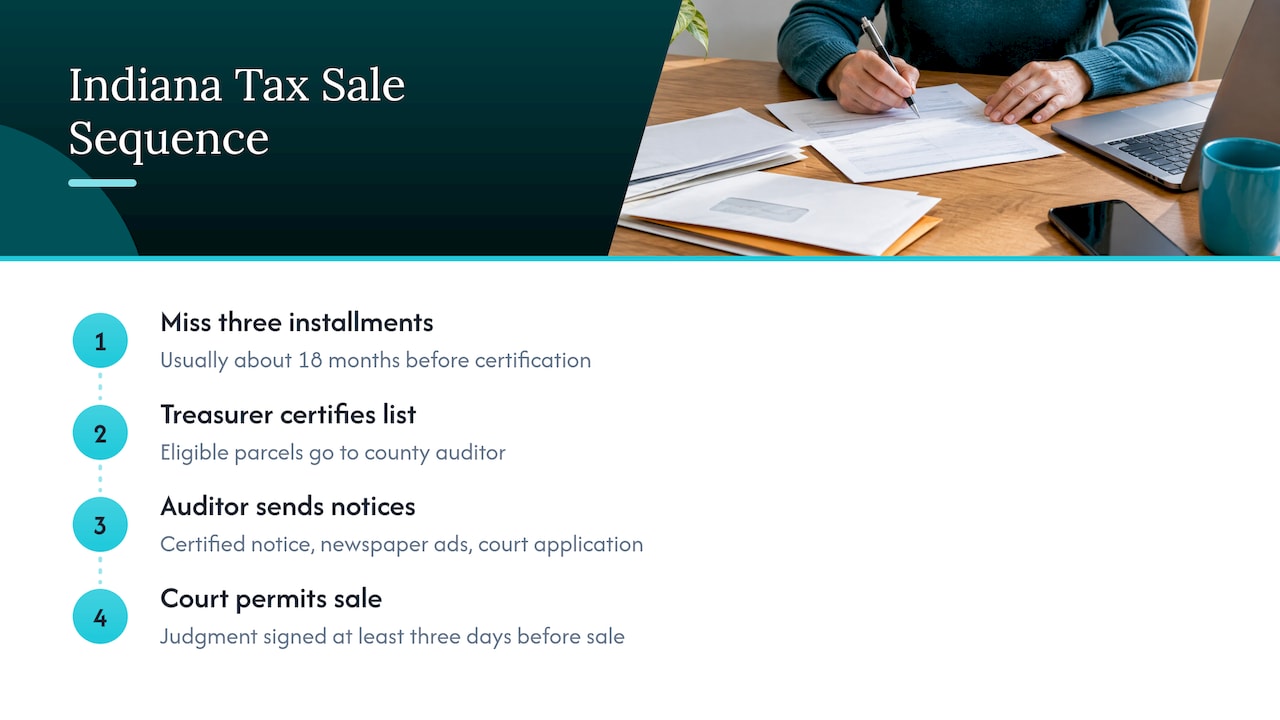
The legal trigger is in Indiana Code 6-1.1-24-1. A property becomes eligible for tax sale when taxes or special assessments from the prior year's spring installment or older are delinquent, and the delinquent taxes, penalties, fees or interest exceed $25. That is a low bar. The county treasurer then certifies the list of eligible parcels to the county auditor, no later than 51 days after the first tax payment due date.
In practice, the Indiana Office of Court Services describes the usual pattern as three missed installments, about a year and a half, before the treasurer certifies the list. The auditor then sends certified notice, publishes newspaper ads and files an Application for Judgment with the court. The judgment order permitting the sale must be signed at least three days before the sale.
What notices you should expect
The details differ by county. In Putnam County, the treasurer's tax sale page says the auditor mails a Tax Sale Notice by certified letter stating the tax, penalties and costs that must be paid to remove the property, and that payment is accepted until 4:00 p.m. the day before the sale. The same page notes that properties are advertised in local newspapers.
LaPorte County is on a similar calendar. Its treasurer's page says the annual sale is typically held in October, with notifications beginning in late July. A $220 tax sale administration fee is added once a property is scheduled, and if the amount is not paid by the mid-August deadline, the owner's name and property information are published in the local newspaper and on the county's tax sale vendor website. Check your own county treasurer's page for the current schedule, because dates and fees are set locally and can change.
A certified letter you did not open is still a notice. If you have been avoiding mail from the county, open it now and note the sale date and the payoff figure.
What actually happens at the sale
People often ask whether Indiana has tax deed sales. It does not work that way at the auction. According to a 2025 Indiana tax sale treatise, the treasurer sells the property subject to redemption to the highest bidder. The winner receives a certificate of sale, which creates a lien, not title. The minimum bid covers all delinquent taxes plus current-year taxes, penalties and costs.
That has practical meaning for you:
- You remain the owner, and you are entitled to possession. LaPorte County's guide for lien purchasers says the winning bid grants a lien with no property rights, and that a lienholder cannot enter the property against the owner's will without risking trespass liability.
- The lien buyer must pay later property taxes during the redemption period if they want to take the property to a tax deed.
- Nothing is final yet. The sale starts a clock.
Still, a lien sale puts a stranger's financial interest on your title, and every month of delay makes redemption more expensive and a clean sale harder.
The redemption period and what it costs
Delaware County's treasurer confirms the standard window: one year from the sale date. Indiana Code 6-1.1-25 shortens it to 120 days in certain cases, such as parcels that were not offered or did not sell, and property on the vacant-and-abandoned list has no redemption right.
To redeem you pay the county treasurer. The county sources and a legal guide to Indiana delinquent taxes list these pieces:
- 110% of the minimum bid if you redeem within six months of the sale, or 115% if you redeem after six months but within the year.
- 5% per year on any overbid the buyer paid.
- Post-sale taxes the buyer paid, with 5% per year interest.
- Certified attorney, notice and title search costs.
- Any new delinquencies since the sale.
The premium is a flat step, not daily interest. Redeeming on day 170 costs the same as on day 10, so the real jump comes at the six-month mark.
A worked example
Suppose the minimum bid on your house is $6,000 and nobody overbids. Redeeming in month four would cost $6,600 before the other items above. Redeeming in month eight would cost $6,900 before those items. This is an illustration to show how the steps work, not a quote. Your payoff figure comes from your county treasurer.
What happens if you do not redeem
If the year passes, the buyer can ask the court for a tax deed. The Office of Court Services guide says the buyer must send certified-mail notices within six months of the sale and file a verified petition after the redemption period ends, within three months. The treatise notes the court must find that the period expired, the property was not redeemed, all taxes and costs were paid and the notices were properly given before it orders the deed.
A tax deed removes the previous owner's interest and wipes out liens, including mortgages, according to Grant County's FAQ. That is why a lender usually pays attention to a tax sale, and why you do not want to arrive at this stage with a mortgage balance still attached.
If your property sells for more than the minimum bid, the overbid goes first to the taxes, penalties and costs, then to other delinquent taxes. The remainder sits in a surplus fund the former owner can claim if a deed issues, subject to county approval, according to taxlien.io's Indiana guide. It is real money, but it is a thin substitute for the equity you could have kept by selling on your own terms.
How to stop an Indiana tax sale before the auction
There are two statutory ways to take the parcel off the list, as Indiana Code 6-1.1-24-1.2 and the county pages describe:
- Pay everything owed before the sale. In Putnam County, for example, payment is accepted until 4:00 p.m. the day before.
- Sign a written arrangement with the treasurer. The auditor removes the parcel if you and the treasurer sign an arrangement requiring payment in full by the last business day before July 1 of the following year. A missed payment voids it and the parcel goes back on the list, though a later arrangement is possible.
Both need cash you may not have. A third route is to sell the house. Taxes are tied to the land, as Morgan County's treasurer explains, so any delinquency is settled out of the sale instead of passing quietly to a buyer. That makes the closing table the natural place to clear it.
For a deeper walk through the deadlines, see our guide for Indiana owners and bidders on stopping a tax sale.
Why selling before the sale can leave you better off
The tax bill is rarely the only problem. Homes that fall behind on taxes often also need repairs, have a mortgage in trouble, sit empty after an inheritance, or carry a tenant the owner is tired of managing. Listing with an agent in that situation means repairs, showings and a closing that may take longer than your sale date allows.
A direct cash sale fits the calendar better:
- No repairs or cleaning. We buy houses in as-is condition.
- Speed. Some sellers report closing in as little as five days, and closing dates are flexible if you need more time to move.
- No fees from you. We charge no commissions and cover closing costs.
- Taxes paid at closing. The delinquent amount comes out of the sale price, and you keep what remains.
This suits several situations. Facing foreclosure on top of back taxes, our foreclosure timeline shows how the two clocks overlap. Heirs who inherited a property with unpaid taxes can sell before the carrying costs grow. Relocating families can close on their own schedule, and landlords with a difficult tenant can sell the property with the problem included. You can read more about selling a house with back taxes in Indiana and selling a house with liens, which matters if a judgment or mortgage is also on the title. If you want a wider view of the owners we work with, this guide to the distressed homeowner is a helpful overview.
Before you contact anyone: gather these
- The most recent tax statement or the payoff figure from your county treasurer.
- Any certified-letter notice and the sale date on it.
- Your mortgage statement, if you have one.
- Names on the deed, and probate papers if you inherited the home.
If you are unsure whether a legal step is required, such as probate for an inherited property or what a court must check before a tax deed, talk to an Indiana attorney. Grant County's treasurer gives the same advice about the requirements the court reviews.
Presenting our offer
We buy houses, condos, duplexes, townhomes, mobile homes, commercial properties, apartment complexes and land across Northwest Indiana, in any condition, for cash. There are no fees or commissions for you, and we cover closing costs. Sell your house for cash with a short form, or read how our process works in Indiana first. We do not publish a price because every offer depends on the property.

If the auction date is close, say so in your first message. The calendar is the first thing we look at.
Our perspective
Most people reach us after the certified letter, not before it. The letter looks like the end, and it is not. Indiana gives owners time: the sale transfers a lien, and the redemption year is a real window. But every step on the calendar costs more than the one before it, and the equity you built is what pays for the delay.
We are a local buyer, not a hedge fund or a national investor. We buy as-is, so nobody asks you to fix the roof or clear the garage to get a number. We cover closing costs and charge no commission, so the offer is what you see. Where an owner needs more time to move out, we can set the closing date to fit.
If the taxes are small and you can pay them, pay them. If you cannot, and the house is a burden, selling to us before the auction is a clean way out, with the taxes settled at the table and the rest in your hands.
Daniel
FAQ
Does Indiana have tax deed sales?
Not at the auction. Indiana sells the property subject to redemption, and the winning bidder receives a lien certificate, not title. A deed comes only later, if the owner does not redeem and the buyer petitions the court within the statutory window.
How long do I have to redeem my house after an Indiana tax sale?
Usually one year from the sale date. It is 120 days in certain cases, such as parcels that did not sell, and there is no redemption right for property on the vacant-and-abandoned list. Pay the redemption amount to the county treasurer.
Can I sell my house if I owe back property taxes in Indiana?
Yes. The delinquent taxes are paid out of the proceeds at closing, because they attach to the land. A cash buyer can often close quickly enough to meet your deadline, and you keep whatever remains after the payoff and any other liens.
Can I stop the sale without paying everything at once?
Yes, in some cases. Under Indiana Code 6-1.1-24-1.2, you and the treasurer can sign a written arrangement to pay in full by the last business day before July 1 of the next year. Missing a payment voids it, so only sign if you can meet the schedule.
Sources
- Indiana Code, Title 6, Article 1.1, Chapter 24
- Indiana Code, Title 6, Article 1.1, Chapter 25
- Indiana Office of Court Services: Tax Sale Filings
- Putnam County Treasurer: Tax Sale Information
- LaPorte County: Real Estate Tax Sale
- LaPorte County: Facts for Lien Purchasers
- Grant County Treasurer: Frequently Asked Questions
- Delaware County: Redeeming property after a tax sale
- Morgan County: Recently Sold Property
- Indiana tax sale treatise, 2025
- Delinquent Property Taxes in Indiana, legal guide
- Indiana tax lien overview