
Landlords sell rental properties when the combined weight of financial pressure, regulatory burden, and daily management stress tips the investment equation against holding. The reasons landlords exit the rental market in 2026 are sharper than ever: mortgage refinancing costs have erased margins that once looked solid, the Renters' Rights Act has reshaped eviction rules, and a quarter of landlords may leave the market entirely. Whether you own one rental or ten, understanding why landlords divest real estate helps you recognize when your own numbers and stress levels are telling you something worth hearing.
Why landlords sell rental properties: the core drivers
No single trigger explains most sales. Industry commentary confirms that landlords respond to a stack of regulatory, financial, and management pressures hitting at the same time. That combination is what makes ownership feel structurally difficult rather than temporarily inconvenient. The three main categories are financial strain, compliance complexity, and operational fatigue. Each one alone is manageable. Together, they change the math.
What financial pressures drive landlords to sell?
Rising mortgage costs are the most direct financial reason landlords sell. Properties financed at historic lows now face refinancing at elevated rates that push monthly payments above rental income. When cash flow turns negative, the property stops being an asset and starts being a liability.

Tax changes compound the problem. Mortgage interest relief restrictions have reduced the net profit many landlords actually keep. Add in rising insurance premiums, void periods, and letting agent fees, and the yield that looked attractive three years ago can look thin or negative today.
Common financial red flags that signal it may be time to sell include:
- Negative monthly cash flow after mortgage, insurance, and maintenance
- Refinancing quotes that exceed current rental income
- Capital gains that are large enough to justify cashing out now
- Portfolio concentration where one property represents too much of your net worth
- Upcoming major repairs like a roof or boiler that will not be recovered through rent
Pro Tip: Before deciding to sell, run a 12-month cash flow projection using your actual refinancing rate, not your current rate. Many landlords discover the decision has already been made for them by the numbers.
The profitability erosion is not always dramatic. It often happens gradually as costs rise faster than rents. By the time a landlord notices the squeeze, they have already been subsidizing the property for months.
How do regulatory changes push landlords toward selling?
The 2026 Renters' Rights Act is the single biggest regulatory shift affecting landlord decisions right now. The abolition of no-fault evictions, known as Section 21, removes the most straightforward route landlords had to reclaim their properties. The Telegraph reports a 43% increase in Section 21 evictions filed before the abolition took effect. That surge reflects landlords acting while they still could.
The compliance picture has grown more demanding in four specific ways:
- Eviction routes are narrower. Without Section 21, landlords must prove a legal ground for possession, which takes longer and costs more in legal fees.
- Enforcement exposure is higher. Local councils now have stronger powers to investigate and fine landlords for property standards violations.
- Lease management is more complex. Periodic tenancies replace fixed terms in many cases, reducing landlord control over tenancy length.
- Administrative demands are ongoing. Compliance documentation, safety certificates, and deposit protection rules require consistent attention.
For landlords who manage properties themselves, this regulatory load is a real time cost. For those who use letting agents, it adds to fees. Either way, the margin for error has shrunk. Selling unwanted rental property before the next compliance deadline is a choice more landlords are making deliberately, not out of panic.
Why do management challenges lead to selling?
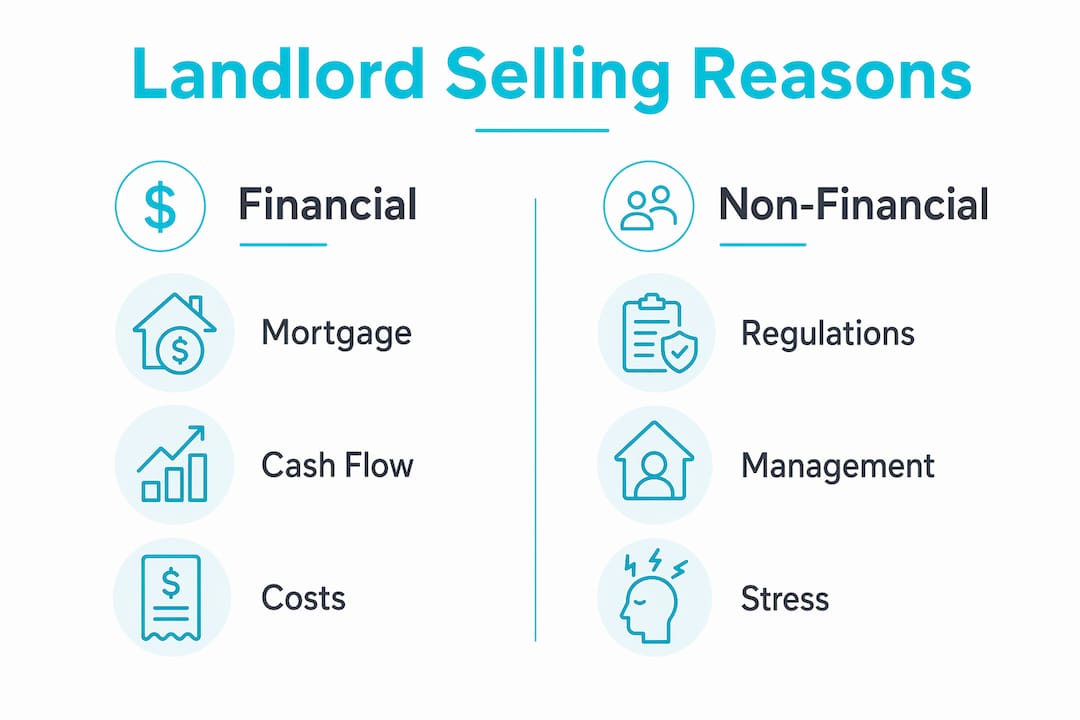
The Landlord Association identifies management frustrations, not single crises, as the most common trigger for sales. This is the cumulative effect: no one repair, no one difficult tenant, no one missed payment breaks a landlord. It is the accumulation of all of them over years that does it.
Here is how the two ownership experiences compare:
| Ownership Type | Typical Monthly Demands | Stress Level Over Time |
|---|---|---|
| Well-maintained, stable tenant | Minimal contact, routine checks | Low, manageable |
| Aging property, frequent turnover | Repairs, disputes, re-letting costs | High, compounding |
The second column in that table is where most landlords who sell actually live. The hidden cost is time and energy, not just money. A landlord spending six hours a month on tenant calls, contractor coordination, and paperwork is working a part-time job for a yield that may not justify it.
Portfolio simplification is a legitimate strategy, not a failure. Selling one difficult property to reduce workload and concentrate capital in better-performing assets is a sound decision. Many experienced landlords treat it as active portfolio management.
Pro Tip: Track your actual hours spent on each property for 90 days. Most landlords are surprised to find one property consumes 70% of their management time. That data makes the sell decision much clearer.
Professional property management can reduce this burden. Letting agent fees are tax-deductible and can prevent costly errors, which makes them worth considering before selling. But for many landlords, the decision to sell is also a decision to exit the management role entirely, and that has real lifestyle value.
What are the practical options for selling a tenanted property?
Selling with tenants in place and selling with vacant possession are two different transactions with different buyers, timelines, and price implications. Understanding both is critical before you list.
Tenant-in-situ sales typically complete in 8–14 weeks, while vacant possession sales can take 6–14 months. That timeline difference alone drives many landlords toward selling with tenants still living in the property.
Key considerations for each route:
- Selling with tenants in place attracts investors who want immediate rental income from completion. The buyer skips void periods and inherits a paying tenant, which is a genuine selling point.
- Selling for vacant possession appeals to owner-occupiers and commands a higher price in most markets, but requires the tenant to leave first, which takes time and legal process.
- Ground 1A notice is the legal mechanism for serving notice to sell with vacant possession under the new rules. Timing and pricing must be precise because a failed notice triggers re-letting restrictions that can lock you out of the market for months.
- Investor buyers often prefer tenanted properties because they generate income from day one and eliminate the risk of a void period after purchase.
The price difference between tenanted and vacant sales varies by market, but vacant possession typically achieves a higher figure. The trade-off is time. If you need to sell in the next three months, a tenanted sale is almost always the faster path. For guidance on selling an inherited or occupied home, the process shares several of the same considerations.
Simplifying the property selling process for landlords with tenants in place often comes down to choosing the right buyer type from the start, rather than listing broadly and hoping for the best.
Key takeaways
Landlords sell rental properties when financial pressure, regulatory complexity, and management fatigue combine to make holding the asset more costly than selling it.
| Point | Details |
|---|---|
| Financial pressure is the top trigger | Negative cash flow after refinancing is the clearest signal it is time to sell. |
| Regulation has raised the stakes | The 2026 Renters' Rights Act removed no-fault evictions, making possession harder and compliance more demanding. |
| Management fatigue is underestimated | Cumulative time and energy costs often outweigh rental income benefits before landlords recognize it. |
| Tenanted sales are faster | Selling with tenants in place typically completes in 8–14 weeks versus up to 14 months for vacant possession. |
| Preemptive selling preserves capital | Selling before the next major repair or compliance cost is a risk management strategy, not a last resort. |
The decision most landlords make too late
I have talked with a lot of landlords over the years, and the pattern I see most often is this: they wait. They absorb one bad year, then another, then a difficult tenant, then a boiler replacement, then a regulatory change. By the time they decide to sell, they have spent two or three years subsidizing a property that stopped making sense financially long before they acted.
The decision to sell is rarely about one thing. It is about recognizing that your time, your capital, and your peace of mind are all finite. A rental property that demands constant attention and delivers shrinking returns is not a passive investment. It is a second job you did not sign up for.
My honest advice is to do the math before the stress makes the decision for you. Run your actual numbers, including your real time cost, and compare them against what you would net from a sale. Most landlords who do this exercise find the answer is clearer than they expected. The market in 2026 rewards landlords who act with intention, not those who hold on out of habit.
— Daniel
Sell your rental property fast in northwest indiana
If you are a landlord in Northwest Indiana weighing whether to sell, Dan buys houses makes the process direct and free of the usual friction. There is no need to repair the property, stage it, or wait through a traditional listing cycle.

Dan buys houses purchases rental properties in any condition, including those with tenants in place, across Hobart, Hammond, Highland, Crown Point, and the surrounding area. You get a cash offer, a clear timeline, and no surprise fees. Some sellers close in as little as five days. If you want to understand exactly how the process works before committing to anything, the details are straightforward and worth reviewing. You can also sell your house fast without the back-and-forth of a traditional sale.
FAQ
What is the most common reason landlords sell rental properties?
Financial pressure is the leading driver, specifically negative cash flow after refinancing at higher mortgage rates. Regulatory changes like the 2026 Renters' Rights Act and ongoing management fatigue are close secondary factors.
How long does it take to sell a rental property with tenants in place?
Tenant-in-situ sales typically complete in 8–14 weeks, compared to 6–14 months for vacant possession sales. The faster timeline makes tenanted sales attractive when landlords need to exit quickly.
Do tenanted properties sell for less than vacant ones?
Tenanted properties generally sell at a slight discount compared to vacant possession sales. Investor buyers accept this trade-off because the property generates rental income from the day they complete the purchase.
Can a landlord sell a property without evicting the tenant first?
Yes. Selling with a tenant in place is a legal and common route. The buyer inherits the tenancy, and the sale proceeds without requiring the tenant to vacate. This approach attracts investor buyers rather than owner-occupiers.
Is selling a rental property a sign of financial failure?
Selling is often a deliberate portfolio decision, not a failure. Preemptive sales that protect capital before a major repair or compliance cost are recognized as sound risk management by experienced investors.