
Dynasty real estate is the strategic acquisition, management, and succession planning of property assets across multiple generations to preserve and grow family wealth. This approach combines active investment techniques, passive income vehicles, and legal inheritance structures into a single, compounding system. Investors who build dynasty portfolios treat real estate not as a transaction but as a permanent family asset class. In 2026, stabilized interest rates and tight inventory create both pressure and opportunity for those committed to this long-term model. Understanding how to invest in real estate through a dynasty lens separates short-term speculators from generational wealth builders.
What investment strategies compose a dynasty real estate portfolio?
A dynasty portfolio is built in layers, starting with active strategies that generate capital and graduating toward passive vehicles that compound it. This stacking method is the engine of real estate wealth building, and skipping steps is the most common reason portfolios stall.
The progression follows a clear path:
-
Wholesaling. The entry point for most investors. Wholesaling generates $5,000–$25,000 per deal without requiring ownership or renovation. It builds deal-finding skills and market knowledge that every later strategy depends on.
-
Fix-and-flip. The next layer. Flipping targets 15–25% returns over a 4–8 month cycle. Profits fund down payments on rental properties and build contractor relationships needed for BRRRR execution.
-
BRRRR (Buy, Rehab, Rent, Refinance, Repeat). The most powerful capital recycling tool in dynasty real estate. BRRRR lets investors scale portfolios without continuously raising fresh equity, demanding sophisticated execution but delivering compounding results.
-
Syndications and REITs. The passive tier. Syndications require $25,000–$100,000 minimum investments and target 12–20% internal rates of return. They free up time while capital works independently.
The stacking logic matters. Active strategies fund passive entry points. Passive vehicles then generate income that funds further active deals. The cycle accelerates portfolio growth without requiring constant fresh capital.
Pro Tip: Build your contractor network during fix-and-flip before you need it for BRRRR. Execution capacity, not capital, is the real bottleneck at scale.

Investors researching low-risk entry strategies in Northwest Indiana will find that starting with traditional rentals before advancing to BRRRR is the most reliable path for first-time dynasty builders.
How does luxury real estate factor into dynasty property investment strategies?
Luxury real estate serves as the preservation layer in a dynasty portfolio. While active strategies generate capital and passive vehicles compound it, luxury assets protect accumulated wealth from erosion over decades.
The luxury market in 2026 operates under chronic undersupply. That scarcity drives record transactions: a Monaco apartment sold for €471 million, with Monaco pricing exceeding €100,000 per square meter. New York City high-end units exceed $11,236 per square foot. These are not outliers. They reflect a structural floor beneath premium property values.
Key reasons dynasty investors include luxury assets:
- Value retention. Premium properties in supply-constrained markets hold value through economic downturns better than mid-tier assets.
- Diversification. Luxury real estate moves on different demand cycles than workforce housing, reducing portfolio correlation.
- Generational appeal. High-quality assets attract high-quality tenants and buyers, simplifying management across ownership transitions.
- Prestige and negotiating power. Owning recognized luxury assets improves access to private lending and institutional partnerships.
"Luxury market classification has evolved beyond a simple million-dollar benchmark, reflecting the diversification and segmentation of high-end real estate. Dynasty investors who treat luxury as a monolithic category miss the nuanced entry points available across its seven distinct tiers."
The practical takeaway is that luxury real estate is not just for billionaires. Entry-level luxury in secondary markets, such as premium lakefront properties in the Midwest, can anchor a dynasty portfolio at a fraction of coastal pricing.
What legal and financial structures support dynasty real estate asset transfer?
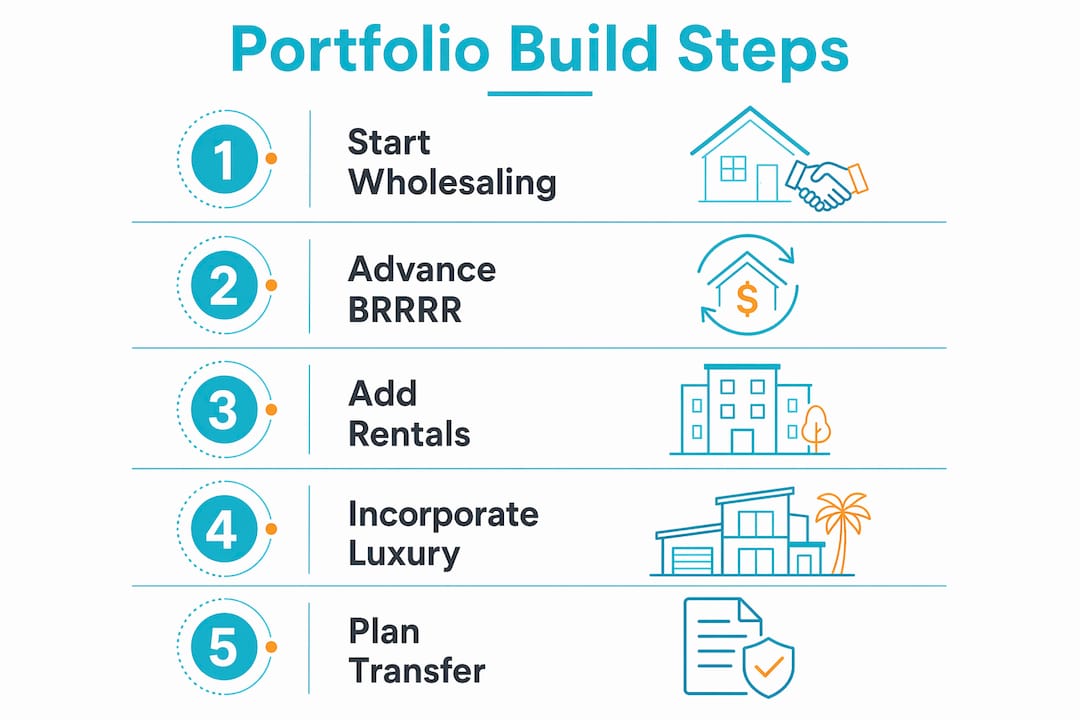
Legal structure is where most dynasty portfolios succeed or fail across generations. Without the right framework, a portfolio built over decades can be dismantled by probate courts, creditor claims, or estate taxes in a single settlement.
The core tools high-net-worth investors use:
- Limited liability companies (LLCs). Each property or property group sits inside its own LLC. LLCs prevent property-specific liabilities from threatening the entire portfolio. A lawsuit against one property cannot reach assets held in separate entities.
- Revocable and irrevocable trusts. Trusts transfer ownership outside of probate, keeping the transition private, fast, and legally clean. Irrevocable trusts also remove assets from the taxable estate.
- Cost segregation. This tax strategy accelerates depreciation on commercial and residential investment properties. Long-term holding with cost segregation can dramatically reduce annual tax liability and improve cash flow sustainability across the portfolio.
- Holding periods and 1031 exchanges. Deferring capital gains through 1031 exchanges allows investors to roll profits into larger assets without triggering a tax event, compounding portfolio value over time.
Pro Tip: Hold each property in a separate LLC owned by a parent holding company. This structure limits liability at the asset level while centralizing management and tax reporting at the top.
Holding dynasty properties in specialized legal entities not only protects against liabilities but enables targeted tax strategies that maximize after-tax wealth transfer to the next generation. The legal structure is not an afterthought. It is the architecture that makes the portfolio transferable.
What operational considerations and challenges impact dynasty real estate management?
Managing a dynasty portfolio across decades is operationally demanding. Property types, tenant classes, and market conditions all shift. The investors who sustain portfolios across generations are the ones who build systems, not just assets.
The central tension in dynasty property management is complexity versus cash flow. More properties mean more income, but also more management overhead, maintenance cycles, and tenant turnover. The solution most experienced investors arrive at is niche specialization.
Specialized rental niches such as student housing, corporate rentals, and mid-term furnished units reduce operational fatigue. Premium tenants stay longer, pay reliably, and require less active management than standard residential tenants. Investors who focus on alternative housing types in their local markets often find that niche properties outperform generic rentals on both cash flow and tenant quality.
| Management approach | Complexity | Cash flow stability | Tenant turnover |
|---|---|---|---|
| Standard residential rentals | Moderate | Moderate | High |
| Specialized niche rentals | Low to moderate | High | Low |
| Commercial properties | High | High | Very low |
| Syndication interests | Very low | Moderate to high | Not applicable |
The table shows a clear pattern. Specialization reduces complexity while improving income stability. For dynasty portfolios intended to survive ownership transitions, lower complexity is not a compromise. It is a design requirement.
Remote work migration in 2026 reshapes rental demand in ways that favor flexible, furnished, and mid-term rental formats. Dynasty investors who adapt their niche selection to this shift will outperform those locked into traditional annual lease models.
How to start building a dynasty real estate portfolio in 2026
Starting a dynasty portfolio requires an honest assessment of three variables: capital, time, and risk tolerance. The best strategy depends on aligning these three factors rather than chasing the highest theoretical return.
Follow this sequence:
-
Assess your starting position. Calculate liquid capital, monthly cash flow capacity, and hours available per week. A realistic baseline prevents overextension in the first 12 months.
-
Start with active income generation. Wholesaling or traditional rentals build market knowledge and capital simultaneously. New investors who skip this step and go straight to syndications miss the deal-reading skills that protect them later.
-
Apply the BRRRR method to recycle capital. Once you have one or two rentals generating income, use BRRRR to acquire additional properties without deploying fresh savings. Using equity effectively enables ongoing acquisition and supports long-term portfolio growth.
-
Layer in passive vehicles. After active strategies generate consistent cash flow, allocate a portion to syndications or REITs. This diversifies income sources and reduces dependence on active management.
-
Build the legal structure before you need it. Set up your LLC and trust framework before the portfolio grows complex. Retrofitting legal structures onto an existing portfolio is expensive and sometimes impossible without triggering tax events.
-
Commit to ongoing education. Market conditions in 2026 shift faster than in prior decades. Investors who study traits of successful real estate investors and adapt their approach consistently outperform those who rely on a fixed playbook.
The dynasty portfolio is not built in a year. It is built in a decade, then transferred across generations through the structures you put in place at the start.
Key Takeaways
Dynasty real estate succeeds when active capital generation, passive income vehicles, and legal inheritance structures work together as a single compounding system.
| Point | Details |
|---|---|
| Stack strategies in sequence | Start with wholesaling, advance to BRRRR, then layer in syndications as capital grows. |
| Luxury assets preserve wealth | Premium properties in supply-constrained markets hold value through economic cycles better than mid-tier assets. |
| Legal structure is non-negotiable | LLCs and trusts protect assets, avoid probate, and enable clean generational transfer. |
| Niche specialization reduces complexity | Focused rental categories lower management overhead and improve cash flow stability across ownership transitions. |
| Equity recycling drives scale | BRRRR and 1031 exchanges allow portfolio growth without continuous fresh capital deployment. |
What I've learned building dynasty portfolios over time
The biggest mistake I see investors make is treating dynasty real estate as a future goal rather than a present structure. They plan to set up the LLC "later." They plan to add the trust "when the portfolio is bigger." By the time they get there, the cost of restructuring is enormous and the window for certain tax strategies has closed.
The second lesson is that operational simplicity is underrated. Early in my experience, I chased complexity: multiple property types, multiple markets, multiple strategies running simultaneously. The portfolios that actually transferred cleanly across generations were the ones built around one or two well-executed niches with clear management systems. Complexity is the enemy of longevity.
I've also watched the luxury market shift in ways that surprised me. The idea that luxury real estate is only for coastal billionaires is outdated. Secondary markets with strong employment bases and limited new construction are producing luxury-tier returns at entry prices that mid-market investors can reach. The seven-tier classification of luxury real estate that Realtor.com now uses reflects this reality. Dynasty investors who ignore the lower tiers of luxury are leaving a significant wealth preservation tool on the table.
My prediction for the next five years: the investors who combine BRRRR execution with niche specialization and airtight legal structures will build portfolios that genuinely transfer to the next generation intact. The ones who chase yield without structure will hand their heirs a legal and tax problem instead of an asset.
— Daniel
How Dan buys houses supports your dynasty real estate goals
Building a dynasty portfolio sometimes means moving quickly on inherited properties, relocating assets, or converting underperforming holdings into capital you can redeploy.

Dan buys houses works with real estate investors and homeowners across Northwest Indiana who need to sell properties fast, in any condition, without repairs or open houses. The process is direct: you request a cash offer, Dan buys houses evaluates the property, and some sellers close in as little as five days. That speed matters when you are repositioning capital for your next acquisition. Get a cash offer today and find out what your property is worth without the delays of a traditional sale. If you want to understand the full process first, the buying process explained page walks through every step.
FAQ
What is dynasty real estate?
Dynasty real estate is a multigenerational property investment strategy that combines active income generation, passive ownership vehicles, and legal inheritance structures to build and transfer family wealth across generations.
What legal structures protect a dynasty real estate portfolio?
LLCs and trusts are the primary tools. LLCs isolate liability at the property level, while trusts transfer ownership outside of probate and can reduce estate tax exposure.
How does BRRRR support dynasty portfolio growth?
BRRRR allows investors to recycle equity from one property into the next acquisition, scaling the portfolio without continuously deploying fresh capital. It is the most capital-efficient method for building a large rental portfolio over time.
What role does luxury real estate play in a dynasty portfolio?
Luxury assets serve as the wealth preservation layer. Premium properties in supply-constrained markets hold value through economic downturns and diversify portfolio income away from standard residential cycles.
When should I set up an LLC for my real estate portfolio?
Set up the LLC before you acquire your first investment property. Retrofitting legal structures onto an existing portfolio triggers costs and potential tax events that are avoidable with early planning.