
You can usually sell a house that has liens, but every lien on it must be paid off, negotiated down, or formally released before a buyer can walk away with clean title. That's the whole game: liens don't kill a sale, they just add steps between your signature and the closing table. In the vast majority of cases, the title company or escrow agent pays the lienholder directly from your sale proceeds at closing, wipes the debt, and records the release. No drama, no lawyer, no delay.
Three things you should do today:
- Order a preliminary title report from a title company so you know exactly which liens are recorded against the property, for how much, and who holds them.
- Request payoff letters from every lienholder listed on that report, in writing, with a payoff-good-through date.
- Talk to a title or escrow agent about how the payoffs will be handled at closing, and if your equity is thin or your timeline is tight, get a cash offer from a company like Dan buys houses on the table as a backup plan.
Key Takeaways
Clearing a lien before closing isn't optional, but the method you choose should match your equity and your deadline, not a one-size-fits-all script.
| Point | Details |
|---|---|
| Liens don't block a sale | Escrow can pay most liens directly from proceeds at closing once payoff letters confirm the amounts. |
| Order the title report first | A preliminary title report ($75–$200) surfaces every lien weeks before a buyer's lender finds one. |
| Federal tax liens run on their own clock | File IRS Form 14135 at least 45 days before closing to request a Certificate of Discharge. |
| Match the fix to the lien type | Mortgages pay off routinely; tax, judgment, and mechanics liens often need negotiation or dispute review. |
| Cash sales skip lender delays | Dan buys houses purchases as-is in Northwest Indiana and can close in as little as five days when a lien timeline is tight. |
Table of Contents
- Types of Liens on a House Selling and What They Mean for You
- How Liens Affect Title Searches, Escrow, and Buyer Financing
- Which Path Clears a Lien Fastest: Payoff, Settlement, Short Sale, Dispute, or Cash Sale
- Step-by-Step Checklist for Selling a House With a Lien
- Federal Tax Liens: Discharge, Release, or Withdrawal
- What Happens at the Closing Table When Liens Are Involved
- What Resolving a Lien Actually Costs and How Long It Takes
- When a Cash Sale Beats Waiting Out a Lien
- The Real Priority When You're Selling With a Lien
- Get a Cash Offer From Dan Buys Houses in Northwest Indiana
- Sources
Types of Liens on a House Selling and What They Mean for You
Not every lien behaves the same way, and knowing which kind you're dealing with tells you how fast (and how cheaply) you can clear it. Liens split into two broad camps: voluntary and involuntary.
A voluntary lien is one you agreed to. Your mortgage is the obvious example, and a home equity line of credit is another. These are almost always the easiest to resolve because the lender already expects to be paid off when you sell. The payoff amount is known, the process is routine, and escrow handles it as a matter of course.
Involuntary liens are the ones that cause headaches, because someone else put them there without your cooperation. These include:
- Tax liens — federal (IRS) or state/local (unpaid property taxes), which usually take priority over almost everything else recorded after them.
- Judgment liens — filed by a creditor who sued you and won, often for unpaid debts or contractor disputes.
- Mechanics liens — filed by a contractor or supplier who worked on the house and wasn't paid in full.
- HOA liens — filed by a homeowners association over unpaid dues or assessments.
- Child support or alimony liens — filed by a state agency enforcing a family court order.
Seniority matters more than most sellers realize. Liens generally get paid in the order they were recorded, with a few exceptions like property tax liens that often jump to the front of the line regardless of recording date. A second mortgage or junior lien sits behind the first mortgage in that payoff order, which matters if your proceeds are tight.
Mortgage and HELOC balances are typically payable at closing without any negotiation. Tax and judgment liens often need more legwork. A recorded judgment might carry interest that's accrued for years, and a tax lien might require a formal government process before it can be removed from the title. When you pull the recorded document itself, check three things: the exact lienholder name, the dollar amount claimed, and the recording date. That date determines where the lien sits in the payoff line, and the amount claimed is sometimes outdated or wrong.
How Liens Affect Title Searches, Escrow, and Buyer Financing
A title search is what surfaces every recorded claim against your property, and running one before you list is the single best move you can make. Skip it, and you find out about a lien the same week your buyer's lender does, which is a far worse time to discover a problem.
Once escrow has your title report, the mechanics are straightforward:
- Escrow identifies every lienholder named in the report.
- Escrow requests a formal payoff letter from each one, specifying the exact amount owed as of a certain date.
- At closing, escrow pays each lienholder directly from your sale proceeds, in order of seniority.
- The lienholder files a release or satisfaction of lien with the county recorder, clearing the title.
Most residential lenders and every title insurer require clear title before they'll fund a purchase or issue a policy, which is why liens create so much anxiety for buyers. Industry guidance from the National Association of Realtors notes that liens complicate sales precisely because buyers' lenders and title insurers demand a clean title, and large tax or judgment liens routinely require special handling that a standard 30-day escrow period wasn't built for.
The failure modes worth watching for: a lien that got recorded after your title report was pulled (a late filing slips through), a clerical error where a lien attached to your address by mistake, or a contractor who filed a mechanics lien you never knew about because notice requirements vary by state.
Pro Tip: Pull your title report at least four to six weeks before you plan to list, not after you've accepted an offer. That window gives you time to dispute an error or track down a payoff letter without holding up a buyer who's already picked out curtains.
Which Path Clears a Lien Fastest: Payoff, Settlement, Short Sale, Dispute, or Cash Sale
The right resolution path depends mostly on two things: how much equity you have, and how much time you can spare. Here's how the five realistic options stack up.
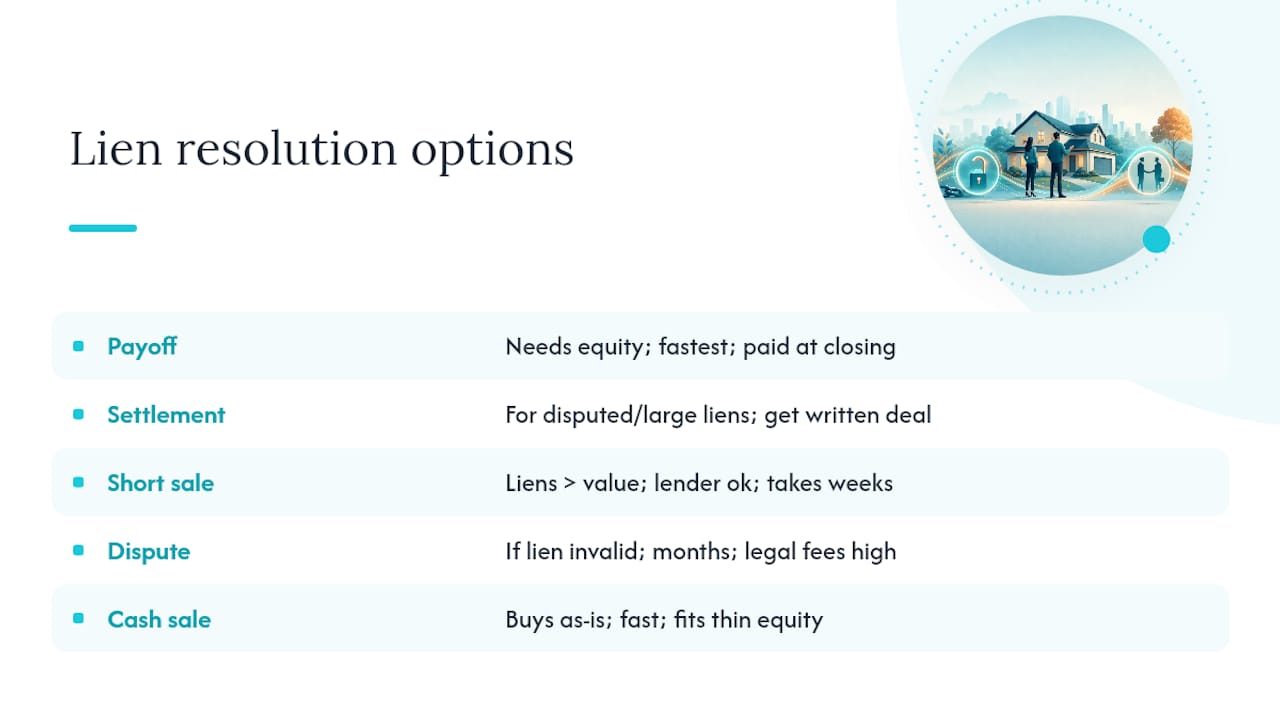
Payoff at closing is the default and the fastest route when you have enough equity. Escrow requests a payoff letter, confirms the exact balance, and cuts a check to the lienholder before you see a dime. This works for mortgages, HELOCs, and most judgment liens where the debt is smaller than your proceeds.
Negotiating a settlement makes sense when the lien amount is disputed or larger than what you can comfortably pay. Contact the creditor directly, explain you're selling, and ask if they'll accept a reduced payoff to close the account faster than pursuing collection. Get any agreement in writing before closing, because a verbal promise from a collections department means nothing to a title company.
Short sale becomes necessary when your total liens, including the mortgage, exceed what the house will sell for. Your lender has to approve the sale price and the payoff shortfall in advance, which means submitting financial hardship documentation and waiting on lender review, sometimes for weeks. The seller walks away without covering the gap in most cases, but a deficiency judgment is possible depending on your state and loan type, so this is a moment where talking to a real estate attorney pays for itself.
Disputing a lien or filing a quiet title action is worth considering only when you genuinely believe the lien is invalid, such as a mechanics lien filed after the statutory deadline or a judgment that's already been satisfied. This route can take months and legal fees add up fast, so it only makes sense when the disputed amount justifies the cost. Bankruptcy exemptions under 11 U.S.C. §522 can also affect which property interests survive a dispute, which is exactly the kind of nuance an attorney should weigh in on rather than a seller guessing.
Selling to a cash buyer sidesteps most of this entirely. A company that buys as-is doesn't need the property to carry a mortgage or meet lender conditions, which means the transaction isn't held hostage by a buyer's financing falling through when a lien surfaces mid escrow. This is often the practical choice when equity is thin, the timeline is short, or the lien situation is messy enough that a traditional buyer would walk.
Pro Tip: If you're juggling more than one lien type, tackle the negotiation on the involuntary ones (tax, judgment, mechanics) first. Voluntary liens like your mortgage are already priced in and won't surprise anyone at the closing table.
Step-by-Step Checklist for Selling a House With a Lien
Selling property with liens isn't complicated once you know the order of operations. Follow this sequence and you'll avoid the two things that kill most lien sales: surprises at closing and blown deadlines.
- Order a preliminary title report and county-records search the moment you decide to sell, not after you list.
- Request payoff letters from every lienholder identified in that report, each with a specific payoff-through date.
- If a federal tax lien is involved, submit IRS Form 14135 immediately, since the government's own review window can eat over a month.
- Decide your sale strategy: list traditionally if equity covers the liens, pursue a short sale if it doesn't, or contact a cash buyer if you need speed over top dollar.
- Gather supporting documents: proof of the original debt, any partial payments made, correspondence with lienholders, and your mortgage statement.
- Coordinate with your title or escrow agent to confirm final payoff amounts before closing and verify releases get recorded afterward.
| Step | What to Order or Request | Typical Timing |
|---|---|---|
| Title search | Preliminary title report from a title company | 3 days |
| Lien payoff letters | Written payoff letter from each lienholder | 1–2 weeks |
| Federal tax lien discharge | IRS Form 14135 application | 30–45+ days |
| Short sale approval (if needed) | Lender review of hardship package | 2 weeks |
| Closing and release recording | Title/escrow payoff and county recording | 1–4 weeks post closing |
Notice how the federal tax lien step sits apart from everything else. That's not an accident. The IRS runs on its own calendar, and it's the one part of this checklist that can force your hand toward a faster sale method if you can't wait it out.
Federal Tax Liens: Discharge, Release, or Withdrawal
A federal tax lien is its own animal, and the terminology matters. A release ends the lien entirely, usually because the debt was paid in full. A withdrawal removes the public notice of the lien even though the debt may still be owed. A discharge removes the lien from one specific piece of property, which is what most home sellers actually need, because you're not trying to erase the whole tax debt, just clear this one house.
The mechanism is Form 14135, the Application for Certificate of Discharge. File it as early as possible, because the IRS typically takes over a month to process the request, and that clock doesn't bend for a buyer who wants to close quickly.
If you have a signed purchase agreement and a federal tax lien on the property, submit Form 14135 the same week, not after your other paperwork is squared away. The IRS review window is the longest fixed delay in this entire process, and it's the one deadline you can't negotiate your way around.
When the IRS timeline simply doesn't fit your situation, whether you're facing foreclosure or a job relocation with a hard move date, your realistic alternatives are negotiating a reduced settlement directly with the IRS, pursuing a short sale if equity is negative, or selling to a cash buyer who can structure a closing date around the discharge timeline instead of a rigid mortgage contingency.
What Happens at the Closing Table When Liens Are Involved
Your title or escrow agent becomes the traffic cop once liens are in play. Expect them to request payoff letters, recorded copies of the lien documents themselves, and satisfaction or release forms from each lienholder before they'll schedule closing.
Payoffs happen in order of seniority, meaning the most senior lien (usually your first mortgage, unless a tax lien outranks it) gets paid before anything junior touches the proceeds. This affects your bottom line directly: if your liens add up close to your sale price, ask your agent for a written estimate of net proceeds before you sign anything.
On your settlement statement, check for:
- Every lien listed matches the payoff letter amount, not an estimate.
- Escrow fees and any per diem interest on the payoff are itemized separately.
- A line item confirming the lienholder will receive payment directly, not you.
After closing, the job isn't quite finished. Confirm with the county recorder's office that the lien release actually got filed. It typically shows up within a few weeks, but a full breakdown of escrow's closing-day responsibilities is worth reading if you want to understand exactly what your agent is doing behind the scenes.
What Resolving a Lien Actually Costs and How Long It Takes
Expect a preliminary title report to run $75 to $200, a small price for the peace of mind of knowing exactly what you're dealing with before a buyer's lender finds it for you. Attorney fees for negotiating a settlement or disputing a lien vary widely depending on complexity, and short sales carry their own processing costs tied to lender review.
On timing: a straightforward payoff-at-closing resolves in the normal weeks of an escrow period. A negotiated settlement can take weeks to a couple of months depending on how responsive the creditor is. An IRS discharge runs 30 to 60-plus days once Form 14135 is filed. A dispute or quiet title action can stretch into months, occasionally longer.
The most common delay isn't the lien itself, it's a seller who waits until after accepting an offer to start requesting payoff letters. Order the title report first. Everything else moves faster once you know what you're actually paying off.
When a Cash Sale Beats Waiting Out a Lien
For sellers facing foreclosure, an inherited property with liens attached, or simply not enough equity to cover what's owed, a direct cash sale often solves problems a traditional listing can't touch. Dan buys houses purchases properties in Northwest Indiana in as-is condition, which means you're not asked to make repairs, clean out a house, or wait through a buyer's mortgage underwriting while a lien sits on the title.

Because there's no lender in the middle demanding a spotless title before funding, the timeline compresses. Some sellers working with Dan buys houses close in as little as five days, which matters when an IRS discharge or a slow-moving creditor would otherwise blow past your deadline.
What to expect if you go this route:
- You'll be asked for the same basics: your mortgage statement, any lien documents you have, and property details.
- Dan buys houses coordinates directly with the title company to confirm payoff amounts and ensure liens get satisfied from the sale proceeds.
- There's no requirement to fix anything up first, list it, or negotiate with multiple buyers while a lien clock is ticking.
The Real Priority When You're Selling With a Lien
Most articles on this topic treat every lien type the same way, and that's the biggest miss in conventional advice. A mortgage payoff and a federal tax lien are not remotely comparable problems. One is routine paperwork escrow handles without you thinking twice. The other runs on a government calendar that doesn't care about your closing date, and treating it as an afterthought is how sellers end up scrambling in week three of a thirty-day escrow.
My take, based on how these deals actually play out: order the title report before you do anything else, including before you talk to a real estate agent. That single document tells you which category you're in, and the category determines whether you have six weeks of breathing room or a hard federal deadline bearing down on you.
Where I'd push back on the standard advice to "just list it and work it out at closing": that works fine for a clean mortgage payoff. It's reckless for a tax lien or a contested judgment, where the wrong assumption can cost you a buyer who walks the moment title comes back clouded. If your equity is thin or your timeline is tight, a cash sale isn't a fallback, it's often the more rational choice from day one.
— Daniel
Get a Cash Offer From Dan Buys Houses in Northwest Indiana
If you've read this far and realized your lien situation, equity, or timeline doesn't leave room for a traditional 30 to 45-day escrow, a direct cash sale is the fastest way to actual closing. Dan buys houses is the option for Northwest Indiana homeowners who can't afford to wait out an IRS discharge, a slow-paying creditor, or a buyer's mortgage underwriter, because there's no financing contingency standing between your lien and your closing check.

You bring the property as it sits, liens and all, and Dan buys houses works directly with the title company to confirm payoff amounts and settle them from proceeds. No repairs, no showings, no waiting on a buyer whose lender balks the moment title comes back with a recorded claim on it. If your house has a mortgage, a tax lien, a judgment, or all three, find out exactly how the buying process works and get a real cash offer on the table before you commit to a longer timeline you might not have.
Sources
- Understanding a federal tax lien — IRS
- 11 U.S.C. §522 — Law Cornell (Bankruptcy exemptions)
- Lien on property: What Real Estate Agents Should Know — NAR
- How to sell a house with a lien on it — LegalClarity