
Selling your home before foreclosure is the single most effective way to protect your credit, recover equity, and stop the auction before it happens. The formal term for this process is a pre-foreclosure sale, and it gives you legal control that most homeowners don't realize they still have. Legal ownership remains yours until the auctioneer's gavel falls, which means you have real options right now. Acting fast is the difference between walking away with cash in hand and losing everything to the bank.
What homeowners must know before selling a home in foreclosure
The first thing to confirm is your exact payoff balance. Call your lender today and ask for a written payoff statement. Late fees begin accruing just 10–15 days after a missed payment, which means your debt grows faster than most homeowners expect. Every week you wait adds costs that shrink the gap between what you owe and what your home is worth.
Your equity position determines which sale method is available to you. Equity is your home's current market value minus your mortgage balance and selling costs. Homeowners frequently overestimate equity by using their original purchase price instead of today's market value. Get a current comparative market analysis from a local real estate agent or a cash buyer before you make any decisions.

Understanding the foreclosure timeline in your state is equally critical. Indiana follows a judicial foreclosure process, which means the lender must file a lawsuit before the auction can occur. That process takes time, but it does not stop on its own. Acting by 60 days behind on payments gives you enough runway to list, negotiate, and close before the auction date.
Here is what to gather before you contact any buyer or agent:
- Written payoff statement from your lender
- Recent mortgage statements showing current balance
- Property tax records and any HOA balance
- A current estimate of your home's market value
- Documentation of any liens on the property
Pro Tip: Request your payoff statement in writing, not just verbally. Lenders update payoff figures daily, and you need a dated document to share with buyers and title companies.
How to choose the fastest selling method to avoid foreclosure sale
Three sale methods exist for homeowners in pre-foreclosure: traditional listings, cash sales, and short sales. Each one fits a different financial situation and timeline.
| Sale Method | Typical Timeline | Best For | Key Requirement |
|---|---|---|---|
| Traditional listing | 30–60 days | Owners with equity and time | Active market, agent, repairs possible |
| Cash buyer sale | 7–14 days | Owners with little time | Any condition, no repairs needed |
| Short sale | 3–6 months | Owners underwater on mortgage | Lender approval required |
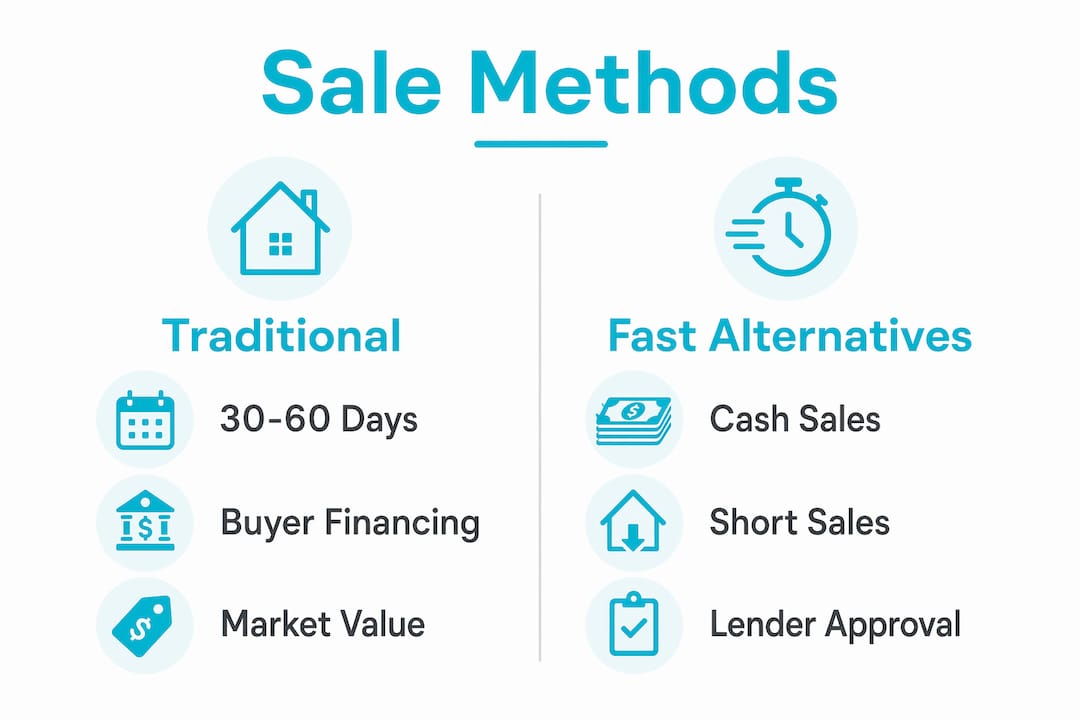
Traditional sales take 30–60 days because buyers need financing approvals, inspections, and appraisals. That timeline is risky when your auction date is weeks away. A financing contingency can collapse the deal at the last moment, leaving you with no time to recover.
Cash sales close in 7–14 days because cash buyers skip financing, inspections, and appraisals entirely. That speed is the defining advantage when you are 90 days behind on payments and the auction clock is running. Cash buyers also purchase homes as-is, so you do not need to repair a leaking roof or repaint before closing.
A short sale is the right path only when you owe more than your home is worth. Lender approval is required for the lender to accept less than the full mortgage balance. Short sales involve federal loss mitigation requirements, separate documentation timelines, and lender review periods that can stretch months. They protect your credit better than foreclosure, but they are not fast. Use a short sale only when no other option covers your debt.
- Choose a cash sale if your auction is within 30–60 days
- Choose a traditional listing if you have 90 or more days and positive equity
- Choose a short sale only if you are underwater and your lender agrees to negotiate
Pro Tip: Contact a cash buyer and a real estate agent on the same day. Get both a cash offer and a market value estimate before deciding. The gap between the two numbers tells you exactly what speed is costing you.
Step-by-step: how to sell your house quickly before the auction
Speed and sequence matter here. Follow these steps in order.
-
Contact your lender immediately. Ask for the exact payoff balance, the current auction date, and the name of the foreclosure attorney handling your case. Write everything down with dates.
-
Get a current property valuation. A cash buyer like Dan buys houses can provide a no-cost evaluation within 24 hours. Compare that figure to your payoff balance to confirm your equity position.
-
Choose your sale method. If your auction is within 60 days, a cash sale is your most reliable path. If you have more time and clear equity, a traditional listing may recover more value.
-
List or accept an offer immediately. For traditional sales, price aggressively for speed. For cash sales, accept the offer and open escrow the same day.
-
Send proof of sale activity to your lender. Lenders will often pause the auction when shown a signed listing agreement or a credible purchase offer. This step is critical and most homeowners skip it. A simple letter from your agent or buyer with the offer attached can buy you the extra days you need.
-
Close the sale and pay off the mortgage. The title company handles the payoff directly from closing proceeds. Once the lender receives full payment, the foreclosure stops permanently.
The table below shows how timing affects your available options.
| Days Behind on Payments | Recommended Action | Realistic Sale Method |
|---|---|---|
| 30–60 days | Contact lender, get valuation | Traditional or cash |
| 60–90 days | Accept cash offer immediately | Cash buyer preferred |
| 90+ days or auction scheduled | Contact cash buyer today | Cash buyer only |
Common mistakes that kill your chances of selling before foreclosure
Waiting too long is the most damaging mistake homeowners make. Early action preserves equity and dignity; late action forces crisis decisions or results in total equity loss. Most homeowners who lose their homes to auction waited three to six months after the first missed payment before taking any action.
Ignoring lender communications is the second most common error. Lenders send notices with critical deadlines. Missing those deadlines can eliminate your right to cure the default or negotiate a sale timeline. Open every letter from your lender and respond in writing.
Overestimating your equity causes deals to collapse at closing. A homeowner who believes they have $40,000 in equity based on what they paid in 2019 may find the current market value and selling costs leave them $10,000 short. That gap kills the deal unless the lender agrees to a short sale.
"Most homeowners face foreclosure not because they had no options, but because they waited until the options ran out." This is the pattern that separates homeowners who walk away with cash from those who lose everything.
Attempting a traditional sale without confirming lender approval for a short sale is another trap. If you are underwater, a buyer's offer cannot close without lender sign-off. Starting a traditional listing process without that approval wastes weeks you do not have. Confirm your equity position and lender stance before signing any listing agreement.
Failing to send proof of sale activity to your lender is a preventable mistake. Many homeowners list their home and assume the lender will wait. Lenders do not automatically pause the auction. You must proactively send documentation showing active sale efforts. That single step has saved countless sales from falling apart at the last moment.
Key takeaways
Selling before foreclosure protects your credit, preserves your equity, and keeps you in control until the moment you close.
| Point | Details |
|---|---|
| Act within 60 days | Acting by 60 days behind on payments gives you enough time to list and close before auction. |
| Cash sales are fastest | Cash buyers close in 7–14 days, making them the best option when time is short. |
| Confirm equity first | Use current market value minus costs, not your original purchase price, to assess equity. |
| Send proof to your lender | A signed offer or listing agreement can pause the foreclosure auction and buy closing time. |
| Short sales require lender approval | If you owe more than your home is worth, lender sign-off is required before any sale can close. |
What I've learned from watching homeowners face this moment
I have seen this situation play out many times in Northwest Indiana. The homeowners who come out ahead share one trait: they called early. Not after the third notice. Not after the auction date was set. Early, when they still had choices.
The hardest part of this process is not the paperwork or the timeline. It is the emotional weight of admitting the situation is real. Denial is the true enemy here. Most homeowners facing foreclosure hesitate because acting feels like giving up. It is not. Selling on your terms is the opposite of giving up. It is the most financially sound decision you can make under pressure.
Cash offers get dismissed too quickly. Homeowners hear "cash offer" and assume it means a lowball number. Sometimes there is a gap between a cash offer and full market value. But that gap shrinks to nothing when you factor in agent commissions, repair costs, carrying costs during a 60-day listing, and the risk of a financing contingency killing the deal at the last moment. The net number is often closer than people expect.
Clear communication with your lender changes everything. Lenders are not eager to foreclose. Foreclosure is expensive and slow for them too. When you show up with a signed offer and a closing date, most lenders will work with you. The ones who do not are the exception, not the rule.
Selling before foreclosure is not a last resort. It is the smart first move when you know you cannot keep the home.
— Daniel
How Dan buys houses helps Northwest Indiana homeowners sell fast
Homeowners in Northwest Indiana facing foreclosure need a buyer who moves as fast as the situation demands.

Dan buys houses provides cash offers within 24 hours and closes in as little as five days, with no repairs, no open houses, and no financing contingencies to derail your timeline. The process is straightforward: you request an offer, receive a fair cash number, and choose your closing date. Dan buys houses purchases homes in any condition across Highland, Hobart, Hammond, and the surrounding Northwest Indiana area. If your auction date is approaching, there is no faster or simpler path to stopping it. Reach out today and get your offer before the window closes.
FAQ
Can I sell my home after receiving a foreclosure notice?
Yes. You retain legal ownership and the right to sell until the foreclosure auction is completed. A sale can close at any point before the gavel falls, as long as the proceeds cover your mortgage payoff or your lender approves a short sale.
How fast can I sell my house to stop foreclosure?
A cash buyer can close in 7–14 days, which is fast enough to stop most foreclosure auctions. Traditional sales take 30–60 days and carry more risk when your auction date is close.
What if I owe more than my home is worth?
A short sale is your primary option. Lender approval is required for the lender to accept less than the full balance owed. Contact your lender immediately to begin the loss mitigation process alongside your sale efforts.
Will selling before foreclosure protect my credit?
Yes. A pre-foreclosure sale records far better on your credit report than a completed foreclosure. Your credit recovers faster, and you avoid the multi-year impact that a foreclosure judgment leaves on your record.
How do I pause the foreclosure auction while I sell?
Send your lender a signed listing agreement or a written purchase offer as soon as you have one. Lenders will often postpone the auction when shown credible proof that a sale is actively in progress. Do not assume the lender will wait without documentation.