
Yes, cash sales still come with closing costs. Skipping a mortgage eliminates lender fees, but title, escrow, recording, and tax charges don't disappear. For most cash transactions, total closing costs run about 1% to 3% of the purchase price, which means a $300,000 cash purchase typically lands somewhere between $3,000 and $9,000 once title insurance, transfer taxes, and escrow fees are added up.
TL;DR:
- Closing costs for cash transactions typically range from 1% to 3% of the purchase price, with $300,000 purchases usually costing between $3,000 and $9,000.
- Transfer taxes and attorney fees vary significantly by state and county, which can cause costs to fluctuate from minimal to thousands of dollars on similar deals.
- Title insurance premiums generally account for about 0.5% to 1% of the purchase price, and skipping it exposes the buyer to potential legal risks without coverage.
- Buyers should verify all settlement statement line items in advance, especially transfer taxes, prorated taxes, and fees, to avoid surprises at closing.
- Speeding up closing can incur rush fees for title searches and wire transfers, which may add several hundred dollars extra beyond standard costs.
Table of Contents
- What Do Closing Costs Look Like on a Cash Sale?
- What Fees Actually Show Up on the Settlement Statement?
- Who Pays What, and What Can You Negotiate?
- How Do You Calculate Your Own Closing Costs?
- How Dan Buys Houses Handles Closing Costs and Timing
- What Extra Fees Should Cash Buyers Watch For?
- What Mistakes Trip Up Cash Buyers and Sellers?
- How Do You Review the Closing Disclosure on a Cash Deal?
- Editorial Take: What Actually Matters When Budgeting for a Cash Closing
- Want a Cash Sale Without Owner-Paid Closing Costs?
- Where to Verify These Figures Yourself
- Sources
- FAQ
What Do Closing Costs Look Like on a Cash Sale?
Cash buyers pay less at closing than financed buyers because there's no loan to underwrite. No origination fee, no appraisal the lender requires, no mortgage insurance, no points. That's why the 1% to 3% guideline for cash deals runs noticeably lower than the 2% to 5% range typical of financed purchases, according to consumer guidance from the Consumer Financial Protection Bureau.
Here's what that looks like in real dollars at three common price points:
- For a $200,000 sale, closing costs generally range from about 1% to 3% of the price.
- For a $400,000 sale, closing costs often fall within a similar percentage range, scaling with price.
- For a $800,000 sale, the closing costs scale accordingly, remaining within the general percentage range.
Those ranges hold up in most markets, but a handful of variables push the final number higher. State and county transfer taxes are the biggest wildcard. Some states charge a flat recording fee of a few hundred dollars, while others levy a transfer tax calculated as a percentage of sale price that can add thousands to a six-figure deal. Forbes' state-by-state closing-cost comparison shows this variance clearly. A property in a state with no transfer tax and a property in a state charging even 1% of sale price in transfer tax can differ by thousands of dollars in total closing costs, even at identical purchase prices.
Attorney-state requirements matter too. A dozen or so states require an attorney to handle real estate closings, and that attorney's fee gets added to the settlement statement regardless of financing method. Title complexity is the third factor. A property with a clean, unbroken chain of title closes cheaper than one with a lien to clear, a probate transfer, or a boundary dispute that requires extra title work or a survey.
Indiana closings, including Northwest Indiana markets where cash sales are common for inherited or distressed properties, tend to land toward the lower end of the national range. Indiana doesn't charge a state-level real estate transfer tax, which keeps costs more predictable than in states like Illinois or New York, where transfer taxes can add a meaningful percentage to the total.
The takeaway for budgeting purposes: use 2% as your working estimate for a typical cash deal, then adjust up if you're in a state with a transfer tax or an attorney-required closing, and adjust down if the title is clean and the state has no transfer tax. That single adjustment gets you within a few hundred dollars of the real number more often than not.
What Fees Actually Show Up on the Settlement Statement?
A cash closing still generates a full settlement statement, usually an ALTA Settlement Statement rather than the TRID disclosure used in financed deals. Every line item on it falls into one of seven categories.
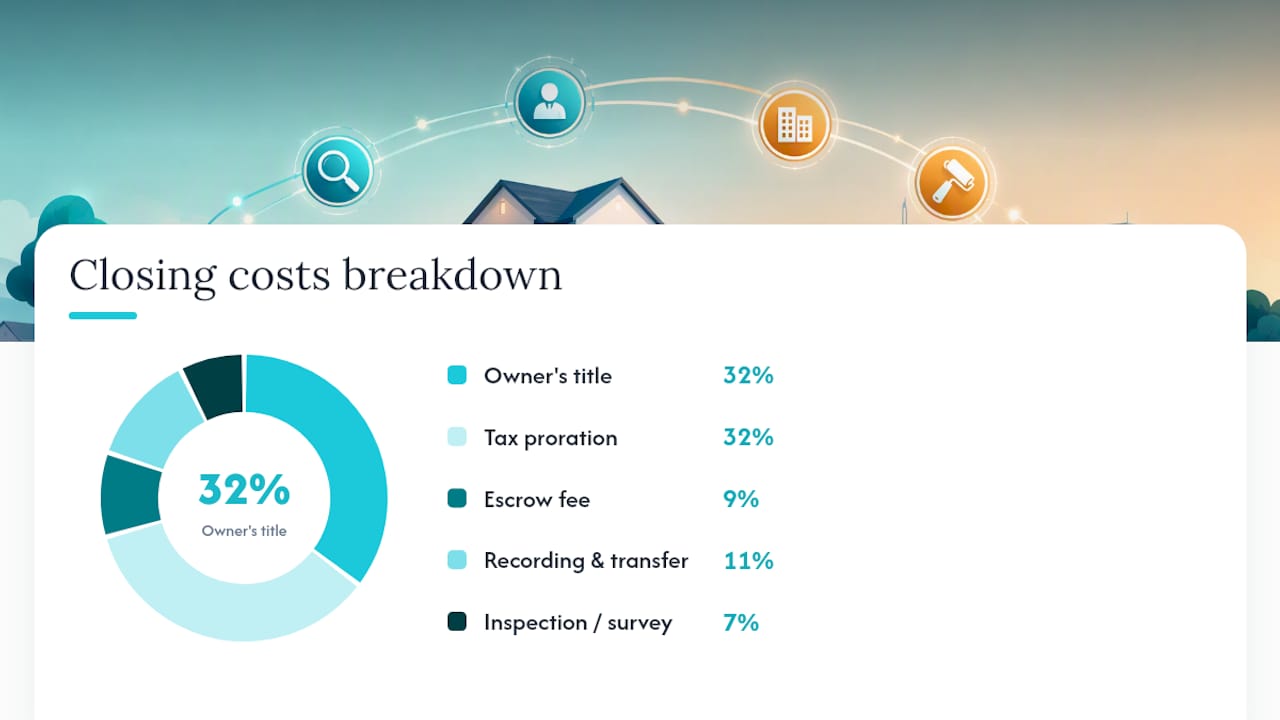
Title search and owner's title insurance. The title company searches public records to confirm the seller actually owns the property free of undisclosed liens, then issues a policy protecting the buyer against title defects that surface later. Premiums for owner's title insurance typically run 0.5% to 1% of the purchase price in many markets, though rates vary by state and some states regulate them directly. Sellers customarily pay for the owner's policy in many markets, but that's a convention, not a rule; check your local contract norms before assuming.
Escrow and settlement agent fees. The title company or attorney handling the closing charges a fee for managing funds, preparing documents, and coordinating signatures. These typically range from $300 to $1,000 depending on transaction complexity and region, and are often split evenly between buyer and seller, though a cash buyer with leverage can sometimes negotiate a different split.
Transfer taxes and documentary stamps. This is where geography does the most damage or the most good. Some counties charge a flat fee per page recorded; others charge a percentage of sale price. State-by-state data shows transfer tax alone can range from zero to more than 2% of purchase price depending on where the property sits.
Recording, courier, and notary fees. Small individually, usually $50 to $200 combined, but they add up and always appear on the statement. The county recorder charges to file the new deed; someone has to notarize signatures; documents often need to be couriered or wired between parties.
Inspection, survey, and optional appraisal costs. A cash buyer isn't required to inspect, but skipping it is a mistake worth avoiding. A general home inspection runs $300 to $600 in most markets; a boundary survey, if the title company requires one, adds another few hundred dollars. Appraisals aren't lender-mandated for cash deals, but some buyers order one any way to confirm they're not overpaying.
Attorney fees. Required in attorney-closing states, optional but common elsewhere for buyers who want legal review of the contract. Fees range widely, from $500 flat to hourly rates that can exceed $1,500 for a complicated transaction.
Prorated property taxes and HOA dues. These aren't fees so much as adjustments. If the seller has already paid property taxes for the year, the buyer reimburses the seller for the portion covering the time they'll own the home, calculated day by day from the closing date. HOA dues get prorated the same way.
| Line item | Typical range | Who usually pays |
|---|---|---|
| Owner's title insurance | 0.5%–1% of price | Seller (varies by market) |
| Escrow/settlement fee | $300–$1,000 | Split |
| Transfer tax | $0–2%+ of price | Varies by state/county |
| Recording/notary | $50–$200 | Buyer |
| Inspection | $300–$600 | Buyer |
| Attorney fee (where required) | $500–$1,500+ | Buyer or split |
Pro Tip: Even though a lender won't force you to buy an owner's title policy on a cash deal, skip it and you're the one absorbing the full cost of any title defect that surfaces years later. A $1,500 premium is cheap insurance against a five-figure legal mess.
Who Pays What, and What Can You Negotiate?
There's no federal rule assigning specific closing costs to buyer or seller. What you'll see as "standard" varies by state, and even within a state, it varies by county custom and what's written into the purchase contract. Treat every convention below as a starting point for negotiation, not a fixed obligation.
In most markets, sellers customarily cover the owner's title insurance policy, real estate commission if an agent is involved, and prorated property taxes up to the closing date. Buyers customarily cover recording fees, their own attorney if they hire one, and inspection or survey costs they request. Escrow fees usually split down the middle.
Cash changes the negotiating dynamic more than most sellers realize. A cash offer removes financing risk entirely, which means no appraisal contingency, no loan approval that can fall through, and often a faster closing timeline. That certainty is worth something to a motivated seller, and buyers routinely use it as leverage to ask the seller to cover part or all of the escrow fee, absorb the transfer tax, or credit a repair allowance instead of a price cut.
The reverse happens too. A seller who wants a truly hands-off deal may ask the cash buyer to cover costs the seller would normally pay, in exchange for a lower sale price or a faster close. Neither direction is wrong; it's a negotiation, not a script.
Here's a practical checklist before you sign anything:
- Get the estimated settlement statement in writing at least a few days before closing, not the morning of.
- Confirm which party pays the owner's title policy. Don't assume; ask directly.
- Check the transfer tax line against your county recorder's published rate.
- Verify prorated tax and HOA figures against the actual due dates, not estimates.
- Flag any "processing" or "administrative" fees you don't recognize and ask the title company to explain them in plain terms.
Pro Tip: If a settlement statement shows a fee you can't identify by name, ask the title company to explain it before you sign, not after. "Miscellaneous" and "processing" fees are where padding tends to hide.
How Do You Calculate Your Own Closing Costs?
You can estimate your total closing costs with reasonable accuracy using five inputs, all of which are easy to pull together before you ever sit down at the closing table — and even use free mortgage calculators and tools to help with your figures.
What you need:
- A title insurance quote from a local title company (call two or three; rates vary)
- Your county recorder's current transfer tax and recording fee schedule
- An escrow fee estimate from the settlement agent handling the deal
- Your most recent property tax bill and the closing date, for prorating
- An HOA statement if applicable, showing dues and their due date
The calculation, step by step:
- Get the title insurance premium quote (usually 0.5% to 1% of price).
- Add the escrow/settlement fee (flat rate, typically $300 to $1,000).
- Add recording and transfer tax fees pulled from your county's published schedule.
- Add inspection and survey costs if you're ordering them.
- Calculate the property tax proration: (annual tax bill ÷ 365) × days of ownership remaining in the tax year.
- Add attorney fees if your state requires one or you're hiring one voluntarily.
- Sum everything, then add a 10% buffer for anything you missed.
Worked example for a $400,000 cash purchase:
- Owner's title insurance (0.6%): $2,400
- Escrow/settlement fee: $650
- Recording and transfer fees: $850
- Inspection and survey: $500
- Property tax proration (6 months remaining, $4,800 annual bill): $2,400
- Buffer (10%): $680
Total: roughly $7,480, or about 1.87% of the purchase price, squarely inside the 1% to 3% range most cash deals fall into.
Title companies occasionally discover a lien that needs a short payoff processed, or a county updates its recording fee mid-year. Building in that cushion means a surprise $400 charge doesn't derail your budget the week of closing.
How Dan Buys Houses Handles Closing Costs and Timing
Speed changes how closing costs get handled, and that's the part most articles on this topic skip. Offers are typically extended within a few days of seeing a property, and some sellers close quickly after acceptance. That compressed timeline means prorations, title work, and payoff figures all have to be nailed down fast, not stretched over the 30 to 45 days a financed deal usually takes.
In practice, this service commonly covers the costs a seller would otherwise absorb in a traditional listing: no repair costs, no cleaning, and no owner-paid closing costs on the offers extended. Sellers walk away without writing a check at the table, which matters most to people dealing with foreclosure deadlines, an inherited property nobody wants to manage, or a rental with tenant problems that need resolving quickly.
Before agreeing to any fast-cash offer, confirm these points in writing:
- Exact closing date and whether it's flexible if you need more time.
- Which specific closing costs, if any, you'll be responsible for.
- Whether the offer is contingent on anything (inspection, title clearance) that could delay closing.
- How prorated property taxes and any outstanding liens will be handled at settlement.
What Extra Fees Should Cash Buyers Watch For?
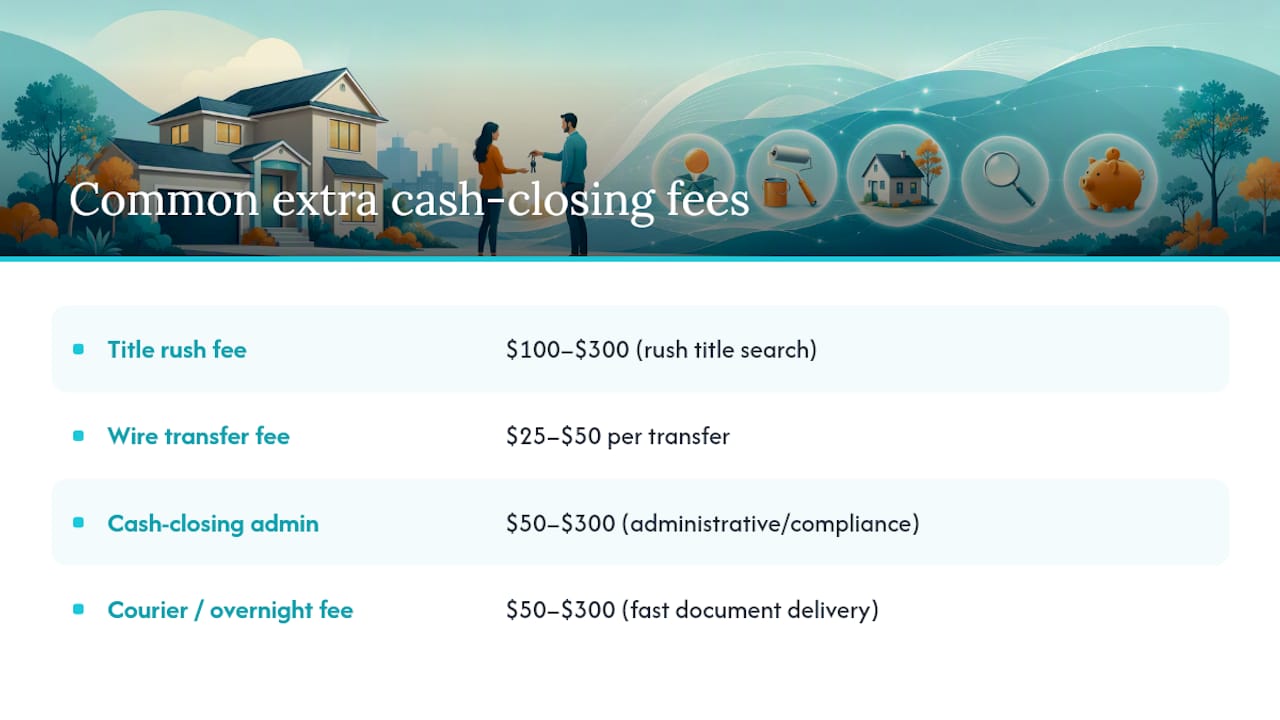
A handful of charges show up specifically because a deal is closing fast and outside the usual mortgage pipeline. Expedited title search fees are the most common. If you need a title company to turn around a search and commitment in days instead of the standard week or two, some charge a rush fee, often $100 to $300 on top of the standard search cost.
Wire transfer fees are another one buyers overlook. Moving six figures of cash through a bank wire typically costs $25 to $50 per transfer, and if funds move through multiple accounts before reaching escrow, that fee can hit more than once. Some title companies also add a "cash closing" administrative fee, distinct from the standard escrow fee, to cover the extra verification work involved in confirming the source of funds. This ties directly into IRS reporting rules: Form 8300 reporting requirements apply when a business receives more than $10,000 in cash in a single transaction, and title companies build compliance steps into their process accordingly.
Courier and overnight document fees run higher on compressed timelines too, since documents that would normally move by regular mail need same-day or overnight handling to meet a five-day or ten-day closing goal. None of these fees are large individually, usually $50 to $300 each, but stacked together on a fast-tracked cash deal, they can add a few hundred dollars beyond the baseline estimate. Ask your title company upfront whether any rush or administrative fees apply to your specific timeline.
What Mistakes Trip Up Cash Buyers and Sellers?
The single biggest mistake is assuming "cash" means "no closing costs." It doesn't, and buyers who skip budgeting for that 1% to 3% often get an unpleasant surprise at the table.
The second mistake is skipping owner's title insurance to save money. It's optional for cash buyers since there's no lender requiring it, but that's exactly the trap: skip it, and you're personally exposed to any title defect that surfaces after closing, with no policy to cover legal costs or losses.
Third, people forget to verify the transfer tax figure against their county's actual published rate instead of trusting a generic online estimate. Since transfer taxes vary enormously by state and county, a national average is nearly useless for budgeting your specific closing.
Fourth, sellers sometimes agree to cover costs verbally without getting it written into the purchase agreement, then discover at the settlement table that the buyer's side doesn't honor the informal agreement. Anything you negotiate needs to be in the contract, not a handshake.
Finally, both sides sometimes fail to review the settlement statement until they're sitting at the closing table with a pen in hand. That's too late to negotiate or question a fee. Request the statement at least two to three days ahead, read every line, and ask questions before the day you sign.
How Do You Review the Closing Disclosure on a Cash Deal?
Financed purchases get a TRID-mandated Closing Disclosure three business days before closing. Cash deals don't fall under that federal timing rule, but reputable title companies still provide a comparable document, usually the ALTA Settlement Statement, and many voluntarily follow a similar advance-notice practice out of good business sense.
Ask your title company or closing attorney directly: "When will I receive the settlement statement, and how many days before closing?" If they can't give you a specific date, push for one. You want it in hand at least two to three business days out, not the morning of signing.
When it arrives, check five things: the sale price matches your contract, the title insurance premium matches the quote you received, every prorated figure uses the correct closing date, no unexplained fee appears that wasn't disclosed earlier, and the final cash-to-close number matches what you budgeted using your own calculation. If any number doesn't match what you expected, call the title company before closing day, not during it.
Editorial Take: What Actually Matters When Budgeting for a Cash Closing
Most advice on this topic treats closing costs like a fixed toll everyone pays the same way. They're not. The 1% to 3% range is a useful starting point, but the real number depends on decisions you can influence: whether you shop title insurance quotes, whether you negotiate the escrow split, and whether you catch a padded fee before signing rather than after.
The conventional wisdom oversells the "cash means simple" narrative. Cash removes financing risk and lender fees, but it doesn't remove title work, transfer taxes, or the need to read a settlement statement line by line. If anything, cash deals move faster, which means less time to catch a problem before it's locked in.
What should you prioritize first? Get the settlement statement early and read it against your own estimate. That single habit catches more errors and unnecessary fees than any negotiating tactic.
— Daniel
Want a Cash Sale Without Owner-Paid Closing Costs?
If reading through every line item above made you want to skip the calculator entirely, that's the option Dan buys houses exists for. The company purchases homes in as-is condition without requiring repairs, cleaning, or owner-paid closing costs on the offers extended, which sidesteps most of what this article just walked through.

Sellers dealing with foreclosure deadlines, an inherited property, a difficult rental, or simply a home that needs more work than they want to take on typically get an offer within a few days and can close quickly when timing matters. There are no agent commissions to negotiate and no repair lists for sellers to address. If you want to see what a no-obligation cash offer looks like for your property, check out how the process works or request an offer directly to compare it against the traditional path.
Where to Verify These Figures Yourself
- HUD's homebuying guidance for process and settlement-statement basics.
- ALTA's title insurance resources for coverage details and premium ranges.
- Forbes' state-by-state closing-cost data to check your specific state.
Sources
- Are There Closing Costs if You Pay Cash for a House? Yes! - Redfin
- Buying a home - HUD
- IRS Publication 523 (Selling Your Home)
- Title insurance consumer resources | ALTA
- Home Closing Costs By State | Forbes
FAQ
Do Cash Sales Have Closing Costs?
Yes. Cash sales skip lender fees like origination charges and mortgage insurance, but title insurance, escrow fees, transfer taxes, and recording fees still apply, typically totaling 1% to 3% of the purchase price.
Does Dan Buys Houses Cover Closing Costs for Sellers?
Dan buys houses commonly covers the closing costs a seller would otherwise pay on the offers it extends across Northwest Indiana, along with skipping repair and cleaning requirements, though exact terms should always be confirmed in writing before closing.