
If you have one mortgage, no junior liens, and a lender willing to put a deficiency waiver in writing, a deed in lieu of foreclosure usually gets you out faster and with less damage. If your title has other liens, or you need more time before you have to leave, foreclosure often becomes the only realistic path. Check your county lien records and get any deficiency waiver in writing before you sign anything.
TL;DR:
- A deed in lieu usually closes faster and with less damage if there are no junior liens and a written deficiency waiver is obtained beforehand.
- Foreclosure provides more time to stay in the home, especially with nonjudicial sales, but involves a longer, more public process and less flexibility to negotiate deficiencies.
- Junior liens like second mortgages or HELOCs typically block a deed in lieu because the property would transfer subject to those liens, whereas foreclosure can wipe them out.
- The decision depends on lien situations, occupant rights, and how quickly you need to exit, with a title report revealing your leverage before proceeding.
- Both options impact credit similarly, but a deed in lieu can shorten the time before you qualify for another mortgage compared to foreclosure.
Table of Contents
- Deed in Lieu vs Foreclosure: Comparing Credit, Timeline, and Risk
- Weighing the Upside and Downside of Each Path
- When a Deed in Lieu Makes Sense (and When It Doesn't)
- What Actually Happens: Steps and Timing for Each Path
- Deficiency Judgments, Taxes, and Your Credit Report
- Other Ways Out: Short Sale, Modification, or a Fast Cash Sale
- A Local Practitioner's View on Fast Cash Sales vs Deed in Lieu
- What Homeowners Get Wrong About This Decision
- Sources
Deed in Lieu vs Foreclosure: Comparing Credit, Timeline, and Risk
A deed in lieu of foreclosure is a voluntary transfer of your property title to the lender to settle the mortgage without a foreclosure sale. Foreclosure is the lender's legal process to seize and sell the property after default, either through the courts (judicial) or outside them (nonjudicial), depending on your state.
Both dent your credit hard, and both can sit on your credit report for up to seven years. But the road to your next mortgage looks different. Conventional loan waiting periods after a deed in lieu tend to run shorter than after a completed foreclosure, though Fannie Mae's guidelines still require extenuating circumstances documentation to shrink either timeline.
The other big gap is time itself:
- A deed in lieu can close in a matter of weeks once the lender approves the package.
- A foreclosure, judicial or nonjudicial, can stretch from several months to well over a year depending on your state's court backlog and redemption rules.
- Deficiency risk is negotiable in a deed in lieu; you can ask for a written waiver before you sign away the title. In foreclosure, the lender pursues a deficiency judgment after the sale, often with less room to negotiate.
- Junior liens are the quiet dealbreaker. Lenders generally won't accept a deed in lieu when a second mortgage or HELOC sits behind the first, because taking the deed means taking the property subject to that lien. A nonjudicial foreclosure sale, by contrast, can wipe out junior liens entirely.
Weighing the Upside and Downside of Each Path
Deed in lieu of foreclosure:
- Faster resolution, often weeks instead of months, once the lender signs off.
- Handled privately between you and the servicer, without a public auction notice on your street.
- Some lenders attach relocation assistance to a standard deed-in-lieu program.
- The catch: junior liens usually block approval, and you're still exposed to a deficiency judgment unless you get a waiver in writing.
Foreclosure:
- Buys you more time in the home, sometimes many months, before you have to move.
- A nonjudicial trustee's sale can clear junior liens the lender would otherwise have to inherit.
- The downside is a longer, public process and typically a longer wait before you qualify for another mortgage.
- Occupancy can turn adversarial. Foreclosure often ends in an eviction notice rather than a negotiated move-out date, while a deed in lieu sometimes comes with cash-for-keys terms.
When a Deed in Lieu Makes Sense (and When It Doesn't)
Some situations point clearly toward one option. Here's how to read your own.
Signs a deed in lieu is worth pursuing:
- You have a single mortgage with no second lien or HELOC attached.
- Your lender is open to a written deficiency waiver before closing.
- You need a fast, clean exit more than you need extra time in the house.
Signs it won't work, or foreclosure fits better:
- You have junior liens, judgments, or a title defect the lender won't take on.
- Occupants in the home have tenancy rights that complicate a quick handoff.
- You need months of extra time, plan to contest lien priority, or are weighing bankruptcy as part of the decision.
Pro Tip: Before you call your servicer, pull a full title report yourself. Knowing exactly what liens sit on the property gives you leverage in the conversation and tells you in five minutes whether a deed in lieu is even on the table.
What Actually Happens: Steps and Timing for Each Path
A deed in lieu starts with a hardship letter and a financial package (pay stubs, bank statements, a budget) sent to your servicer. The lender orders a title search to check for junior liens, then drafts the deed. Once you sign and it's recorded at the county, the mortgage debt is typically satisfied. Many servicers require the home be listed for sale first, often for around 90 days, before they'll even consider a deed in lieu. Expect the whole process to run four to eight weeks once approved.
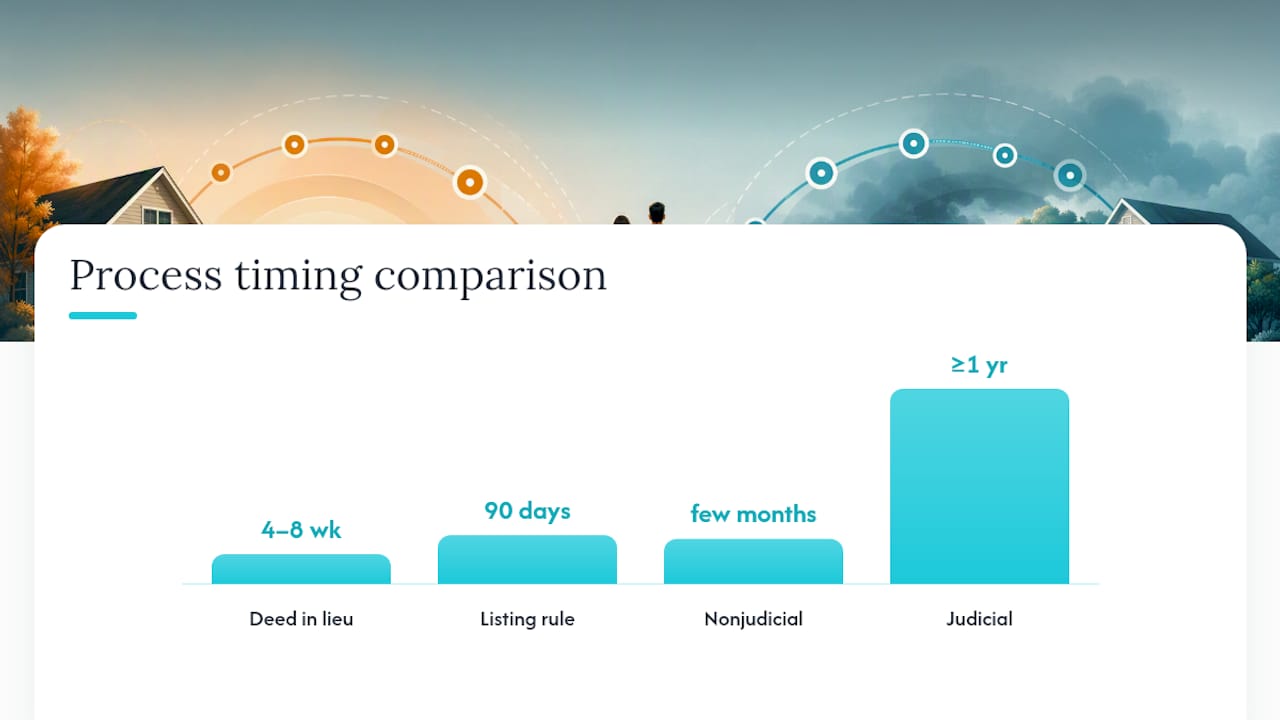
Foreclosure starts with a notice of default, followed by either a court filing (judicial states) or a recorded notice of trustee's sale (nonjudicial states). The property goes to auction if you don't cure the default, and some states allow a redemption period afterward. Judicial foreclosures commonly take a year or more; nonjudicial sales can close in a few months.
Whichever path you're on, request these in writing:
- A signed deficiency waiver, not a verbal promise.
- An estoppel affidavit confirming there's no side agreement affecting the deed.
- Updated payoff statements and a copy of the checklist of documents your servicer will ask you to produce.
Deficiency Judgments, Taxes, and Your Credit Report
Whether a lender can chase you for the gap between what you owe and what the property sells for depends on your loan type and your state's anti-deficiency law. Recourse loans generally allow that pursuit; some states bar it outright for certain purchase-money mortgages. This is exactly why a written waiver, negotiated before you hand over the deed, matters more than almost anything else in this process.
Forgiven mortgage debt can also count as taxable income. IRS Publication 4681 covers canceled debt, foreclosure, and abandonment, and an insolvency exclusion may apply depending on your finances. Talk to a tax professional before you assume the forgiven balance is free money.
By the numbers: FICO's research shows short sales, deeds in lieu, and foreclosures inflict broadly similar credit score damage. The gap between them isn't the hit itself, it's how long each option delays your next mortgage application.
Co-signers and guarantors aren't off the hook either. A deed in lieu or foreclosure releases you from the property, but a co-signer's obligation to the debt can remain unless the lender agrees otherwise in writing.
Other Ways Out: Short Sale, Modification, or a Fast Cash Sale
A short sale can outrank a deed in lieu when you have junior lienholders willing to release their claims for a partial payoff, something a deed in lieu usually can't accommodate. A loan modification keeps you in the home if your hardship is temporary. Bankruptcy can pause foreclosure entirely but comes with its own long-term credit consequences.
Before you decide, work through this checklist:
- Pull your loan documents and confirm your exact balance and loan type.
- Check your county recorder's office for any liens you may have forgotten.
- Contact a HUD-approved housing counselor for free, unbiased guidance.
- If speed matters more than maximizing sale price, research your options before your foreclosure sale date to see what's realistic in your timeframe.
A Local Practitioner's View on Fast Cash Sales vs Deed in Lieu
Watching Northwest Indiana homeowners face this decision, the pattern is consistent: those who act during the notice-of-default window keep more options than those who wait for a sale date. A cash sale to a direct buyer can move faster than a deed in lieu, skip repairs entirely, and let you apply the proceeds toward any deficiency balance before it becomes a judgment. This isn't a substitute for legal or tax advice. Talk to a HUD counselor or attorney first, and know that Dan buys houses serves Northwest Indiana, not every market. If a fast, as-is sale fits your timeline, see how the process works before your options narrow further.
What Homeowners Get Wrong About This Decision
Most articles on this topic treat credit score damage as the deciding factor. It isn't. The research points somewhere else entirely: junior liens and state deficiency law do more to determine your actual outcome than a 50 point difference in credit score ever will. A homeowner with a clean title and a cooperative lender is in a completely different negotiation than one carrying a second mortgage in a recourse state.
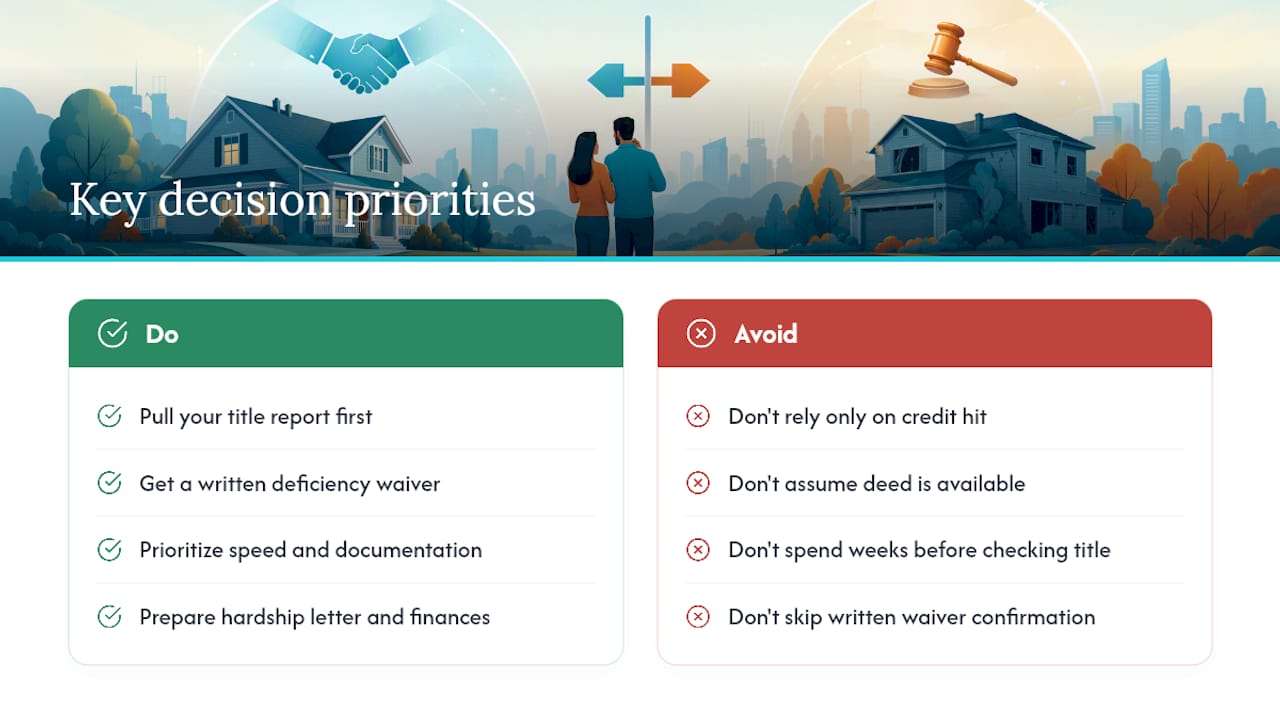
The conventional advice, "compare the credit hit," skips the step that matters most: figuring out whether a deed in lieu is even available to you before you spend weeks negotiating one. Pull your title report first. Get the deficiency waiver in writing second. Everything else, the hardship letter, the financial package, the paperwork, is mechanical once those two pieces are settled.
If you're deciding right now, prioritize speed and documentation over trying to game your credit score. A written waiver and a clean exit beat a marginally better FICO outcome nine times out of ten.
— Daniel
This article is general information, not a substitute for advice from a qualified financial advisor. Consult a qualified financial professional about your own circumstances before acting on anything here.
Sources
- What is a deed-in-lieu of foreclosure? — CFPB
- Deed in lieu vs foreclosure: key differences — LegalClarity
- Standard deed-in-lieu — Freddie Mac
- Short sales and deeds in lieu of foreclosure — Justia