
Should you renovate or sell your home as-is?
For most homeowners with a property that needs significant repairs, selling as-is is the smarter financial move. That is not a blanket rule, but it holds more often than people expect. Renovation projects frequently exceed budgets and timelines due to hidden problems and contractor delays, and carrying costs pile up fast. With mortgage rates still elevated, every extra month you hold a property while renovating eats directly into your net proceeds.
The counterargument is real: strategic repairs can boost your sale price. But major renovations rarely return 100% of their cost in the final sale price. Roofing, HVAC replacement, and foundation work are the worst offenders. Minor cosmetic fixes, on the other hand, can shift buyer perception without draining your budget.
Redfin market experts put it plainly: the right choice depends on your finances, timeline, and property condition. Sellers who need to move fast or lack renovation capital almost always come out ahead by listing as-is, especially when they use flat-fee MLS services or sell directly to a cash buyer.
Renovating vs. selling as-is: the core tradeoffs
- Renovate first: Higher potential sale price, but months of delays, cost overruns, and carrying costs that can wipe out the gain
- Sell as-is: Faster closing, predictable net proceeds, no contractor headaches, though offers typically run below comparable move-in-ready homes
- Strategic minimal repairs: The middle ground, targeting only high-ROI cosmetic fixes before listing
- Your priority matters most: Maximizing price favors renovating; limited time or capital favors as-is
Table of Contents
- How to sell a home that needs repairs efficiently
- Legal and paperwork essentials for as-is sales in the U.S.
- How much can renovations actually increase your home's value?
- Renovating vs. selling as-is: how the timelines compare
- How to find buyers who actually want a fixer-upper
- Financing options buyers use to purchase homes needing renovation
- Dan buys houses can close your sale in days, not months
- Key Takeaways
How to sell a home that needs repairs efficiently
Selling a fixer-upper does not have to mean leaving money on the table. The process just requires a different playbook than a standard listing.
- Get a pre-listing inspection. Knowing exactly what needs attention lets you price accurately and head off surprises during buyer due diligence.
- Price for your buyer pool. Renovation-minded buyers and investors are your audience. Price as-is homes at 15%–25% below comparable move-in-ready sales to generate competitive interest while reflecting typical market discounts for needed repairs.
- Clean and declutter aggressively. A deep clean and maintained lawn signal that the home was cared for, which attracts more buyers and shortens time on market, even without a single repair.
- Choose your listing method deliberately. A flat-fee MLS listing puts your home in front of retail buyers and investors simultaneously, creating competitive bidding that private cash offers cannot match. It also saves on the listing commission, typically above 5.7%.
- Disclose everything upfront. Transparency about known issues builds buyer confidence and protects you legally.
- Prepare for inspection contingencies. Most buyers request an inspection even on as-is contracts. Offer closing cost credits rather than repairs to keep the deal moving.
- Set realistic timeline expectations. A cash buyer can close in two to four weeks. A retail buyer using renovation financing typically takes six to fourteen weeks from listing to close.
Pro Tip: Highlight the home's potential in your listing photos and description. Buyers of fixer-uppers are buying a vision, not a finished product. Show the bones, the lot, the neighborhood.
Legal and paperwork essentials for as-is sales in the U.S.

Selling as-is does not mean selling without obligations. This is where many sellers get tripped up.
U.S. state laws require sellers to disclose known material defects even when the sale is explicitly as-is. Structural issues, environmental hazards, water intrusion, and failing systems all need to be documented in writing. Skipping this step is the fastest path to a post-closing lawsuit.
- Property condition disclosure statement: Required in most states; detail every known defect in writing
- Purchase and sale agreement: Must clearly state the as-is nature of the transaction
- Pre-listing inspection report: Sharing this proactively builds trust and reduces renegotiation risk
- Lead-based paint disclosure: Federally required for homes built before 1978
- Seller's net sheet: Helps you understand your actual proceeds after fees and credits
- Closing documents: Title transfer, deed, and any required local or state forms
For a detailed walkthrough of what paperwork you will need, the as-is home sale paperwork guide from NWI Buyers covers the full document checklist. When buyer inspections surface issues, respond with a closing cost credit rather than agreeing to repairs. It keeps the transaction on track and avoids the risk of repair work creating new problems right before closing.
How much can renovations actually increase your home's value?
The honest answer: it depends heavily on what you fix and where you live. Minor cosmetic updates, fresh paint, refinished floors, and updated fixtures tend to return more per dollar spent than major structural work. Kitchen and bathroom remodels can add value, but full gut renovations in a mid-range market rarely recoup their full cost.
A useful frame: if your home would sell for $300,000 after a $40,000 renovation, but an as-is buyer offers $270,000 today, the renovation nets you roughly $10,000 more before carrying costs and commissions. Factor in four to six months of mortgage, insurance, and taxes, and that gap often disappears entirely. The math only favors renovating when the value lift is substantial and the timeline is short.
For homes needing major structural work, roofing, or HVAC, the calculus almost never works in the seller's favor. Those repairs cost the most and add the least proportional value at resale.
Renovating vs. selling as-is: how the timelines compare
Time is money in real estate, and the gap between these two paths is significant.
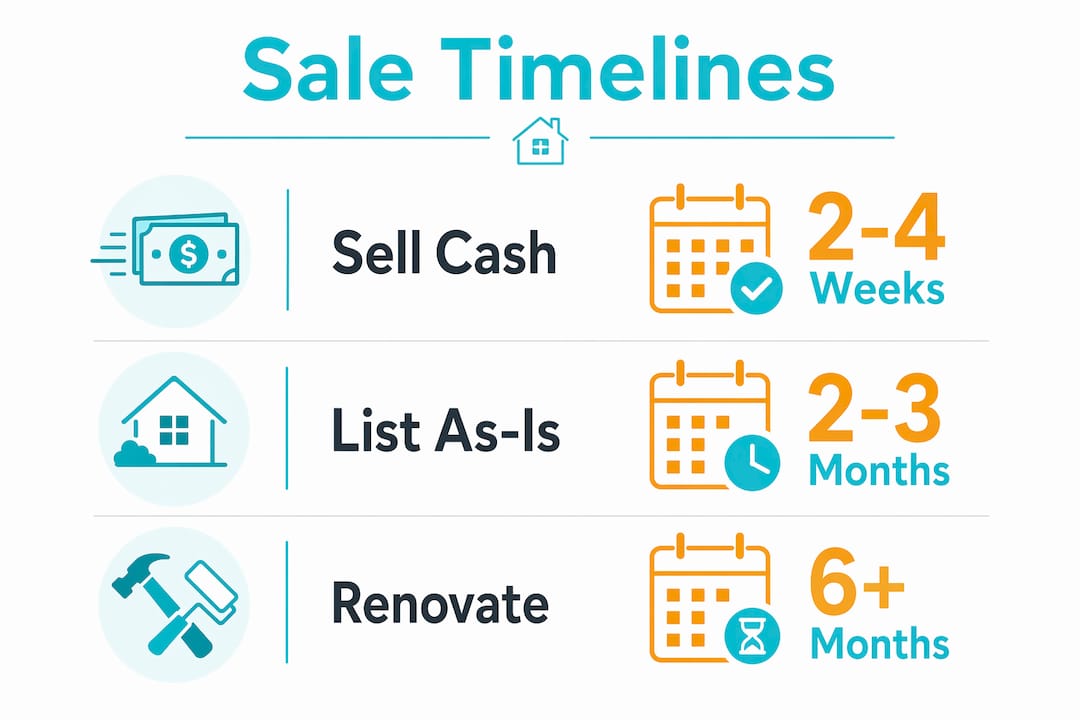
| Path | Typical Timeline |
|---|---|
| Sell to a cash buyer | two to four weeks to close |
| List as-is on MLS (retail buyers) | 6–14 weeks from listing to close |
Every month a home sits in renovation mode costs you carrying expenses. At current rate levels, those monthly costs add up faster than most sellers anticipate. Selling as-is offers something renovating cannot: a predictable end date.
How to find buyers who actually want a fixer-upper
Not every buyer is right for a home that requires improvement. Targeting the wrong audience wastes time and produces lowball offers.
Renovation loan buyers are your best retail option. These are owner-occupants who plan to live in the home and can access FHA 203(k) or Fannie Mae HomeStyle financing to roll repair costs into their mortgage. They typically pay more than investors and less than full retail. Fixer-upper listings on Realtor.com receive 52% more page views per property than comparable homes, so the demand is real.
Real estate investors and flippers move fast and pay cash, but they price in their profit margin, which means offers of 50–70 cents on the dollar. They make sense when speed is the priority or the home has issues that make conventional financing impossible.
Cash home buyers like NWI Buyers occupy a specific niche: they buy homes in any condition, handle all the paperwork, and close on your schedule. For sellers who need certainty over maximum price, this is often the cleanest path.
To reach renovation-minded retail buyers, MLS exposure is non-negotiable. An as-is home sale checklist can help you prepare your listing to attract the right buyer segment from day one.
Financing options buyers use to purchase homes needing renovation
Understanding how your buyers will finance the purchase helps you price and market more effectively.
FHA 203(k) loans let buyers finance both the purchase price and renovation costs in a single mortgage. This opens your home to a wider pool of owner-occupants who might otherwise be priced out of a fixer-upper.
Fannie Mae HomeStyle loans work similarly but allow a broader range of renovation types, including luxury upgrades. Both programs require the home to meet basic habitability thresholds.
Conventional loans can work for homes with moderate issues, but lenders will flag safety hazards, missing utilities, or structural problems. If your home cannot pass a standard appraisal, cash buyers or renovation loan buyers are your realistic pool.
Hard money and bridge loans are common among investors and flippers. These are short-term, higher-rate instruments that let buyers move quickly. Sellers benefit because these deals close fast with fewer contingencies.
Dan buys houses can close your sale in days, not months
If your home in Northwest Indiana needs work and you want out without the renovation circus, NWI Buyers offers a direct path. No repairs, no open houses, no drawn-out negotiations.

Dan buys houses specializes in cash purchases for homes in any condition across Northwest Indiana. The process is straightforward: you reach out, they assess your home, and you receive a no-obligation cash offer. Some sellers close in as little as five days. There are no listing commissions, no repair demands, and no surprises at the closing table. For homeowners facing foreclosure, relocation, or an inherited property without interest in renovating, this is exactly the kind of certainty that a traditional listing cannot provide. Get your cash offer today at nwibuyers.com.
Key Takeaways
Selling as-is is financially smarter than renovating for most homeowners with major repairs needed, especially when carrying costs, timelines, and commission savings are factored in.
| Point | Details |
|---|---|
| As-is pricing reality | As-is offers typically run 15%–25% below move-in-ready comps, but often beat net proceeds after renovation costs. |
| Renovation ROI is limited | Major repairs like roofing and HVAC rarely return their full cost at resale; cosmetic fixes perform better. |
| Disclosure is mandatory | U.S. state laws require written disclosure of all known defects even in as-is sales; skipping this risks lawsuits. |
| MLS exposure matters | Flat-fee MLS listings attract both retail buyers and investors, creating competition that raises your net proceeds. |
| Dan buys houses | NWI Buyers offers cash purchases in Northwest Indiana with no repairs required and closings in as few as five days. |