
You can sell your commercial property for cash and close in a matter of weeks, not months. Direct buyers routinely deliver a written offer within 24 to 72 hours of reviewing your property, with closings possible in 7 to 30 days depending on title work and payoff coordination. Dan buys houses works this way for qualifying commercial assets in its service area. The trade-off is real: you're usually trading a slice of top-line price for speed and certainty.
TL;DR:
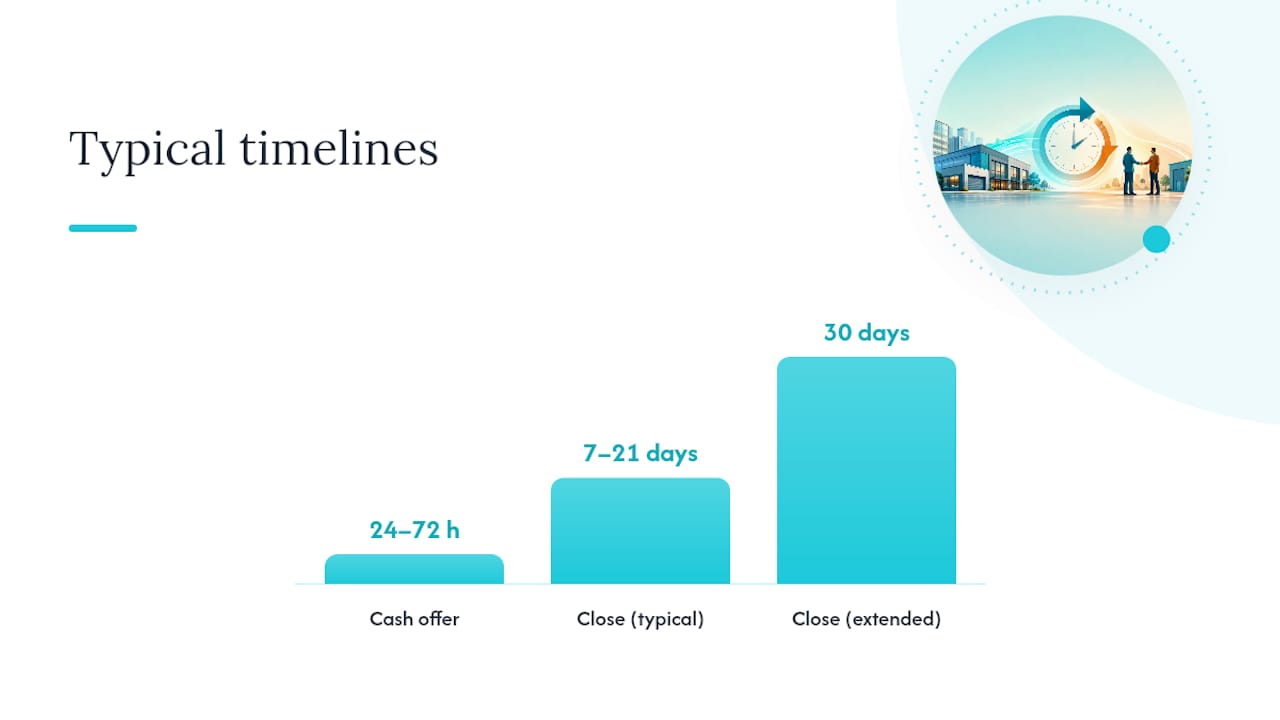
- Cash offers for commercial properties typically arrive within 24 to 72 hours, with closings often completing in 7 to 21 days depending on title work.
- Sellers facing foreclosure, inheritance, tenant issues, or urgent repairs benefit most from quick cash sales, which bypass lengthy traditional listings.
- The discount on cash deals accounts for repair, environmental, and tenant risk, often resulting in net proceeds lower than a market listing but with faster certainty.
- Proper documentation, including payoff statements, leases, and environmental reports, significantly speeds up the closing process.
- Verifying proof of funds and avoiding pressure tactics are essential steps to prevent overpaying or dealing with unreliable buyers.
Table of Contents
- Who benefits most from selling commercial property for cash
- How does a fast cash offer for commercial property work?
- Pros and cons of accepting a guaranteed cash offer
- What's a realistic timeline and net proceeds estimate?
- Do you still have legal disclosure obligations in an as-is sale?
- What documents should you gather before a fast closing?
- How do you vet a commercial cash buyer before signing?
- Negotiating a cash offer on commercial property
- What Dan buys houses has seen close fast
- How to request a cash offer from Dan buys houses
- Sources
Who benefits most from selling commercial property for cash
A cash sale isn't the right move for every owner, but it solves specific problems better than a traditional listing ever could.
- Owners facing foreclosure or a looming payoff deadline who need certainty over the next few weeks, not months
- Heirs who inherited a commercial building and want to liquidate without managing tenants or repairs from a distance
- Landlords stuck with a problem tenant, vacancy, or a lease that's about to sink the property's value
- Owners staring down deferred maintenance, code violations, or environmental cleanup they can't afford to fix before listing
Most direct buyers accept small retail strips, warehouses, mixed-use buildings, and standalone offices, though price range and location still matter to any buyer's underwriting. If your property is fully leased, in strong condition, and in a competitive submarket, a retail listing with broker exposure will likely net you more. Cash sales earn their keep when time, condition, or complexity work against you.
How does a fast cash offer for commercial property work?
The process runs in a straight line, and most of the delay in a traditional sale simply doesn't exist here.
- Submit your property details. Address, square footage, current use, tenant status, known repair needs, and any liens or mortgage balances.
- The buyer runs a quick evaluation. This usually means a desktop underwriting review, a look at photos or a brief site visit, and confirmation of proof of funds on their end.
- You receive a written, no-obligation offer, typically within 24 to 72 hours of submission.
- You accept and title opens. A title company or escrow agent begins clearing liens, payoffs, and prorations.
- You close on your timeline, often somewhere between 7 and 21 days, though 30 days is common when payoffs or entity ownership add steps.
Sellers coordinating a 1031 exchange or needing a delayed close for tax planning can typically request an extended timeline, since principal buyers using their own capital aren't locked into a bank's funding schedule.
Pro Tip: Have your mortgage payoff statement and any lease agreements ready before you submit. Buyers who see clean documentation on day one often shave days off the underwriting step.
Pros and cons of accepting a guaranteed cash offer
Weigh the certainty against the discount before you sign anything.
Pros:
- Closing happens in weeks instead of the 6 to 18 months a traditional commercial sale can take
- No repairs, cleanup, or code compliance work required before closing
- No broker commissions and no listing obligations
- High certainty of close since principal buyers use their own capital instead of bank financing
Cons:
- Offers reflect a built-in discount for repair costs, environmental risk, and tenant uncertainty
- Skipping market exposure means you lose the competitive bidding that can push a retail price higher
- As-is buyers price in risk the same way an insurer prices a bad driving record. It's baked into the number before you ever see it.
Speed and certainty typically justify the lower number when your carrying costs, legal deadline, or repair bill would otherwise eat into any price premium a listing might get you.
What's a realistic timeline and net proceeds estimate?
Written offers commonly land within 24 to 72 hours, and direct buyers close in 7 to 21 days on straightforward deals, stretching to 30 when title or payoff issues need extra time. Traditional commercial sales, by contrast, often run 6 to 18 months from listing to closing table. Buyers discount for deferred maintenance, environmental or structural red flags, and shaky tenant leases, because they're absorbing that repair and risk exposure the moment they sign.
Here's illustrative math on a $500,000 property, not a quote for your specific deal:
| Sale type | Gross price | Commission/fees | Discount for as-is | Net proceeds (approx.) |
|---|---|---|---|---|
| Retail listing | $500,000 | 4 to 6% commission | None | $460,000 to $475,000 |
| Cash sale (as-is) | $500,000 | No commission | price discount typical | net proceeds lower due to discount |
The gap narrows fast once you factor in months of carrying costs, repair bills, and the tax prorations or outstanding liens that every seller still has to settle at closing regardless of which route you choose. Run this comparison yourself using a net-proceeds worksheet before you commit either way.
Do you still have legal disclosure obligations in an as-is sale?
Yes, and this is where sellers get burned. An "as-is" clause protects you from repair demands. It does not protect you from a lawsuit over something you knew and didn't say. Sellers remain responsible for disclosing known material defects, particularly environmental hazards like contamination, asbestos, or underground storage tanks, regardless of what the purchase contract says about accepting the property in its current condition.
- Disclose known structural, environmental, or code issues in writing, even if the buyer says they don't need it
- Keep dated, contemporaneous records of what you told the buyer and when
- Don't let a broker or buyer's rep talk you into softening a known problem in the disclosure language
- Coordinate title and payoff details early. Unresolved liens or encumbrances can stall closing or shrink your proceeds at the last minute
Pro Tip: If your property has any environmental history, industrial use, or unresolved code violations, have an attorney review your disclosure statement before you sign. It's a small cost against a real liability.
What documents should you gather before a fast closing?
The single biggest lever you control over your own timeline is how organized your paperwork is on day one.
- Deed and current mortgage payoff statement
- Existing leases and rent rolls, plus tenant contact information
- Recent tax bills and any outstanding assessment notices
- Certificates of occupancy and prior inspection or survey reports
- Environmental reports, if the property has any industrial or commercial use history
- Corporate ownership documents (operating agreement, articles of incorporation) if the property sits inside an LLC or corporation
Sellers who show up with this ready to hand over routinely get their written offer faster and hit their closing date without last-minute scrambling for a signature from an entity manager or a missing lease amendment.
How do you vet a commercial cash buyer before signing?
Not every buyer claiming to pay cash actually has the funds or the intent to close cleanly. A few checks protect you.
- Insist on a written offer with clear terms, not a verbal number over the phone
- Ask for proof of funds before you take the property off any other conversation
- Check for a track record: completed deals, references, or a local presence you can verify
- Confirm the buyer works with an independent title company or escrow agent, not an in-house "closing" arrangement you can't audit
Red flags include pressure to sign within hours, any request for an upfront fee before closing, vague answers about who's actually buying the property, and reluctance to name the title company handling the transaction. Ask directly: who holds escrow, what happens if title comes back with a lien you didn't know about, and can they show you a past closing statement with identifying details redacted.
Negotiating a cash offer on commercial property
Negotiating a cash offer works differently than negotiating a retail listing, and treating it the same way costs sellers money and time.
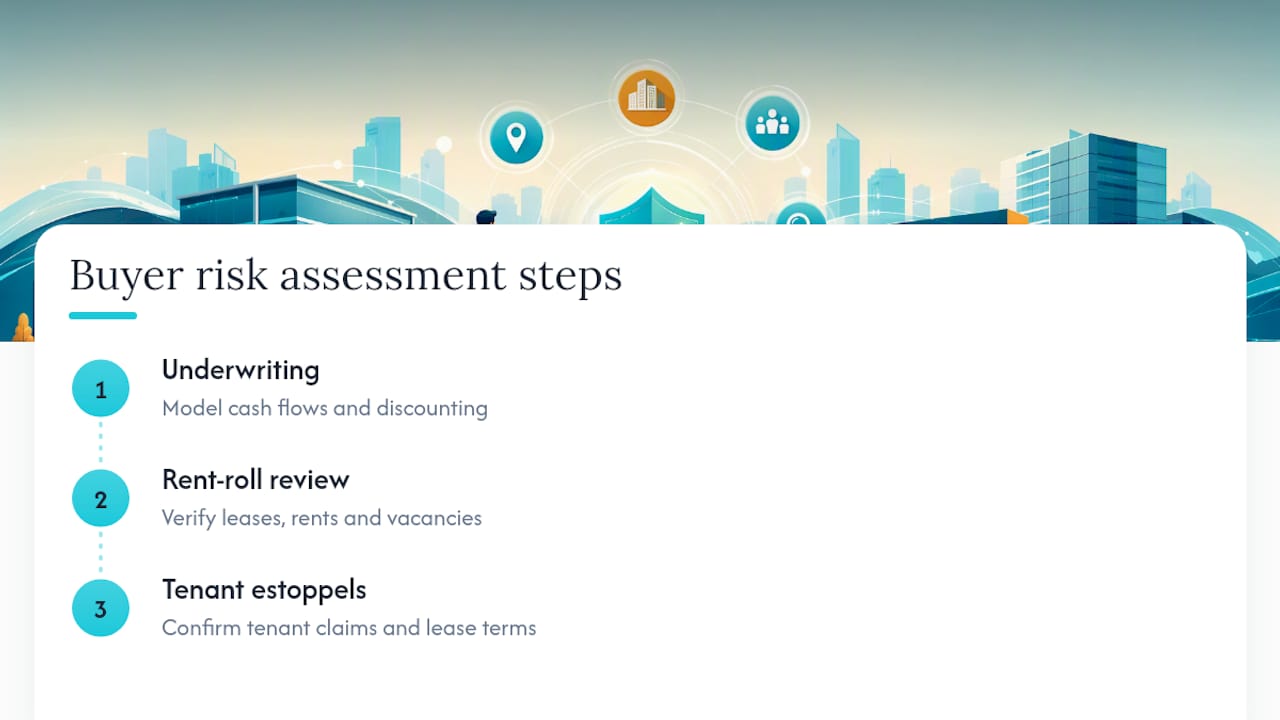
Start by asking the buyer to walk you through how they arrived at their number. A buyer using internal underwriting, rent roll review, and tenant estoppels to price risk should be able to explain their discount, not just state it. If they can't or won't, that's leverage for you to push back on price or walk away.
Your strongest negotiating chip isn't the price. It's the timeline. If you can close in 10 days instead of 30, or you're flexible on possession date, say so upfront. Buyers often improve terms for a seller who removes friction from their side of the deal, since certainty and speed are exactly what makes a cash purchase valuable to them in the first place.
Get two or three offers before you accept anything. A single offer gives you no reference point for whether the discount is reasonable or padded. If your property has upside a buyer might be underpricing, like an undervalued lease renewal coming up or a permitted expansion possibility, put it in front of them in writing rather than assuming they've already factored it in.
Don't negotiate on price alone. Ask about who pays for title insurance, whether there's a due diligence period that could give the buyer an exit, and how earnest money is handled if the deal falls through. These terms can matter more to your net proceeds than another 2% on the offer price.
What Dan buys houses has seen close fast
Foreclosure deadlines, inherited buildings nobody in the family wants to manage, and relocations that can't wait for a six-month listing cycle are the situations that show up again and again. Sellers with clean title and organized documents move fastest, sometimes closing in as little as five days once payoff figures are confirmed. What separates a smooth closing from a stalled one usually comes down to paperwork readiness, not the property itself.
— Daniel
How to request a cash offer from Dan buys houses
If the trade-off between speed and top-dollar price makes sense for your situation, Dan buys houses gives you a direct path with no broker commissions and no repair demands standing between you and a closing date. You submit your property details, get a written offer, and close on a schedule you choose, not one dictated by a lender's underwriting queue.

The process is straightforward: share the basics on your property, get a no-obligation written offer, and set your own closing timeline once you accept. There's no cost to request an offer, and no repair list to check off before anyone will talk numbers with you. If you want to see exactly how the process works, that page walks through each step from submission to closing table. Sellers near Hobart can start with the local Hobart cash offer page, and owners near Highland have a dedicated option through the Highland cash sale page. Reach out today and find out what your property is worth in cash, on your timeline.
Sources
This article draws on data from Roth Capital's commercial property sale process, TowneBank's analysis of as-is property sales, and Chung Law's disclosure obligation guide. For seller checklists, see documents needed for a quick sale and why cash buyers close faster.
This article is general information, not a substitute for advice from a qualified financial advisor. Consult a qualified financial professional about your own circumstances before acting on anything here.
- Sell Your Commercial Property | Roth Capital
- Pros and cons of as-is properties (TowneBank)
- Disclosure obligations for commercial property sellers in California (Chung Law)