
For most homeowners who need to move quickly, a vetted local cash buyer who purchases as-is is the fastest reliable route. You can typically receive an offer within 24–72 hours and close in as little as 5–21 days, with no repairs, no showings, and no commissions.
- Offer timeline: Most local cash buyers respond within one to three business days.
- Close window: Typical cash closings run 1–3 weeks; some close in as few as five days.
- Main trade-off: Cash offers are usually lower than what the open market might produce. You're paying for speed and certainty, not maximum price.
Pro Tip: Before you sign anything, ask the buyer for written proof of funds and a specific closing date in writing. Any serious buyer will provide both without hesitation.
Table of Contents
- What are the fastest ways to sell a home?
- How does a direct cash buyer actually work?
- Speed vs. price: what does a fast cash sale actually cost you?
- When does a quick cash sale actually make sense?
- How do buyers calculate your offer?
- How do you pick a trustworthy cash buyer?
- Key takeaways: your quick-action checklist
- What fast home sales look like from the inside
- Dan buys houses can close your sale in Northwest Indiana
- Sources and further reading
What are the fastest ways to sell a home?
Not every fast-sale route works the same way, and the speed differences are significant. Here's a plain-English breakdown of your realistic options.
Local cash buyer ("we buy houses" investor): Submits an offer within 24–72 hours, closes in 1–3 weeks. Buys as-is, no repairs or showings required. The trade-off is a below-market offer price.
iBuyer (algorithmic platform): iBuyers often generate offers in minutes or hours and typically close within a few weeks in eligible markets. More convenient than a traditional listing, but service fees can be substantial and not every market or property type qualifies.

Accelerated agent listing: A skilled agent can price aggressively and push for a fast close, but you're still dependent on buyer financing and inspections. Traditional agent-assisted sales typically yield higher prices but usually take longer than a cash offer.
Auction: Can produce a sale in days, but the outcome is unpredictable and auction fees eat into proceeds.
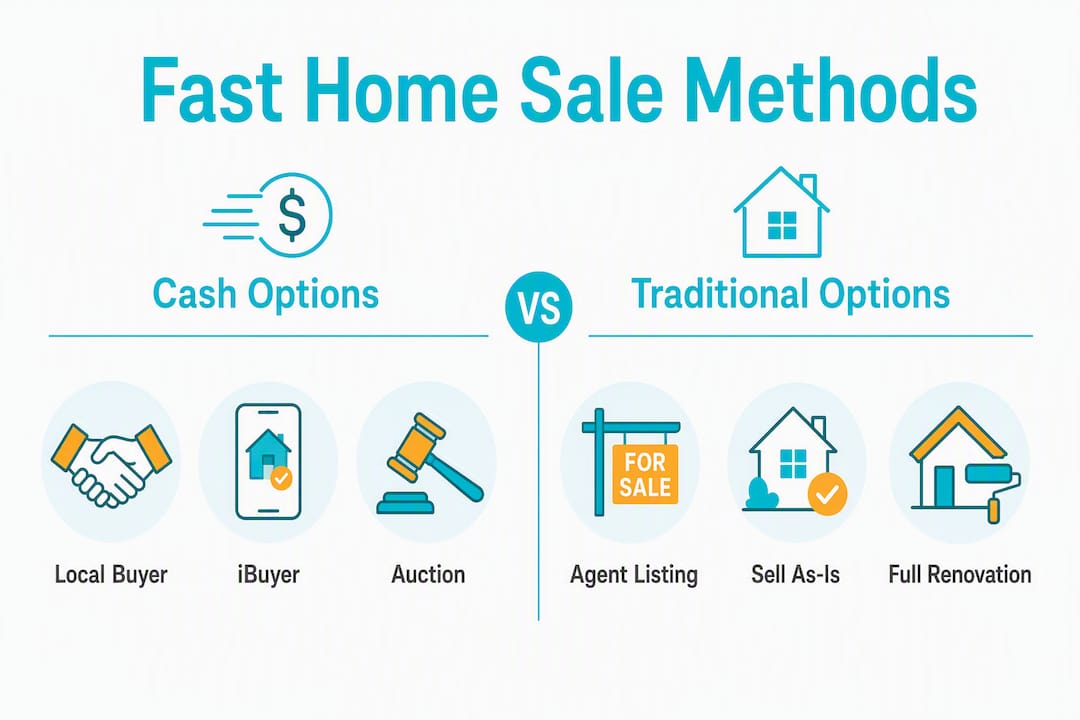
Sell-as-is on the open market: Lists the home in current condition without repairs. Faster than a full renovation-then-list approach, but still subject to normal market timelines.
| Option | Typical offer speed | Typical close time | Main drawback |
|---|---|---|---|
| Local cash buyer | within 24–72 hours | 5–21 days | Below-market offer |
| iBuyer | Minutes to hours | 2–4 weeks | Fees; limited eligibility |
| Accelerated agent listing | Days to weeks | — | Financing contingencies |
| Auction | Days | 1–4 weeks | Unpredictable price |
| As-is open market listing | Days to weeks | — | Still market-dependent |
For context, the National Association of Realtors has reported median time-on-market in the range of several weeks depending on home type and location. A cash close in much less time is a fundamentally different experience.

How does a direct cash buyer actually work?
The process is simpler than most sellers expect. Cash buyers close faster because they eliminate mortgage underwriting, reduce contingencies, and simplify closing logistics. Here's what the sequence looks like in practice.
- Submit your property information. You share the address, basic condition, and your timeline. No photos, staging, or prep required.
- Preliminary offer. The buyer reviews your info and typically responds within 24–72 hours with a preliminary number.
- Walkthrough or inspection. A brief in-person visit confirms the property's condition. No open houses, no strangers walking through on weekends.
- Final written offer. After the walkthrough, you receive a firm written offer. This is the number you can accept, negotiate, or decline.
- Closing. A title company handles the paperwork. You show up, sign, and receive your funds. Some sellers close in as few as five days from this point.
The buyer handles most of the logistics. You don't need to clean, repair, or even remove everything before closing in many cases. That's the operational reason a cash sale can move so much faster than a traditional listing.
Speed vs. price: what does a fast cash sale actually cost you?
Cash buyers typically offer lower prices than the open market because the offer has to account for real costs the buyer will carry. This isn't arbitrary. The discount reflects a specific set of deductions.
- Holding costs: — Property taxes, insurance, utilities, and financing costs while the buyer owns the property before resale.
Think of the discount as the price of certainty. You're not gambling on whether a financed buyer's loan will close, whether an inspection will kill the deal, or whether the market will shift in the next 45 days.
Pro Tip: Get offers from two or three local cash buyers before accepting. The spread between offers can be meaningful, and a higher competing offer gives you real leverage.
The offer discount accounts for estimated repair costs, holding costs, and the investor's required resale margin based on the home's after-repair value. That's not a lowball. That's the arithmetic. Understanding those components helps you push back with documentation when the numbers don't add up. An investor cash offer explained in detail can help you read the logic behind any number you receive.
When does a quick cash sale actually make sense?
Speed and certainty matter more than price in more situations than most sellers initially admit. Here's a practical checklist.
A cash sale is likely the right call when:
- You're facing foreclosure and need to close before a court date.
- You've inherited a property you don't want to maintain or list.
- Relocation is time-sensitive, with a job start date or lease deadline driving the timeline.
- The home needs major repairs you can't afford or don't want to manage.
- A divorce or estate settlement requires a clean, fast liquidation.
- You're a landlord tired of problem tenants and want out without a drawn-out listing.
For sellers in inherited-property situations, a guide to selling estate homes quickly covers the specific steps and timeline considerations worth knowing.
A traditional sale is still the better choice when:
- You have 60–90 days and the home is in good condition.
- Maximizing net proceeds is the top priority and you can absorb the wait.
- The local market is hot and homes are moving in under two weeks anyway.
- You have the cash reserves to carry the property through a full listing cycle.
The honest answer is that if time is genuinely tight, the price gap between a cash offer and a retail sale often shrinks when you factor in carrying costs, agent commissions (typically 5–6%), and the risk of a deal falling through.
How do buyers calculate your offer?
Most sellers expect a flat discount, but offers are actually assembled from specific inputs. Knowing them lets you anticipate the number and, in some cases, push it higher.
- Holding and finance costs: — Taxes, insurance, utilities, and any financing costs during the renovation and resale period.
A simplified version: Offer = ARV minus repair costs minus holding costs minus resale margin minus closing costs.
Investors price in repair risk and holding costs, which is why the same home can receive different offers from different buyers with different cost structures. You can influence the number by providing recent repair receipts, a pre-listing inspection report, a clear title, and documentation of any recent upgrades. Buyers price uncertainty into their offers. Remove the uncertainty and the offer tends to move up.
How do you pick a trustworthy cash buyer?
Vetting a buyer takes about 20 minutes and protects you from the small number of bad actors in this space.
- Ask for proof of funds. A legitimate buyer can produce a bank statement or letter from a financial institution showing they have the cash. No proof, no deal.
- Request a written offer with a specific closing date. Verbal commitments mean nothing. The offer should state the price, the closing date, and any conditions.
- Check for local licensing and references. Ask whether they're registered in your state and whether they can provide references from recent sellers.
- Verify their track record. Search the company name with your city and "reviews." Look for patterns, not just a single complaint.
- Read the contract before signing. Understand whether there are inspection contingencies that allow the buyer to reduce the offer after the walkthrough.
Red flags to watch for:
- Pressure to sign within hours of the first contact.
- Vague or unsigned contracts with blank fields.
- Any request for upfront fees before closing.
- Refusal to provide proof of funds.
- No physical address or local presence.
Before you sign a purchase agreement, ask the buyer directly: "Will this price change after the walkthrough?" A trustworthy buyer will explain their inspection process clearly and tell you under what conditions, if any, the final offer might differ from the preliminary one.
Gather these documents before you start the process to avoid delays: title deed, mortgage payoff statement, recent utility bills, property tax records, and any existing inspection reports. A full quick home sale document checklist covers everything most buyers will request.
Key takeaways: your quick-action checklist
If you're ready to move forward, here's what to do in the next 24 hours.
- Verify funds first. Ask any buyer for written proof of funds before sharing personal details or signing anything.
- Get the timeline in writing. A promised closing date means nothing unless it's in the contract.
- Gather your documents now. Title deed, mortgage payoff, tax records, and any inspection reports speed every step.
- Get multiple offers. Contact two or three local cash buyers. The spread can be significant.
- For urgent situations: If foreclosure or a hard deadline is in play, contact a vetted local cash buyer today. Emergency foreclosure situations in Indiana have specific timelines that make speed critical.
This article is general information, not legal or financial advice. Confirm current rules and tax implications with a qualified professional before closing.
A vetted local cash buyer that purchases as-is is the fastest reliable route for most urgent sellers, with offers typically within 24–72 hours and closings possible in as little as 5–21 days when documents are ready.
| Point | Details |
|---|---|
| Fastest reliable route | A vetted local cash buyer purchasing as-is typically offers within 24–72 hours and closes within 5–21 days. |
| Main trade-off | Cash offers are lower than retail because buyers deduct repair costs, holding costs, and a resale margin. |
| Protect yourself | Always get written proof of funds and a specific closing date in the contract before signing. |
| Speed up closing | Gather your title deed, mortgage payoff statement, and any inspection reports before the first call. |
| Dan buys houses | Dan buys houses purchases homes as-is in Northwest Indiana with no commissions and can close quickly. |
What fast home sales look like from the inside
Most sellers come to me after weeks of trying to figure out whether a cash sale is worth it. By the time they call, they've already done the math on repairs they can't afford, or they've got a moving date that won't move. The question is never really "should I sell fast?" It's "can I trust the person I'm selling to?"
The sellers who get the best outcomes are the ones who come prepared. They have their title docs ready, they know their mortgage payoff number, and they've already decided what timeline they need. That preparation is what turns a five-day close from a marketing claim into an actual result.
One scenario that comes up often: a seller inherits a property with deferred maintenance, no desire to manage a renovation, and a co-heir who wants to settle the estate quickly. The home goes from inquiry to closed in under three weeks. No repairs, no showings, no agent fees. The seller walks away with a clean number and a resolved situation. That's the actual value of a cash sale. Not just speed. Resolution.
The conventional wisdom says cash buyers always lowball. What that misses is that the alternative isn't just "more money." It's more time, more uncertainty, more carrying costs, and more chances for a deal to fall apart. For a lot of sellers, the cash offer is the better financial decision once all of that is priced in.
Dan buys houses can close your sale in Northwest Indiana
Selling a home fast in Northwest Indiana doesn't require a listing, an agent, or a single repair. Dan buys houses purchases homes as-is for cash, covering houses, condos, duplexes, townhomes, mobile homes, and more, with no commissions and no seller-paid closing costs.

The process is direct: submit your property address, receive a written cash offer within 24–72 hours, and close on a date that works for your schedule. Some sellers close in as little as five days. The company's track record with urgent situations, including foreclosure, relocation, and inherited properties, means the team understands tight deadlines and handles the paperwork from offer to close.
Ready to get a number on your home? Submit your property details for a cash offer or call Dan buys houses directly at (219) 239-1233.
Sources and further reading
| Source | What it supports |
|---|---|
| Cash-homebuyer companies Bankrate | Cash buyer speed, iBuyer timelines, offer discount logic, and how buyers price repair risk |
| How To Sell Your House Fast, Bankrate | Agent-sale timelines, NAR median days-on-market, offer calculation components |
| How our process works in Indiana, NWI Buyers | Dan buys houses step-by-step process and five-day close claim |
| About Our Company, Dan buys houses | Service focus on urgent sellers, no-fee model, local trust signals |
| Documents Needed for a Quick Home Sale, NWI Buyers Blog | Document checklist for accelerating a cash closing |
| Why Cash Buyers Close Faster, NWI Buyers Blog | Operational reasons cash buyers outpace financed buyers on timeline |
| Emergency Home Sale to Stop Foreclosure in Indiana, NWI Buyers Blog | Foreclosure-specific timelines and urgency considerations |
| Ways to Sell Estate Home Quickly, NWI Buyers Blog | Inherited property sale strategies and estate-specific considerations |