
Yes, you can sell the marital home during a divorce. Whether you should depends on timing, state law, your mortgage situation, and whether both spouses can cooperate enough to sign a listing agreement.
Three things to do right now:
- Check your legal position. Confirm whether your state has automatic restraining orders (ATROs) that limit property transfers after a divorce petition is filed, and whether you need court approval to list.
- Pull your mortgage and title documents. Know who is on the loan, what the payoff balance is, and whether any liens exist. The CFPB's mortgage resources walk through borrower responsibilities and payoff procedures.
- Choose a sales path. A traditional listing with a neutral agent, a buyout by one spouse, or a fast-cash sale through a direct buyer like Dan buys houses, each carries different timelines and tradeoffs.
Key Takeaways
Selling the marital home during divorce is usually possible, but timing, state law, and tax implications determine whether it is the right move and how much each spouse actually nets.
| Point | Details |
|---|---|
| Sell before divorce is final | Married couples may exclude up to $500,000 in capital gains; single filers get only $250,000 after divorce. |
| State law shapes the split | Indiana and other equitable distribution states divide proceeds fairly, not always equally; community property states default to 50/50. |
| Document every decision | Put pricing, repair credits, and offer protocols in writing before listing to prevent costly disputes. |
| Co-ownership carries real risk | Prolonged joint ownership keeps both spouses liable for mortgage and maintenance costs and delays financial recovery. |
| Dan buys houses | Offers as-is cash purchases with flexible closing dates in Northwest Indiana, a practical option when speed or certainty matters most. |
Table of Contents
- Should you sell the house during the divorce process?
- How state law determines who can sell and how proceeds are split
- What are your realistic options for the marital home?
- Step-by-step: how to sell the house during a divorce
- How are sale proceeds divided, and what are the tax consequences?
- Who should be involved in your home sale, and when?
- When does a fast-cash sale make sense during a divorce?
- When should you call a professional?
- What I've seen working with divorcing sellers in Northwest Indiana
- Dan buys houses offers divorcing sellers a faster, simpler exit
- Sources
Should you sell the house during the divorce process?
Selling is often the cleanest financial move, but it is not always the right one. Here is an honest look at both sides.
Reasons to sell:
- Converts the home's equity into cash both spouses can use immediately, avoiding the need to value and offset a hard-to-divide asset.
- A completed sale removes ongoing mortgage, insurance, and maintenance obligations from both parties.
- Selling before the divorce is final may let you claim the married-filing-jointly capital gains exclusion, which is up to $500,000 under IRS rules versus $250,000 for a single filer.
- Agreeing to sell often accelerates settlement talks because the home is frequently the largest and most contested asset.
Reasons to wait or explore alternatives:
- If the sale drags on, both spouses keep paying carrying costs: mortgage, taxes, utilities, and upkeep.
- Selling at the wrong moment in the market can cost more than the tax benefit you were trying to preserve.
- When children are involved, disrupting their school and housing situation mid-divorce adds emotional weight that is hard to quantify but real.
Pro Tip: Before deciding, run the numbers on what each spouse nets after mortgage payoff, closing costs, and taxes. A home priced at four hundred thousand dollars with a mortgage of two hundred eighty thousand dollars and typical selling costs leaves substantially less to split, not $200,000. That reality check changes the conversation.
Co-ownership after separation creates ongoing liability and can delay each spouse's ability to move on financially. Legal experts recommend avoiding prolonged joint ownership where possible, because both parties remain responsible for mortgage payments and maintenance costs even after they stop living together.
How state law determines who can sell and how proceeds are split
The legal framework governing your home sale depends entirely on which state you live in.
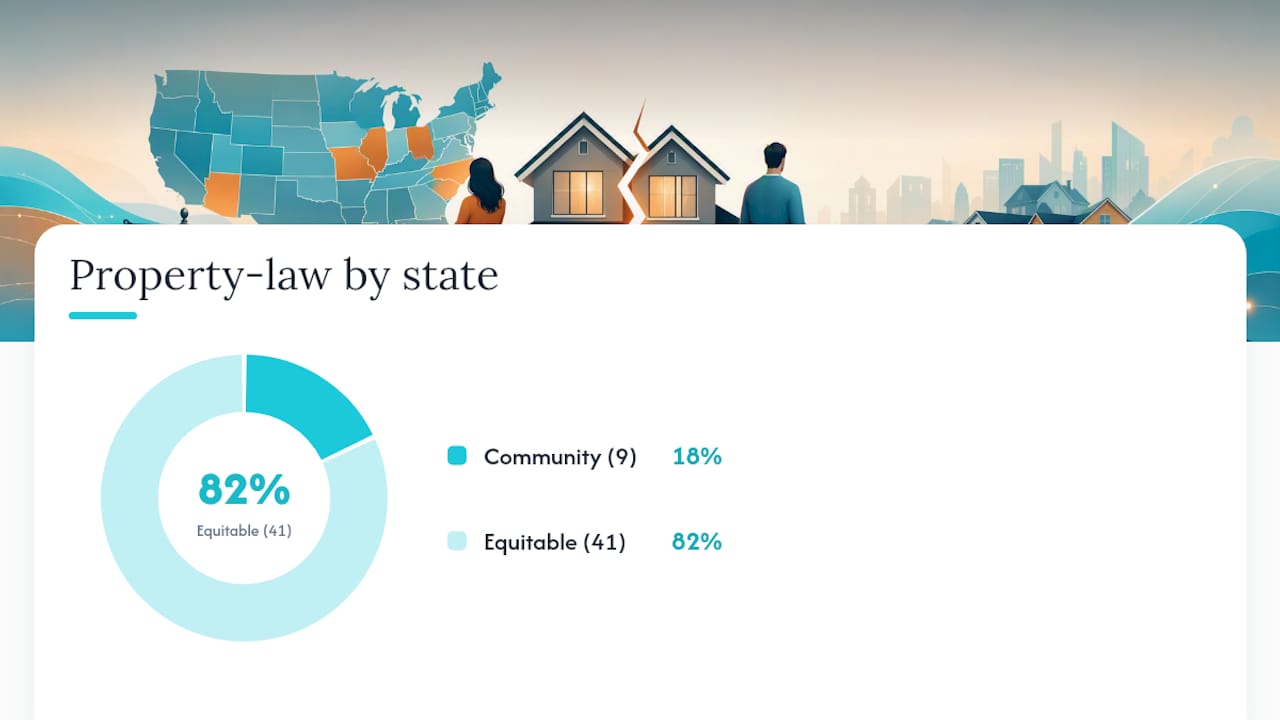
Community property states (Arizona, California, Idaho, Louisiana, Nevada, New Mexico, Texas, Washington, Wisconsin) treat most assets acquired during the marriage as equally owned 50/50. Both spouses must consent to a sale, and proceeds are typically split evenly unless a court orders otherwise.
Equitable distribution states (the remaining 41 states, including Indiana) divide marital property "fairly," which does not always mean equally. A judge weighs factors like each spouse's income, contributions to the home, and ability to afford ongoing costs. Indiana courts treat the marital home as marital property subject to equitable division and often prefer practical outcomes: a buyout, a sale and split, or an asset offset.
Title and liens matter too. If both names are on the deed, both must sign to transfer title. If only one spouse is on the deed but the home was purchased during the marriage, it is still likely marital property in most states. Outstanding liens, including contractor liens or a home equity line of credit, must be paid at closing before any proceeds are distributed.
Court controls to know about:
- ATROs in states like California automatically restrict property transfers after a divorce petition is filed. Selling without court approval in those states can expose you to contempt proceedings.
- A judge can order a deferred sale (common when minor children need housing stability) or appoint a neutral referee to manage the transaction.
- Check your local rules before listing, because the consequences of an unauthorized transfer can unravel a deal and complicate your settlement.
For complex ownership questions, the American Bar Association's family law resources are a solid starting point for finding state-specific guidance.
What are your realistic options for the marital home?
Most divorcing couples end up choosing one of five paths. Each has a different financial and logistical profile.
Sell and split the proceeds
This is the cleanest option when neither spouse can afford the home alone or when both want a definitive financial break. The main risk is that a contested listing, where spouses disagree on price or offers, can stall for months and cost both parties money.
Buyout: one spouse keeps the home
One spouse pays the other their share of the equity, typically by refinancing the mortgage into their name alone. The buying spouse must qualify for the new loan on a single income, which is often harder than it sounds. Lenders evaluate debt-to-income ratios based on post-divorce income, not the household income that originally secured the loan.

Refinance to remove one spouse from liability
Even without a buyout, one spouse may refinance to remove the other from mortgage liability. This protects the departing spouse's credit if the remaining spouse later misses payments. Confirm mortgage servicer requirements early, because some loans have assumption clauses that complicate this process.
Co-own or rent out the property
Some couples defer the sale, rent the home, and split rental income while the market improves or until children finish school. This sounds cooperative in theory. In practice, prolonged co-ownership creates ongoing financial entanglement and can prevent either spouse from qualifying for a new mortgage. It works only when both parties communicate well and document every financial decision in writing.
Court-ordered sale
When one spouse refuses to cooperate, the other can petition the court to order a sale. A judge may appoint a neutral referee to manage the listing, accept offers, and distribute proceeds. This route adds legal fees and time but is sometimes the only way to force a resolution.
Pro Tip: Document your chosen path in the marital settlement agreement before the sale closes. Verbal agreements about who pays for repairs or how to handle a low offer disappear fast when emotions run high.
Step-by-step: how to sell the house during a divorce
- Gather your documents. Pull the settlement agreement draft, mortgage statements, title report, and any lien records. A complete home sale document checklist prevents surprises at closing.
- Agree on a listing approach. Both spouses should sign a joint listing agreement with a neutral agent neither party has a prior relationship with. If cooperation is impossible, your attorneys can stipulate a neutral referee or request court appointment.
- Get a neutral valuation. Use an agreed comparative market analysis (CMA) or a third-party appraisal. Pricing disputes are among the most common reasons divorce sales stall, and a neutral number removes the argument.
- Coordinate showings and marketing. Decide in advance who handles showing requests, who must vacate during showings, and how quickly each party must respond to offers. Put this in writing.
- Negotiate offers with a clear protocol. NAR guidance recommends written agreements and attorney involvement when pricing or offer disputes arise. Build a mediation clause into your listing agreement so impasses have a defined resolution path.
- Close and distribute proceeds. At closing, the title company pays off the mortgage, any liens, and closing costs first. Net proceeds go to an escrow or trust account and are distributed according to the settlement agreement. Update the deed and notify the court if your jurisdiction requires confirmation of the sale.
Pro Tip: Ask your title company to issue two separate closing disclosure statements, one for each spouse, so each party can independently verify the numbers before signing.
Watch for these common friction points:
- One spouse delays signing documents or refuses to vacate for showings.
- Disagreements over repair requests from buyers.
- One party accepting or rejecting an offer without the other's consent.
- Disputes over who pays for pre-sale repairs or staging costs.
How are sale proceeds divided, and what are the tax consequences?
The order of payoff at closing
Every dollar from the sale flows in a fixed order: mortgage payoff first, then any liens (home equity loans, contractor liens, tax liens), then closing costs and agent commissions. What remains is the net proceeds, and that is what gets split.
If the home is underwater (the sale price is less than the mortgage balance), both spouses may owe money at closing. Confirm this scenario with your lender before listing.
Capital gains: the timing decision that matters most
The IRS allows married couples filing jointly to exclude up to $500,000 of capital gains on a primary residence sale, provided they meet the two-year ownership and use tests. Single filers get a $250,000 exclusion. Selling before the divorce is final can preserve the larger exclusion, while selling after may cut it in half for each spouse.
Timing the sale relative to your divorce filing can therefore have a significant financial impact. IRS Publication 523 covers the ownership and use tests in detail. A CPA should review your specific situation, particularly if your home has appreciated substantially.
Other financial considerations:
- Settlement offsets: one spouse may keep the home while the other receives retirement accounts or other assets of equivalent value. Document the offset clearly in the settlement agreement.
- Repair credits: if one spouse paid for pre-sale repairs out of pocket, that cost should be credited against their share of proceeds or reimbursed at closing.
- Tax deductions: mortgage interest and property taxes paid during the sale period may still be deductible depending on filing status and timing. A CPA can confirm which deductions apply.
For post-divorce financial planning, including how to rebuild your budget after the sale, this post-divorce financial planning guide covers the recovery steps in practical terms.
Who should be involved in your home sale, and when?
The neutral listing agent
A good agent in a divorce sale acts as a transaction manager, not an advocate for either party. They communicate with both spouses equally, document every decision in writing, and escalate disputes to attorneys rather than trying to resolve them personally. NAR's guidance on divorce transactions emphasizes written agreements and coordination with both spouses' attorneys as the baseline standard.
Attorneys
Your divorce attorney should review and approve any listing agreement, offer acceptance, or sale-related decision that affects the settlement. Never sign a purchase agreement without confirming it aligns with your settlement terms.
Mediators and financial neutrals
When spouses disagree on price, repair requests, or which offer to accept, a mediator can facilitate a resolution faster and cheaper than going back to court. A Certified Divorce Financial Analyst (CDFA) can model the tax and net-proceeds impact of different scenarios, which often defuses emotional pricing arguments with math.
CPAs and tax advisors
Loop in a CPA before you list, not after closing. The capital gains exclusion timing, deductibility of selling costs, and impact on each spouse's tax filing status are decisions that need to be made before the sale, not cleaned up afterward.
Pro Tip: If you and your spouse cannot agree on a listing agent, each attorney can nominate one candidate and a mediator can select from those names. This keeps the process moving without either party feeling outmaneuvered.
When does a fast-cash sale make sense during a divorce?
A direct cash sale skips the listing process entirely. Here is how it typically works:
- Contact a cash buyer and provide basic property details.
- The buyer reviews the property (often without a formal inspection).
- You receive a written cash offer, usually within days.
- If you accept, closing can happen in as little as a few days to a few weeks, depending on title clearance.
When a cash sale fits better than a traditional listing:
- Foreclosure risk is real and you need to close before the lender acts.
- The home needs significant repairs neither spouse wants to fund.
- Both spouses want a guaranteed close date to finalize the settlement.
- One or both parties have already relocated and cannot manage showings.
- The relationship is too adversarial for a months-long listing process.
The tradeoff is price. A cash buyer typically offers below full market value in exchange for speed, certainty, and buying as-is. For many divorcing sellers, that discount is worth it to close the chapter and move on.
Dan buys houses (NWI Buyers) purchases homes as-is throughout Northwest Indiana, with no required repairs, no agent commissions, and flexible closing dates. Their process is straightforward: you describe the property, they make a written offer, and you choose the closing date. For divorcing sellers who need a clean, certain exit, that flexibility matters.

Pro Tip: Get the cash offer in writing before your next attorney meeting. Having a concrete number on the table often accelerates settlement negotiations, because both parties can see exactly what the home is worth in a no-contingency sale.
For more on selling a home quickly for cash, including what to expect from the process and how offers are calculated, that resource covers the mechanics in plain terms.
When should you call a professional?
Call a family law attorney when:
- Ownership or title is disputed between spouses.
- One spouse refuses to sign a listing agreement or cooperate with showings.
- Your state has ATROs or other restrictions you need to navigate.
- The settlement agreement does not yet address what happens to the home.
Call a mortgage lender or the CFPB when:
- You are behind on payments and foreclosure risk is growing. An emergency home sale may be the fastest way to protect both spouses' credit.
- One spouse wants to assume the loan or refinance into their name alone.
Call a CPA when:
- The home has appreciated significantly and capital gains exposure is real.
- You are unsure whether to sell before or after the divorce is final.
- You need to understand how the sale affects each spouse's tax filing status.
Consider a cash buyer when:
- You need a guaranteed close date to finalize the settlement.
- The home needs repairs neither party will fund.
- Negotiations are stalled and a fast, certain exit is more valuable than top dollar.
A divorce checklist can help you track which professionals you have contacted and what decisions still need documentation.
What I've seen working with divorcing sellers in Northwest Indiana
Divorce sales are not just financial transactions. They are often the last shared decision two people make, and the pressure that creates is real. What I have seen consistently is that the sellers who move through the process fastest are the ones who separate the emotional weight of the home from the financial math of the sale.
The couples who struggle longest are usually the ones who cannot agree on price, not because they have different market data, but because the number feels like a verdict on the marriage. A neutral appraisal or a concrete cash offer cuts through that because it removes the argument. There is no "your number" or "my number" when a third party puts a figure in writing.
For sellers in Northwest Indiana who need speed and certainty, a direct cash sale is often the most practical path. No showings, no repair negotiations, no waiting on a buyer's financing to clear. You pick the closing date, both spouses sign, and the settlement can move forward. That is not the right answer for everyone, but for sellers facing foreclosure risk, significant repair needs, or a relationship too adversarial for a six-month listing, it is worth a serious look.
Dan buys houses offers divorcing sellers a faster, simpler exit
When a traditional listing is not realistic, Dan buys houses gives Northwest Indiana sellers a direct alternative: a cash offer on your home as-is, with no repairs required, no agent commissions, and a closing date you control.

Divorce timelines do not wait for the real estate market. If you are facing foreclosure risk, a home that needs significant work, or simply a situation where both spouses need a guaranteed close date to finalize the settlement, a cash sale removes the variables. Dan buys houses buys homes in any condition throughout Northwest Indiana, and the process is straightforward: describe your property, receive a written offer, choose your closing date.
See how the process works or request your cash offer today to get a number in hand before your next attorney meeting.
Sources
- Should You Sell the House Before or After Divorce? - Jerome A. Scharoff, P.C.
- IRS
- Mortgages | Consumer Financial Protection Bureau
- Selling a Home During a Divorce in California: What You Need to Know - Jacob Lavian
- Who Gets the House in a Divorce in Indiana? - WSM Law
This article provides general information only and is not a substitute for legal, tax, or financial advice. Consult a licensed attorney, CPA, or financial advisor for guidance specific to your situation and state.