
If selling to a cash buyer is the right move for you, the single best immediate action is to request a written cash offer along with proof of funds from a local buyer today. Many sellers who choose this route can close within a few weeks, and some, with the right buyer, close in as little as three to five days. The speed is real, but so is the trade-off: cash offers typically come in below what a traditional listing would net you. When that gap is worth it depends entirely on your situation.
Here's what to do in the next hour:
- Collect your property basics: address, rough square footage, current condition, and any known issues.
- Contact a local cash buyer and request a written offer plus a proof-of-funds document before you sign anything.
- Decide your ideal closing date and communicate it upfront so the buyer can confirm whether they can match it.
The speed-versus-price trade-off is the central fact of every cash sale. Bankrate notes that cash-homebuyer companies can deliver offers within 24 hours, with closings commonly in 1–3 weeks, though select local buyers and connectors may close in as little as three to five days. That gap shrinks to irrelevance when you're staring down foreclosure, a probate deadline, a cross-country relocation, or a property that needs $40,000 in repairs before any conventional buyer's lender will touch it. In those situations, speed and certainty are worth more than the extra dollars a six-month listing might eventually produce. Elevated pending-sale cancellation rates in volatile markets reinforce that point: a financed offer that falls apart two weeks before closing costs you time, money, and stress that a clean cash deal avoids entirely.
Table of Contents
- How do cash house buyers actually work, step by step?
- Pros and cons: when does a cash sale actually make sense?
- How do you vet cash house buyers and pick a reliable one?
- What does a cash offer actually look like, and how is it calculated?
- How fast can you actually close, and what speeds it up?
- Common seller scenarios and how cash buyers handle them
- How Dan buys houses (NWI Buyers) works for Northwest Indiana sellers
- Key Takeaways
- Why cash sales are misunderstood more than they're misused
- Get a no-obligation cash offer from NWI Buyers today
- Useful sources for further research
How do cash house buyers actually work, step by step?
The process is shorter than most sellers expect. Here's the typical flow from first contact to keys handed over:
- Inquiry. You contact the buyer (phone, web form, or in person) and share basic property details: address, condition, your timeline.
- Property review. The buyer does a walkthrough or a virtual assessment. Unlike a traditional inspection, this is not a negotiating weapon; it's how they confirm their repair-cost estimates.
- Written offer. You receive a written offer, usually within 24–48 hours. A reputable buyer provides proof of funds at this stage, not after you've signed.
- Title search and escrow. A title company or real estate attorney confirms clean ownership, checks for liens, and opens escrow. This step protects you as much as the buyer.
- Closing. You sign the deed transfer, the buyer wires funds, and you walk away with cash. No waiting 30–45 days for a lender to fund.
Who is actually buying your house?
This matters more than most sellers realize. Three distinct types of buyers operate under the "cash buyer" umbrella:
- Direct/principal investors own the capital themselves. They buy, renovate, and resell or rent. Offers are final and closings are fast because there's no third party to satisfy.
- Wholesalers put your property under contract and then assign that contract to another investor for a fee. They may not have funds of their own. This is the source of most bait-and-switch complaints.
- iBuyers (like Opendoor or Offerpad) use algorithms and market comps to generate automated offers. Bankrate explains that iBuyers often have strict eligibility criteria: price caps, lot-size limits, flood-zone exclusions, and property-type restrictions that disqualify many homes.
Key terms you'll see in the contract
- As-is: You sell the property in its current condition with no repairs required.
- Assignment clause: Allows the buyer to transfer the contract to a third party. A red flag if you weren't told upfront.
- Proof of funds: A bank statement or letter confirming the buyer has liquid capital available.
- Escrow: A neutral third party holds funds and documents until all conditions are met.
- Earnest money: A deposit the buyer puts down to show serious intent. Reputable buyers put this in escrow, not directly in their own pocket.
Pros and cons: when does a cash sale actually make sense?
The real advantages
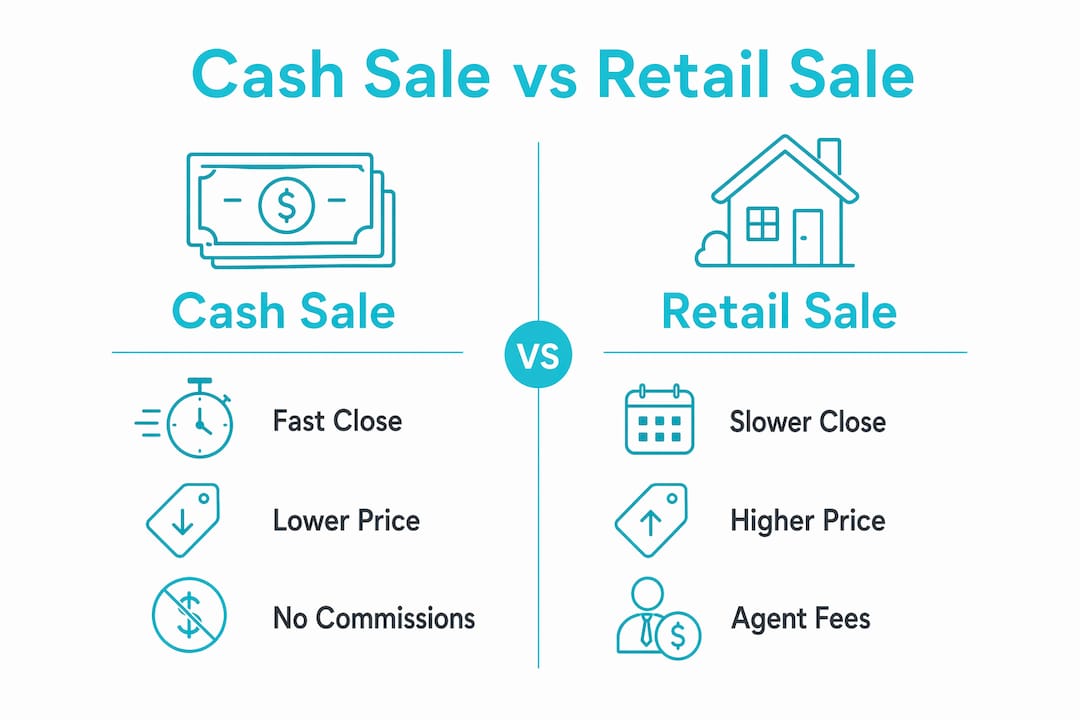
- Speed. Closings in days to a few weeks versus 60–90 days for a financed sale.
- No repairs or staging. You sell the property exactly as it sits. Cash buyers purchase as-is, which means no contractor bids, no weekend cleanup projects, no open houses.
- Fewer contingencies. No financing contingency means the deal doesn't collapse because a lender changed its mind.
- Flexible closing date. Most direct buyers will work around your schedule, whether you need two weeks or two months.
- No agent commissions. In a direct sale, you're not paying a 5–6% agent fee, which partially offsets the lower offer price.
- Certainty. Once you sign, the deal is done. No appraisal gaps, no buyer cold feet, no last-minute lender conditions.
The real drawbacks
- Lower offer price. Cash buyers factor in repair costs, holding costs, and their resale margin. Expect offers below what a retail buyer would pay on the open market.
- Potential hidden fees. Bankrate advises reading the fine print carefully. Some companies advertise "no commissions" but include service fees or post-inspection price reductions.
- Bait-and-switch risk. Some operators give a strong preliminary offer, then lower it after the walkthrough. More on how to avoid this in the next section.
- Assignment contract risk. If your buyer is a wholesaler, your contract may be sold to someone you've never met.
Four situations where a cash sale is clearly the right call
- Foreclosure or pre-foreclosure. You have a hard deadline. A cash sale can close before the auction date; a traditional listing almost certainly cannot.
- Inherited property or probate. Estate sales often involve multiple heirs, out-of-state parties, and properties that haven't been maintained. Cash buyers handle the complexity without requiring you to renovate first.
- Major repairs needed. If the roof, foundation, or electrical system needs significant work, most conventional buyers can't get financing approved. A cash buyer doesn't need lender sign-off.
- Urgent relocation. Job transfer, divorce, or a family situation that requires you to move now rather than in three months.
How do you vet cash house buyers and pick a reliable one?
The difference between a smooth closing and a nightmare usually comes down to one thing: whether you verified the buyer before you signed. Here's a practical checklist.
Vetting checklist
- Request proof of funds immediately. Ask for a bank statement or a letter from a financial institution dated within the last 30 days. The amount should cover your expected sale price.
- Confirm entity formation. Ask for the LLC or corporation name and look it up in your state's business registry. A legitimate buyer has a registered entity.
- Verify the title/escrow company. Reputable buyers use an independent title company or real estate attorney. If they want to use their own in-house "closing team" with no third-party oversight, that's a problem.
- Ask for a written offer with clear terms. The offer should state the purchase price, closing date, earnest money amount, and whether there are any contingencies.
- Check local reviews and references. Look for Google reviews, BBB listings, or references from past sellers in your area.
Questions to ask on the first call
- "Can you send proof of funds before I sign anything?" A legitimate buyer says yes without hesitation.
- "Are you the principal buyer, or will this contract be assigned?" The answer should be "we are the principal buyer and we do not assign contracts."
- "Which title company will you use?" They should name a specific, independent company.
- "What happens if your offer changes after the walkthrough?" A reputable buyer explains their process clearly and doesn't dodge the question.
Pro Tip: To confirm a buyer is a principal investor and not a wholesaler, ask them to provide both proof of funds AND their entity's operating documents. A wholesaler typically can't produce both. This single step prevents your property from being tied up while someone else scrambles to find the actual capital.
Red flags to walk away from
- Refusal to provide proof of funds before signing
- Insistence on an assignment clause without clear explanation
- Vague or evasive answers about which title or escrow company they use
- Pressure to sign within hours or "lose the offer"
- Requests for a large non-refundable deposit before any contract is signed and explained
What does a cash offer actually look like, and how is it calculated?
Cash buyers use a straightforward formula, even if they don't always show you the math. Understanding it helps you evaluate whether an offer is fair.
How buyers arrive at a number
- After-repair value (ARV): What the home will sell for after renovations, based on comparable sales in your neighborhood.
- Estimated repair costs: What the buyer expects to spend bringing the property to market condition.
- Holding costs: Property taxes, insurance, utilities, and financing costs while the buyer owns the property.
- Resale margin: The profit the buyer needs to make the deal worthwhile.
The offer you receive is roughly: ARV minus repair costs minus holding costs minus the buyer's margin. The wider the gap between your home's current condition and its ARV, the lower the offer relative to market value.
What discount should you expect?

Offers from cash buyers typically land below what a retail buyer would pay. The exact gap depends on property condition, local market strength, and the buyer type. Bankrate notes that the no-repairs convenience comes with lower expected proceeds. For a deeper look at how investor offers are structured, the investor cash offer breakdown on the NWI Buyers blog walks through the line items in plain language.
Illustrative net-proceeds example
Compare that to a traditional listing scenario where a $175,000 sale price minus 6% agent commissions ($10,500), $8,000 in pre-sale repairs, and $3,500 in closing costs leaves you with roughly $153,000 after a 60–90 day wait and no guarantee the deal closes. The cash offer nets less on paper, but the gap is smaller than it first appears once you account for carrying costs, repairs, and the risk of a deal falling through.
Who pays closing costs?
Most reputable direct buyers cover closing costs as part of their offer. Bankrate cautions that "no commission" marketing doesn't always mean zero fees, so read the contract line by line before signing.
How fast can you actually close, and what speeds it up?
Typical timelines by buyer type
| Buyer Type | Fastest Close | Typical Close |
|---|---|---|
| Local direct investor | 3–5 days | 1–2 weeks |
| National network/connector | 5–7 days | 2–3 weeks |
| iBuyer | 7–14 days | 3–4 weeks |
| Traditional cash buyer | 7–14 days | 2–4 weeks |

Some local investors advertise very fast closings, as fast as three days, and back that with a guaranteed deposit structure. Title issues, liens, or probate complications can push any of these timelines past 30 days regardless of buyer type.
What you can do to close faster
Sellers who prepare before the offer consistently close sooner. Here's what to have ready:
- Clear title documents or a recent title report if you have one
- Your current mortgage payoff statement (call your lender to request it)
- Government-issued photo ID
- Any HOA documents, if applicable
- Removed personal property from the home before closing day
- Keys, garage openers, and appliance manuals organized and ready
The title search is usually the longest step. If you know of any liens, judgments, or ownership disputes on the property, disclose them upfront. Surprises at the title company add days or weeks to the process.
Common seller scenarios and how cash buyers handle them
Not every cash sale looks the same. Here's how the process adapts to the most common situations:
-
Foreclosure or pre-foreclosure. Time is the defining factor. A cash buyer can often close before the auction date if you act early. Gather your mortgage statements, the foreclosure notice, and your lender's contact information. The buyer's attorney and your lender will coordinate the payoff directly at closing.
-
Inherited property or probate. The executor of the estate must have legal authority to sell before any contract is signed. If probate is still open, the sale may require court approval, which adds time. Collect the will, letters testamentary, and any co-heir contact information. One caution: proceeds from an inherited property may trigger capital gains tax depending on the stepped-up basis and sale price. Consult a tax professional before closing. For a practical guide to selling an estate home quickly, the NWI Buyers blog covers the key steps.
-
Major repairs needed. This is the cleanest scenario for a cash sale. You don't need to fix anything; the buyer prices the repairs into their offer. Be honest about known issues during the walkthrough. Hiding a foundation crack or a leaking roof doesn't save you money; it creates liability.
-
Landlord with a problem tenant. Cash buyers who specialize in investment properties often purchase occupied rentals. They take on the tenant relationship after closing. Document the lease terms, any unpaid rent, and any existing eviction proceedings before you negotiate.
-
Divorce or relocation. Both parties must agree to the sale and sign the contract if both are on the deed. A cash sale's speed is a genuine advantage here: it removes a shared asset cleanly and quickly, which simplifies the broader legal process. Gather the deed, any joint mortgage statements, and confirm both parties are available to sign on the closing date.
How Dan buys houses (NWI Buyers) works for Northwest Indiana sellers
Dan buys houses, operating as NWI Buyers, is a direct cash buyer serving Northwest Indiana, including Hobart, Portage, Merrillville, and the surrounding region. The process is built around one principle: no surprises.
The step-by-step process
- Request an offer. Call or fill out the form on nwibuyers.com. Share your property address and basic details. No obligation, no cost.
- Property review. Dan or a team member visits the property for a walkthrough. This is not a formal inspection designed to lower the offer; it's a straightforward assessment.
- Written offer with proof of funds. You receive a written cash offer. Proof of funds is provided at this stage so you can verify the buyer has the capital to close.
- Flexible closing date. You choose the closing date. Some sellers close in as few as three to five days when needed; others prefer a few weeks to arrange their move.
What sellers are guaranteed
- As-is purchase. No repairs, no cleaning, no staging required. Dan buys houses accepts homes in any condition, including properties with structural issues, deferred maintenance, or tenant occupancy.
- No commissions or seller fees. This is a direct sale. There's no listing agent, no buyer's agent, and no commission line on the closing statement.
- Flexible closing timeline. Whether you need to close in a week or in 60 days, the schedule works around you.
- Transparent written offer. The offer is in writing with clear terms before you're asked to sign anything.
Trust signals
Dan buys houses uses an independent escrow and title process, which means a neutral third party handles the funds and deed transfer. The company purchases houses, condos, duplexes, townhomes, mobile homes, commercial properties, and land across Northwest Indiana. For sellers in Merrillville specifically, the Merrillville fast-sale page covers local details.
Key Takeaways
Selling to a cash buyer is the fastest practical way to close a home sale, but the right move depends on your timeline, property condition, and how much the price gap matters to you.
| Point | Details |
|---|---|
| Speed vs. price trade-off | Cash offers close in days to weeks but typically come in below a traditional listing price. |
| Verify before you sign | Always request proof of funds and confirm the buyer is a principal investor, not a wholesaler. |
| Seller scenarios that fit | Foreclosure, inherited property, major repairs, and urgent relocation are the strongest cases for a cash sale. |
| Net proceeds reality | Savings on repairs, commissions, and carrying costs narrow the gap between cash and listed-sale proceeds. |
| Dan buys houses | NWI Buyers is a direct cash buyer in Northwest Indiana offering as-is purchases, no fees, and closings in as few as three to five days. |
Why cash sales are misunderstood more than they're misused
The conventional wisdom says cash buyers are a last resort for desperate sellers. That framing misses something. A cash sale isn't a consolation prize; it's a different product entirely. You're not selling a house at a discount. You're buying certainty, speed, and simplicity, and you're paying for those things with a lower headline number.
The sellers who regret cash sales are almost always the ones who didn't run the full comparison. They looked at the cash offer, compared it to the Zillow estimate, and felt cheated. But the Zillow estimate doesn't include six weeks of mortgage payments while the house sits on the market, the $12,000 in repairs the inspector flagged, the 6% commission, or the 15% chance the financed deal falls through at the last minute. When you add all of that up honestly, the gap between a cash offer and a traditional sale is often much smaller than it looks on paper.
The other thing most guides get wrong: they treat all cash buyers as interchangeable. A national iBuyer with algorithm-driven pricing and strict eligibility rules is a completely different experience from a local direct buyer who knows your neighborhood, can walk the property the same day, and has the flexibility to work around your timeline. Local buyers who control their own capital and title flow can move faster and adapt in ways a national platform simply can't. That's not a knock on national options; it's just a different tool for a different job.
If you're in Northwest Indiana and you want to know what your home is actually worth to a direct cash buyer, the only way to find out is to ask. One conversation costs nothing.
Get a no-obligation cash offer from NWI Buyers today
You've done the research. Here's the next step: if your property is in Northwest Indiana and you want a real number, not an algorithm estimate, Dan buys houses will give you a written cash offer with proof of funds after a single walkthrough.

What to have ready when you call or fill out the form:
- Property address and a rough description of current condition
- Estimated mortgage payoff balance (call your lender if you don't have it)
- Your preferred closing timeline
- Any known title issues, liens, or occupancy situations
No repairs. No commissions. No pressure to accept. If the offer works for you, you pick the closing date. If it doesn't, you walk away with a clear picture of what a cash sale would look like. Dan buys houses has helped sellers across Hobart, Portage, Merrillville, and the wider Northwest Indiana region close on their schedule, including sellers who needed to close in as little as three to five days.
Request your cash offer at nwibuyers.com and find out what your home is worth to a local buyer who's ready to close.
Useful sources for further research
These sources back the factual claims in this article and are worth bookmarking if you're doing deeper research before deciding:
-
Bankrate: Cash-homebuyer companies — The most thorough independent overview of how cash-buying companies work, what sellers should expect in terms of price and speed, and how iBuyers differ from direct investors. A reliable starting point for any seller comparing options.
-
NWI Buyers — Sell Your House Fast for Cash — The primary landing page for Dan buys houses / NWI Buyers, covering the local service area, process overview, and how to request a no-obligation offer in Northwest Indiana.
-
Texas Real Estate Commission Consumer Protection Notice — While Texas-specific, TREC's consumer protection guidance illustrates the kinds of disclosures and protections sellers should look for in any state when working with real estate investors.
-
Better Business Bureau — A practical tool for checking a cash buyer's complaint history, accreditation status, and customer reviews before signing any contract. Search by company name and location.
-
NWI Buyers: How our process works in Indiana — Step-by-step breakdown of how Dan buys houses structures its offers, walkthroughs, and closings; useful for sellers who want to understand the process before making first contact.