
An estate sale is the organized liquidation of personal property and sometimes real estate, typically triggered by death, downsizing, or relocation. An as-is sale is a real estate contract term meaning the property sells in its current physical condition, with no seller repairs or warranties attached. These two terms describe fundamentally different processes, yet sellers and heirs confuse them constantly. Understanding how estate sale differs from an as-is sale protects you legally, financially, and emotionally when navigating a major life transition.
How does an estate sale differ from an as-is sale?
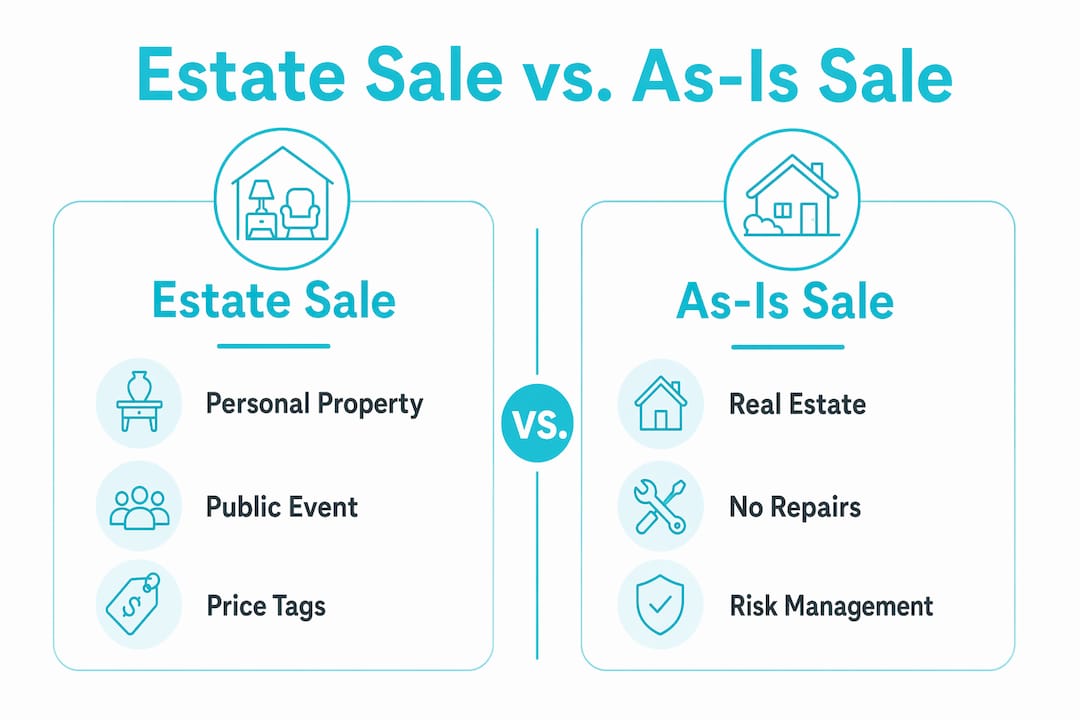
The core distinction is scope. An estate sale focuses on liquidating personal belongings inside a home: furniture, jewelry, collectibles, tools, and household goods. An as-is sale is a real estate transaction where the physical structure changes hands without the seller making repairs or offering credits for defects. One deals primarily with personal property. The other deals with real property and the legal terms of its transfer.

A property can be sold through both methods simultaneously. An executor might hold an estate sale to clear the home's contents, then list the vacant property as-is on the open market. That combination is common in probate situations across Northwest Indiana and nationally. Treating the two as interchangeable, though, creates legal and financial problems.
What is an estate sale and how does the estate sale process work?
An estate sale is a structured liquidation event that follows a predictable sequence of stages. Each stage has a defined purpose and timeline.
- Evaluation. An estate sale company visits the home, catalogs the contents, and assesses market value. This typically takes one to three days.
- Organizing and pricing. Items are sorted, cleaned, researched, and priced. Professionals use comparable sales data and collector guides to set accurate prices.
- Marketing. The sale is advertised through platforms like EstateSales.net, social media, and local mailing lists. A well-marketed sale draws serious buyers, not just bargain hunters.
- The sale event. The public sale runs for 1–3 days, with prices often discounted on the final day to clear remaining inventory.
- Post-sale wrap-up. Unsold items are donated, auctioned, or disposed of. The estate sale company settles accounts and pays the estate its share.
The full process from first call to final clean-out typically spans 2–4 weeks of preparation before the sale opens. Estate sale companies charge fees in the range of 30–40% of gross proceeds. That commission covers all labor, marketing, and logistics. The executor or family retains final authority over pricing strategy and what items are included, even though estate sale companies act as agents on their behalf.
Pro Tip: Interview at least three estate sale companies before signing a contract. Ask each one for a breakdown of their marketing reach, fee structure, and references from recent sales in your area.
What does an as-is sale mean in real estate?
An as-is sale is defined by its contract language: the buyer accepts the property in its current condition, and the seller commits to no repairs, no credits, and no warranties. The as-is clause applies to physical condition, not to legal obligations. Sellers cannot use an as-is clause to hide known problems.
Key legal facts every seller must understand:
- Disclosure is still mandatory. Sellers must disclose all known material defects regardless of the as-is designation. State laws in Indiana and across the country reinforce this requirement.
- The as-is clause does not equal legal immunity. Concealing known defects exposes sellers to post-sale litigation even when the contract says as-is.
- Buyers retain inspection rights. The standard inspection contingency period runs 10–17 days, during which buyers can hire inspectors and review findings.
- Buyers can exit the contract. If an inspection reveals substantial undisclosed defects, buyers can recover their earnest money and walk away.
- Negotiations still happen. Buyers routinely use inspection results to request price reductions even in as-is deals. Sellers who expect zero negotiation after signing an as-is contract are often surprised.
Pro Tip: Collect every maintenance record, repair receipt, and inspection report you have before listing as-is. Organized documentation demonstrates good faith and reduces your legal exposure significantly.
Real estate experts clarify that as-is is a risk management strategy, not a signal of property condition. Many well-maintained homes sell as-is simply because the seller wants a clean, fast transaction without contractor delays.
Estate sale vs. as-is real estate sale: a direct comparison
The difference between estate sale and as-is sale becomes clearest when you compare them side by side across the dimensions that matter most to sellers.
| Category | Estate Sale | As-Is Real Estate Sale |
|---|---|---|
| Primary focus | Personal property liquidation | Real property transfer |
| Trigger | Death, downsizing, relocation | Convenience, condition, speed |
| Timeline | 2–4 weeks prep, 1–3 days event | Standard listing to closing (30–60 days typical) |
| Professionals involved | Estate sale company, executor | Real estate agent, title company, attorneys |
| Legal obligations | Fiduciary duty to beneficiaries | Mandatory defect disclosure |
| Buyer pool | General public at a sale event | Qualified real estate buyers |
| Fees | 30–40% of gross proceeds | Standard agent commissions plus closing costs |
One common misconception deserves direct correction. As-is does not always mean a property is distressed or problem-ridden. Executors frequently choose as-is sales because they live out of state, lack access to the property, or simply want to avoid the burden of managing contractors. The condition of the home and the as-is label are separate issues.
The procedural difference is also significant. An estate sale is a public event with foot traffic, price tags, and cash transactions. An as-is real estate sale follows the standard contract process: listing, showings, offers, inspections, and closing through a title company.
What are the practical benefits of each sale type?
Choosing between these two approaches depends on your specific circumstances, timeline, and financial goals.
Scenarios where an estate sale makes sense:
- The home contains significant personal property with real market value, such as antiques, art, or collectibles.
- The family wants to maximize proceeds from belongings rather than donating or discarding them.
- There is enough time to prepare a proper sale event without pressure from creditors or probate deadlines.
Scenarios where an as-is real estate sale makes sense:
- The executor lives far from the property and cannot manage repairs or showings.
- The estate needs to close quickly to satisfy debts or distribute assets to beneficiaries.
- The property has deferred maintenance that would require significant capital to address before listing.
A rushed as-is sale without evaluating repair ROI can cost an estate far more than targeted updates would have. That is not a hypothetical. Targeted repairs informed by ROI analysis can dramatically increase net proceeds and better fulfill an executor's fiduciary duty to beneficiaries.
Pro Tip: Before accepting an as-is discount, get two contractor bids on the most visible defects. Compare the repair cost against the likely price increase. Sometimes a $5,000 fix adds $15,000 to the offer price.
You can also learn more about selling an inherited home as-is to weigh the pros and cons specific to estate beneficiaries before committing to either path.
How do you navigate estate and as-is sales successfully?
Both sale types reward preparation and professional guidance. Cutting corners on either creates legal and financial risk.
- Interview multiple professionals. For estate sales, compare at least three companies on fees, marketing reach, and experience with similar estates. For as-is real estate sales, interview agents who specialize in probate or investor transactions.
- Document property condition thoroughly. Gather all maintenance records, warranties, permits, and prior inspection reports. This documentation protects you legally and builds buyer confidence.
- Understand your disclosure obligations. Executors sometimes believe an as-is clause waives their duty to disclose known defects. It does not. Known defect disclosure remains legally required to avoid post-sale litigation.
- Clarify inspection contingency terms. Before signing any as-is contract, confirm the inspection period length and what triggers a buyer's right to cancel. Know your exposure before you commit.
- Consult a real estate attorney. Probate sales carry fiduciary obligations. An attorney who handles estate transactions can review contracts, confirm disclosure compliance, and protect you from liability.
For a detailed breakdown of paperwork and seller obligations, the guide on as-is home sale paperwork covers what sellers need to prepare before signing anything.
Key takeaways
An estate sale liquidates personal property through a structured public event, while an as-is real estate sale transfers property ownership without seller repairs or warranties. These are distinct processes with different legal obligations, timelines, and financial outcomes.
| Point | Details |
|---|---|
| Different scope entirely | Estate sales target personal property; as-is sales address real estate contract terms. |
| Disclosure is always required | As-is clauses do not remove the legal duty to disclose known material defects. |
| Timeline varies significantly | Estate sales take 2–4 weeks to prepare; as-is closings follow standard real estate timelines. |
| ROI analysis matters | Skipping repair evaluation before an as-is sale can reduce net proceeds significantly. |
| Professional guidance is non-negotiable | Executors need estate sale companies, real estate agents, and attorneys working in coordination. |
What i've learned after years of buying homes in any condition
The biggest mistake I see sellers make is treating as-is as a shortcut that eliminates responsibility. It does not. Sellers who skip disclosure because they think the as-is clause covers them end up in litigation that costs far more than the repairs they avoided. Transparency is not optional. It is the foundation of a clean transaction.
The second mistake is conflating speed with carelessness. You can sell fast and still do it right. When an executor calls me because they inherited a property three states away and cannot manage showings or contractors, the answer is not to rush blindly into an as-is listing at a steep discount. The answer is to spend two or three days gathering documentation, getting one or two contractor opinions, and understanding what the property is actually worth before accepting the first offer.
Estate sales and as-is sales both serve legitimate purposes. The estate sale process works best when there is real value in the personal property and enough time to market it properly. The as-is route works best when speed and simplicity outweigh the potential upside of repairs. Neither is universally superior. The right choice depends entirely on your timeline, your financial goals, and your legal obligations as an executor or seller.
What I tell every seller I work with: know what you own, know what you owe, and know what you are legally required to disclose. Everything else is negotiable.
— Daniel
How dan buys houses makes estate and as-is sales simpler
Sorting through estate and as-is sale options is stressful enough without adding repair bids, contractor delays, and open house schedules to the list.

Dan buys houses works directly with heirs, executors, and sellers across Northwest Indiana who need a fast, straightforward path forward. There are no repairs required, no staging, and no lengthy negotiations. You get a cash offer today based on the property's current condition, and you choose the closing date. Some sellers close in as little as five days. If you want to understand how the process works before committing to anything, that information is available with no obligation. Dan buys houses is built for exactly the situations this article describes.
FAQ
What is the main difference between an estate sale and an as-is sale?
An estate sale liquidates personal property inside a home through a public event, while an as-is sale is a real estate contract term meaning the property transfers without seller repairs or warranties. They address different types of property and follow entirely different processes.
Does an as-is clause protect sellers from disclosing defects?
No. Sellers must disclose all known material defects regardless of an as-is clause. Concealing known problems exposes sellers to post-sale litigation under state law.
How long does an estate sale typically take to complete?
The estate sale process generally requires 2–4 weeks of preparation, followed by a 1–3 day public sale event, and a few days of post-sale wrap-up for unsold items and final accounting.
Can a home be sold through both an estate sale and an as-is real estate sale?
Yes. Executors commonly hold an estate sale to clear personal property, then list the vacant home as-is on the real estate market. The two processes are compatible and often used together in probate situations.
What fees do estate sale companies typically charge?
Estate sale companies generally charge 30–40% of gross proceeds. That fee covers all organizing, pricing, marketing, and management of the sale event.