
An as-is home sale is defined as selling a property in its current condition, with the seller making no repairs, renovations, or credits before closing. The buyer accepts all known and unknown defects once the deal closes. This arrangement shifts repair responsibility entirely to the buyer, which changes the financial math, the legal obligations, and the negotiation dynamics for everyone involved. If you are considering selling your home without fixing it up first, understanding the full picture of an as-is property sale is the difference between a smooth transaction and a costly mistake.
What does an as-is home sale mean legally and contractually?
An as-is sale means the seller will not perform repairs or offer credits for defects, transferring repair responsibility to the buyer upon closing. This applies to structural, mechanical, and safety defects alike. The term sounds like a blanket shield for sellers, but the legal reality is more specific than most homeowners realize.
The as-is label applies only to the physical condition of the property, not to legal ownership issues like title defects or liens. You still own the home free and clear of legal encumbrances before you can transfer it. The as-is clause does not change that requirement.
Sellers remain legally required to disclose known material defects in as-is sales. Failure to disclose can lead to lawsuits for non-disclosure or fraud. This is the most misunderstood aspect of as-is transactions. Selling as-is does not mean selling secretly. It means selling without fixing, not without telling.

One common misconception is that listing a home "as-is" in an ad or verbally agreeing to as-is terms is legally sufficient. It is not. Clear contract language is required to enforce as-is terms properly. Verbal mentions carry no legal weight in a real estate transaction. The as-is clause must appear explicitly in the purchase agreement, and it must be drafted with precision to hold up if challenged.
Here is what sellers must do to protect themselves legally:
- Complete all required state disclosure forms honestly and thoroughly
- Include explicit as-is language in the purchase and sale agreement
- Document all known defects in writing before listing
- Consult a real estate attorney if the property has significant structural or safety issues
- Retain copies of all disclosures signed by the buyer
Pro Tip: Review your state's specific disclosure requirements before listing. Indiana, for example, requires sellers to complete a Residential Real Estate Sales Disclosure form regardless of whether the sale is as-is. Missing this step creates legal exposure that no as-is clause can fix.
For a deeper look at the paperwork side of this process, the as-is sale documentation guide from Dan buys houses covers what sellers in Northwest Indiana specifically need to prepare.
How does selling as-is affect home sale price and marketability?
Selling a home as-is typically results in a price 10% to 20% below market value compared to a turnkey property in the same area. That discount reflects the buyer's cost of taking on unknown repair risk. The actual gap depends on three factors: the severity of the repairs needed, the local market's competitiveness, and the buyer pool you attract.
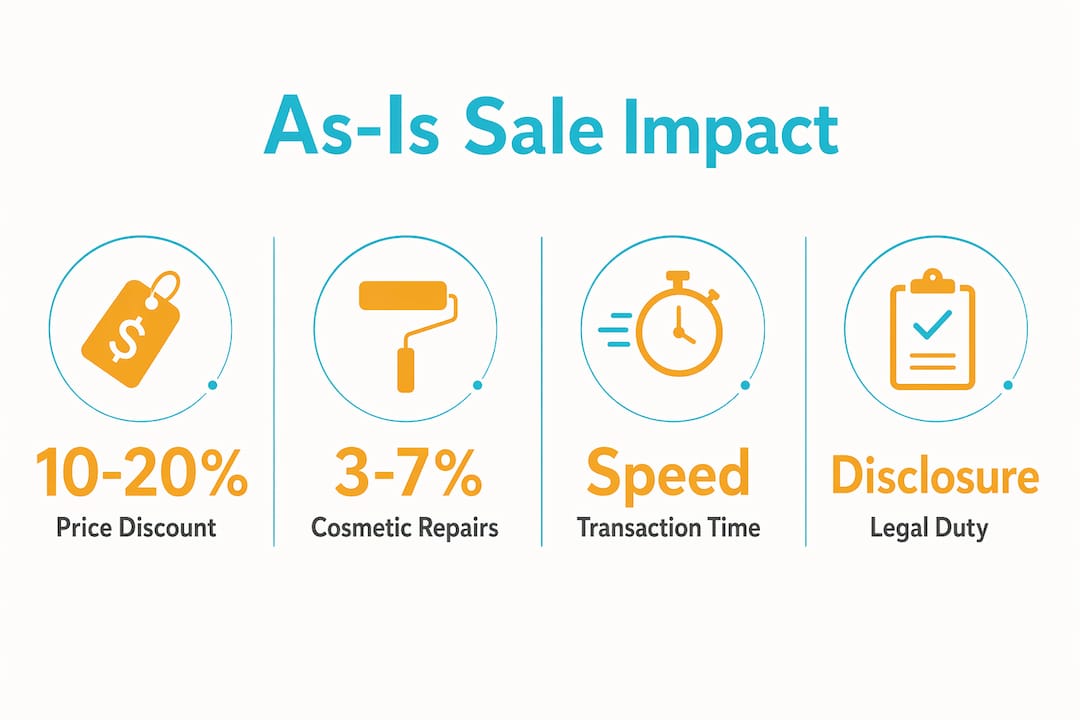
In a hot seller's market, the discount shrinks because buyers compete aggressively even for imperfect homes. In a slower market, buyers have leverage and will push the price lower to compensate for the risk they are absorbing. Location matters just as much. A distressed home in a high-demand neighborhood will sell closer to market value than the same condition property in a declining area.
The table below shows how different repair types typically affect as-is sale prices relative to a fully repaired equivalent:
| Repair type | Typical price impact |
|---|---|
| Cosmetic only (paint, flooring) | 3% to 7% below market |
| Roof replacement needed | 8% to 15% below market |
| Foundation or structural issues | 15% to 25% below market |
| Outdated systems (HVAC, plumbing) | 5% to 12% below market |
| Fire or water damage | 20% to 40% below market |
The financial case for selling as-is is not always negative. Consider a homeowner facing a $40,000 roof and foundation repair bill. Spending that money might recover $35,000 in sale price. Selling as-is at a $30,000 discount saves $10,000 and eliminates months of construction stress. The costs of selling traditionally in Portage, including agent commissions, staging, and carrying costs, can easily consume the gains from repairs.
As-is sales also simplify negotiation and speed up the transaction by removing the back-and-forth over repair credits. That simplicity has real value, especially for sellers who need to close quickly.
What risks and benefits do sellers face when selling their house as-is?
The primary benefit of an as-is sale is speed. Sellers avoid weeks or months of contractor scheduling, renovation delays, and re-listing timelines. As-is sales are most common in distressed transactions like foreclosures, probate, and estate sales, precisely because those sellers need to move fast without upfront investment. The model works because it matches motivated sellers with investors and buyers who are equipped to handle repairs themselves.
The financial benefit is also real when you factor in the full cost of a traditional sale. Repairs, agent commissions averaging 5% to 6%, staging costs, and extended carrying costs can add up to more than the as-is price discount. For many sellers, the net proceeds from an as-is cash sale are comparable to a traditional sale after all costs are accounted for.
The risks, though, deserve equal attention. Buyers can use inspection results to renegotiate price even in as-is sales, so sellers should anticipate possible renegotiations after the inspection period. An as-is label does not lock in your price. It only removes your obligation to make repairs. A buyer who discovers a cracked foundation during inspection will almost certainly come back with a lower number.
The legal risk is the one sellers underestimate most. Sellers remain liable for undisclosed known defects. As-is does not shield against fraud or non-disclosure claims. A seller who knows about mold, a failing septic system, or unpermitted additions and stays silent can face a lawsuit even after closing.
Critical do's and don'ts for as-is sellers:
- Do disclose every known defect in writing before signing any contract
- Do price the home to reflect its actual condition, not your emotional attachment to it
- Do get a pre-listing inspection so you know exactly what buyers will find
- Don't assume an as-is clause eliminates all your legal obligations
- Don't accept a buyer's offer without confirming their financing or cash proof upfront
- Don't skip the attorney review if the property has complex issues like liens or code violations
Pro Tip: A pre-listing inspection costs $300 to $500 and gives you a documented record of the property's condition at the time of sale. This protects you legally and removes the buyer's ability to claim you concealed defects you didn't know about.
How do buyer inspection rights and contingencies work in as-is sales?
An as-is contract does not mean the buyer waives inspection contingencies. Buyers typically retain the right to inspect and cancel during due diligence. This is the single most important thing sellers misunderstand about as-is deals. Accepting an as-is offer does not mean the sale is guaranteed.
Here is how the inspection process typically unfolds in an as-is transaction:
- The buyer and seller execute a purchase agreement with an as-is clause included.
- The buyer schedules a home inspection within the agreed contingency window.
- Buyers generally have a 10 to 17-day inspection period to complete due diligence and cancel without penalty if issues are unacceptable.
- If the inspection reveals serious problems, the buyer can terminate the contract and recover their earnest money.
- Alternatively, the buyer can use the findings to request a price reduction, even in an as-is deal.
- If both parties agree on the revised terms, the sale proceeds. If not, the buyer walks.
The distinction between an as-is sale and waiving the inspection contingency is critical. An as-is sale says the seller won't fix anything. Waiving the inspection contingency means the buyer agrees not to back out based on what the inspection finds. These are two separate decisions. Buyers who waive their inspection contingency take on significantly more risk, and most buyers represented by experienced agents will not do this.
Sellers benefit from understanding this dynamic before they accept an offer. Proper contract drafting includes carefully structuring inspection contingencies and buyer termination rights to protect sellers in as-is transactions. Working with a real estate attorney or a direct buyer who skips the inspection contingency entirely removes this uncertainty from the equation.
Key takeaways
An as-is home sale transfers repair responsibility to the buyer but does not eliminate the seller's legal duty to disclose known defects, making accurate disclosure the most critical step in the process.
| Point | Details |
|---|---|
| As-is definition | Seller makes no repairs; buyer accepts the property in its current condition at closing. |
| Disclosure still required | Sellers must disclose all known material defects in writing regardless of as-is status. |
| Price impact | Expect a 10% to 20% price reduction compared to a fully repaired equivalent property. |
| Buyer inspection rights | Buyers retain the right to inspect and cancel during the contingency period, typically 10 to 17 days. |
| Legal exposure | Undisclosed known defects can result in fraud or non-disclosure lawsuits even after closing. |
What I've learned from years of as-is transactions
Most sellers come to an as-is sale with one of two misconceptions. Either they think it means they can hide problems and walk away clean, or they think they are giving the house away for nothing. Both are wrong, and both lead to bad outcomes.
The sellers who do well in as-is transactions are the ones who treat disclosure as a selling tool, not a liability. When you hand a buyer a thorough, honest condition report upfront, you remove their biggest source of negotiating leverage. They already know what they are buying. There is nothing left to discover that will crater the deal at the last minute.
Pricing is the other place where sellers consistently hurt themselves. The emotional attachment to what a home "should" be worth is real, but the market only pays for what it sees. A home with a failing roof and outdated electrical is not worth the same as the renovated house two streets over, regardless of square footage. Pricing to condition from day one attracts serious buyers and avoids the painful cycle of price reductions and relisting.
My honest advice: get a pre-listing inspection, price honestly, disclose everything, and choose your buyer carefully. A cash buyer who skips the financing contingency and the repair negotiation is often worth more in certainty than a higher offer from a buyer who may walk after the inspection. Certainty of close has real financial value that most sellers don't price into their decision.
— Daniel
Sell your home as-is with Dan buys houses
If you want to skip the inspection negotiations, the repair estimates, and the uncertainty of a traditional listing, Dan buys houses offers a direct path to closing.

Dan buys houses purchases homes in any condition across Northwest Indiana, including Hammond, Highland, Hobart, and Crown Point, with no repairs required and no agent commissions. The process is straightforward: you request an offer, receive a no-obligation cash quote, and choose your closing date. Some sellers close in as little as five days. Whether you are dealing with a distressed property, an inherited home, or simply want to move on without the hassle of a traditional sale, Dan buys houses makes the as-is process exactly as simple as it should be. Get your cash offer today and see what your home is worth.
FAQ
What does as-is mean when selling a house?
As-is means the seller will not make repairs or offer credits for defects before closing. The buyer accepts the property in its current condition, taking on all repair responsibility after the sale.
Do sellers still have to disclose defects in an as-is sale?
Yes. Sellers are legally required to disclose all known material defects even in an as-is sale. Failure to disclose can result in lawsuits for fraud or non-disclosure after closing.
How much less will I get for selling my house as-is?
Selling as-is typically reduces the sale price by 10% to 20% below market value, depending on the severity of repairs needed and local market conditions.
Can a buyer still back out after signing an as-is contract?
Yes. Buyers generally retain a 10 to 17-day inspection contingency period during which they can cancel the contract without penalty if the inspection reveals unacceptable issues.
Is an as-is sale faster than a traditional home sale?
As-is sales are typically faster because they eliminate repair timelines, contractor delays, and extended negotiations. Selling to a cash buyer who purchases as-is can reduce the closing timeline to days rather than months.