
If speed, certainty, and skipping repairs are your top priorities, a direct cash offer is almost always the better choice for Northwest Indiana homeowners. Some sellers close very quickly with Dan buys houses, compared to weeks or months waiting for an estate sale to run its course. Direct cash offers can close in 7–14 days once legal authority is confirmed; some sellers have closed in as little as 5 days. The main exceptions: if the property holds high-value antiques or collectibles that a specialist can appraise and market, or if you're in no rush and the local market is unusually strong, an estate sale might net more gross proceeds before costs.
The short version:
- Direct cash offer wins on speed, certainty, and zero repair or cleanup requirements
- Estate-sale commissions typically run 35%–40% of total sales, and 30%–50% of items often go unsold, leaving you with a cleanout bill on top
- Dan buys houses purchases homes as-is in Northwest Indiana, with no seller-paid closing costs and flexible closing dates
- Direct cash offers can close in 7–14 days once legal authority is confirmed; some sellers have closed in as little as 5 days
Table of Contents
- How do estate sales and direct cash offers actually compare?
- How to run a net-gain analysis before you decide
- How do you vet a direct cash buyer before signing anything?
- What are the legal and paperwork differences between these two methods?
- What are the tax implications for each sale type?
- How does the sale method affect heirs and estate settlement?
- How do you choose a reputable estate sale company?
- What scams and pitfalls should you watch for in both methods?
- Dan buys houses: fast, as-is cash sales across Northwest Indiana
- Key Takeaways
How do estate sales and direct cash offers actually compare?
The core trade-off is gross potential versus net certainty. Estate sales aim for maximum gross; direct cash offers deliver speed and a known number.
| Dimension | Estate Sale | Direct Cash Offer |
|---|---|---|
| Expected net proceeds | Higher gross possible; substantial commission plus cleanout costs reduce net significantly | Lower gross; no commissions, no repair costs, no cleanout fees |
| Time to close | Weeks to several months (prep, marketing, multi-day sale) | 7–14 days after legal authority is confirmed; some sellers close in as little as 5 days |
| Seller effort / prep | High: sorting, staging, pricing, managing public access | Minimal: one walkthrough, written offer, sign and close |
| Fees and hidden costs | Commission 35%–40%; unsold-item disposal $500–$3,000; carrying costs during prep | No seller-paid closing costs; no repair or staging fees |
| Certainty of sale | Moderate: attendance and bids vary; items may not sell | High: written offer, no financing contingencies |
| Best for | High-value collectibles; sellers with time and no urgency | Inherited homes, foreclosure risk, relocation, as-is condition |
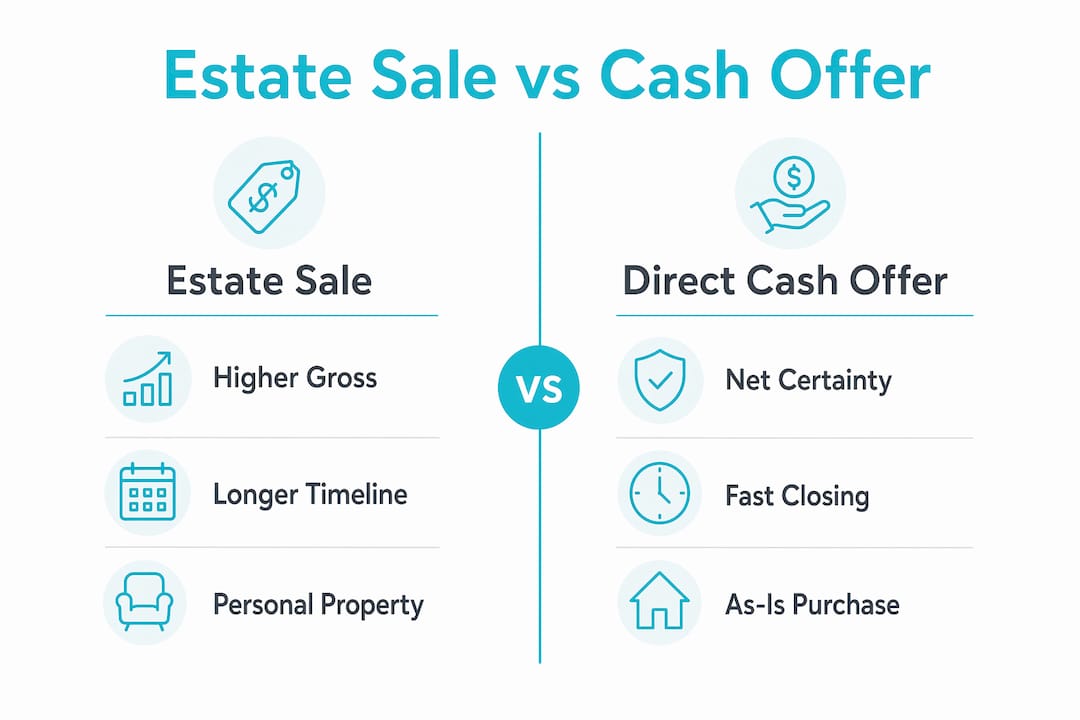
For most Northwest Indiana sellers dealing with an inherited property or a home that needs work, the net difference between these two routes is smaller than it looks on paper once you subtract commissions, disposal fees, and months of carrying costs.
How to run a net-gain analysis before you decide
A side-by-side worksheet protects executors from beneficiary challenges and gives any seller a clear picture. Here's how to build one.
Step-by-step:
- Estimate the gross market value of the property (use a local CMA or recent comparable sales in your NW Indiana zip code).
- Subtract estate-sale or agent commission (35%–40% for estate sale; 5%–6% for a listed sale).
- Subtract prep and repair costs, staging, photography, and disposal/cleanout fees.
- Subtract carrying costs: property taxes, insurance, and utilities for the expected sale period.
- Subtract closing costs (typically 1%–3% of sale price for the seller).
- Compare that net to the cash offer, minus any liens or outstanding taxes owed at closing.
Worked example (NW Indiana property):
| Item | Estate Sale Route | Direct Cash Offer |
|---|---|---|
| Estimated net | — | — |
The gap narrows or widens depending on condition, local demand, and how long the estate sale runs. Document every assumption in writing. Executors who skip this step risk beneficiary disputes if the estate accepts a low offer without a paper trail showing the comparison was done.
Pro Tip: Confirm the executor or administrator has legal authority to sign before scheduling a cash close. Probate timelines vary by county in Indiana, and a cash buyer can be ready before the court paperwork catches up.
How do you vet a direct cash buyer before signing anything?
Cash buyers trade convenience for wholesale pricing — they factor in hauling, unknown repairs, and resale margin. That's fair. What's not fair is a buyer who pressures you to sign before you've verified who you're dealing with.
Due-diligence checklist:
- Verified proof of funds (bank letter or escrow confirmation, not just a verbal claim)
- Written offer with itemized terms: price, closing date, who pays closing costs, what stays or goes
- Clear statement on lien or title issues and how they're handled
- Confirmation that the buyer, not you, covers agreed cleanup or removal
- Local business presence: a real address, verifiable references, and a track record in NW Indiana
Red flags to walk away from:
- "Sign today or the offer disappears" pressure
- No written contract or vague settlement timeline
- Requests for upfront fees before closing
- References that can't be verified or don't exist locally
- Inconsistent answers about who handles title work
"Sellers who need everything removed and want privacy often prefer a direct buyout — but they should expect wholesale pricing because the buyer is absorbing all the unknowns the seller is walking away from." — Hoffman Auctions, estate buyer guidance
Dan buys houses provides written offers, covers closing costs, and purchases properties as-is across Northwest Indiana. There are no seller-paid fees and no requirement to clean or repair before closing.

What are the legal and paperwork differences between these two methods?
A direct cash sale closes through a standard real estate purchase agreement, a title search, and a deed transfer. For an inherited property, the executor or administrator must have court-issued authority (Letters Testamentary or Letters of Administration in Indiana) before signing. A cash sale without that authority can be voided.
An estate sale is a personal property liquidation, not a real estate transaction. It doesn't transfer the house title. If the goal is to sell both the contents and the home, you need two separate processes. Estate-sale contracts with a company should spell out commission structure, insurance coverage, accounting timelines, and what happens to unsold items. The estate-sale industry is largely unregulated, so a written contract is your only real protection.
What are the tax implications for each sale type?
For the real property sale, both routes trigger the same capital gains analysis. The cost basis is typically the fair market value at the date of death (stepped-up basis), which often reduces or eliminates capital gains tax for heirs. Indiana does not have a separate state capital gains tax; gains are taxed as ordinary income at the state level. A tax professional should confirm the basis and any applicable exclusions before closing.
Personal property sold through an estate sale is also taxable. Proceeds above the stepped-up basis of each item are reportable gains, though in practice most household items sell below their basis. High-value items like jewelry, art, or collectibles are the exception and may trigger collectibles tax rates at the federal level. Consult a CPA familiar with Indiana estate law before the sale.
How does the sale method affect heirs and estate settlement?
Speed matters here more than most sellers realize. Every month the estate stays open costs money: property taxes, insurance, utilities, and potential maintenance. A direct cash sale can close the real estate portion of an estate in days, freeing the executor to distribute assets and close probate faster.
An estate sale followed by a traditional listing can stretch the settlement timeline by three to six months or more. That delay affects all beneficiaries, not just the executor. For heirs who need their share quickly, or for estates with outstanding debts, a faster close through a cash sale is often the more practical path.
How do you choose a reputable estate sale company?
Start with the contract. A legitimate estate sale company provides a written agreement that covers commission rate, sale dates, insurance during the event, how unsold items are handled, and when you receive final accounting and payment. Because the industry is lightly regulated, there's no licensing board to complain to if something goes wrong.
Ask for references from recent local sales and verify them. Confirm the company carries liability insurance that covers theft or damage during the public event. Get clarity on the unsold-items plan in writing: will they haul them, donate them, or leave them for you? That last scenario adds $500–$3,000 to your actual cost.
What scams and pitfalls should you watch for in both methods?
With estate sales, the most common problems are undisclosed theft during the event, inflated commission structures, and vague accounting that makes it hard to verify what actually sold. Insist on an itemized sales report and a clear payment timeline.
With direct cash offers, watch for assignment clauses that let the "buyer" sell your contract to a third party without your knowledge, and for lowball offers dressed up with urgency. A legitimate buyer won't object to a short review period or a title company of your choosing. All-cash offers skip financing contingencies, which is a genuine advantage, but only when the buyer has real funds and a clean track record.
Dan buys houses: fast, as-is cash sales across Northwest Indiana
Selling an inherited or distressed property in Northwest Indiana doesn't have to mean months of prep, public strangers walking through the home, or a commission check that shrinks your net.

Dan buys houses purchases homes, condos, duplexes, mobile homes, and more across Northwest Indiana in any condition. No repairs, no cleaning, no seller-paid closing costs. The process is straightforward: submit your property details, get a written cash offer, pick a closing date that works for your timeline, and close. Some sellers have closed in as little as five days. For estates where the executor needs to move quickly, that speed can mean the difference between months of carrying costs and a clean, documented close that protects everyone involved.
Get your no-obligation cash offer at nwibuyers.com and see what your property is worth without any commitment.
Key Takeaways
For most Northwest Indiana homeowners selling an inherited or distressed property, a direct cash offer delivers a higher net than an estate sale once commissions, cleanout costs, and carrying costs are subtracted.
| Point | Details |
|---|---|
| Estate-sale commissions are steep | Commissions run 35%–40%, and unsold items add $500–$3,000 in disposal costs on top. |
| Cash closes are fast | Direct cash offers can close in 7–14 days once legal authority is confirmed; some NW Indiana sellers have closed in as little as 5 days. |
| Net proceeds often favor cash | The worked example shows a — cash offer netting more than a — estate-sale gross after all costs. |
| Legal authority comes first | Executors need Letters Testamentary before signing any sale contract; confirm this before scheduling a close. |
| Dan buys houses | Purchases as-is properties across Northwest Indiana with no seller-paid closing costs and flexible closing dates. |