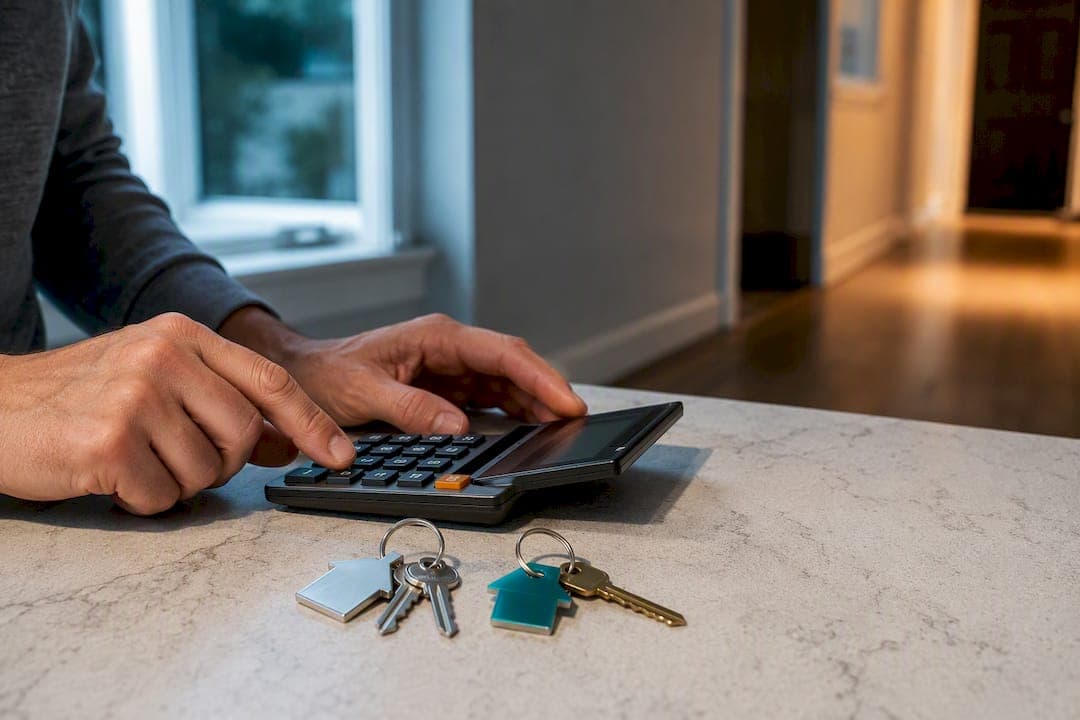
If your rent covers every cost and you can sell within the Section 121 window, renting usually builds more after-tax wealth. If you need cash now, face negative cash flow, or would lose that tax exclusion by holding too long, selling almost always wins. The right call comes down to three factors: cash flow, your locked-in mortgage rate, and the timing of your capital gains exclusion.
TL;DR:
- Renting is usually better if your property generates positive cash flow, a low mortgage rate, and manageable property management costs.
- Selling makes more sense if you need immediate cash, face monthly losses, or risk losing the Section 121 tax exclusion by holding too long.
- Small changes in vacancy rates, appreciation, or rent can flip the rent versus sell decision, emphasizing the importance of conservative assumptions and tax considerations.
- Tax rules like the Section 121 exclusion and depreciation recapture can significantly impact profitability, so tracking move-out dates and depreciation records is crucial.
- A fast cash sale may be the best option for owners facing foreclosure, long repair lists, inherited properties, or tight timelines, bypassing lengthy sale or rental calculations.
Table of Contents
- Rent vs Sell Checklist: Quick Ways to Tell Which Fits You
- How to Build a 5-Year Rent-vs-Sell Model
- The Tax Rules That Can Flip Your Rent vs Sell Decision
- What Landlords Underestimate About Cash Flow
- Two Real-World Scenarios: Rent vs Sell Side by Side
- When a Fast Cash Sale Makes More Sense Than Either Option
- Why the "Just Run the Numbers" Advice Misses the Point
- Get a Cash Offer If Selling Is Your Answer
- Where to Verify These Numbers Yourself
- Sources
- FAQ
Rent vs Sell Checklist: Quick Ways to Tell Which Fits You
You don't need a spreadsheet to get a first read on this. A handful of honest questions about your mortgage, your cash flow, and your timeline usually points you in the right direction before you ever open a calculator.
Renting tends to make sense when most of these are true:
- Positive cash flow already. Rent covers the mortgage, taxes, insurance, and a maintenance reserve with room left over.
- A mortgage rate well below today's market. If you locked in a rate in 2020 or 2021, that loan is a financial asset worth protecting, not just a bill to pay off.
- You can manage the property or afford someone who will. That means either the time and temperament to deal with tenants, or the budget for a property manager.
Selling tends to make sense when most of these apply instead:
- You need a lump sum now. A new down payment, debt payoff, or major life expense that renting can't fund fast enough.
- The numbers run negative every month. If rent doesn't cover PITI plus a realistic maintenance and vacancy allowance, you're subsidizing a tenant's housing out of your own pocket.
- You'd blow past the Section 121 deadline. Holding the property past roughly three years after moving out usually means forfeiting a tax exclusion worth tens of thousands of dollars.
There's a middle path, too. Some owners rent for a year or two, collect some cash flow and appreciation, then sell before the IRS Topic No. 701 lookback period closes. It's a reasonable hybrid, but it requires marking a hard deadline on the calendar and sticking to it. Miss that window by even a few months, and you can lose the entire exclusion.
How to Build a 5-Year Rent-vs-Sell Model
A fair comparison never pits rent against your mortgage payment alone. It weighs total after-tax wealth from renting against total after-tax wealth from selling and reinvesting, over the same stretch of years. That's the approach behind most credible rent vs sell calculators, and it's the only version worth trusting.
Before you touch a calculator, gather these ten inputs:
- Estimated monthly rent for your property in its current condition
- Vacancy rate (realistic range: 3% to 8% annually)
- Full PITI: principal, interest, property tax, and insurance
- Routine maintenance budget (a percentage of rent or property value)
- Capital expenditure reserve for roof, HVAC, and major systems
- Property management fee if you won't self-manage (typically 8% to 12% of rent)
- Expected annual appreciation rate for your local market
- Selling costs if you sold today (agent commissions, closing costs, repairs)
- Your holding period, usually modeled at three, five, or seven years
- Expected return if you invested net sale proceeds elsewhere
Once you have those, the model runs in two parallel tracks. For the "rent" path, add up annual net rental cash flow (rent minus vacancy, PITI, maintenance, and management fees) across your holding period, then add mortgage principal paydown and projected appreciation. At the end of year five, subtract selling costs and any taxes owed on sale to land on total net wealth.
For the "sell" path, calculate net proceeds from selling today, then compound that amount at your expected investment return for the same five years. Whichever number is higher at the end of the period is your financial answer, assuming your assumptions hold.
Here's the catch: small changes in a couple of inputs can flip the outcome entirely. Bump your vacancy assumption from 5% to 8%, or trim expected appreciation by a single point, and a rental that looked like the clear winner can suddenly lose to selling. Run your model twice, once with conservative assumptions and once with optimistic ones, and see if the winner changes. If it does, you're closer to a coin flip than you think.
One more wrinkle: most calculators handle the Section 121 exclusion and depreciation recapture differently, or skip them entirely. A model that ignores taxes on sale after depreciation will systematically overstate how attractive renting looks. Always check whether the tool you're using accounts for both before trusting its verdict.
The Tax Rules That Can Flip Your Rent vs Sell Decision
Taxes are where a lot of these calculations quietly go wrong. Two rules in particular can swing the entire outcome, and both catch homeowners off guard because they don't come due until the property is sold.
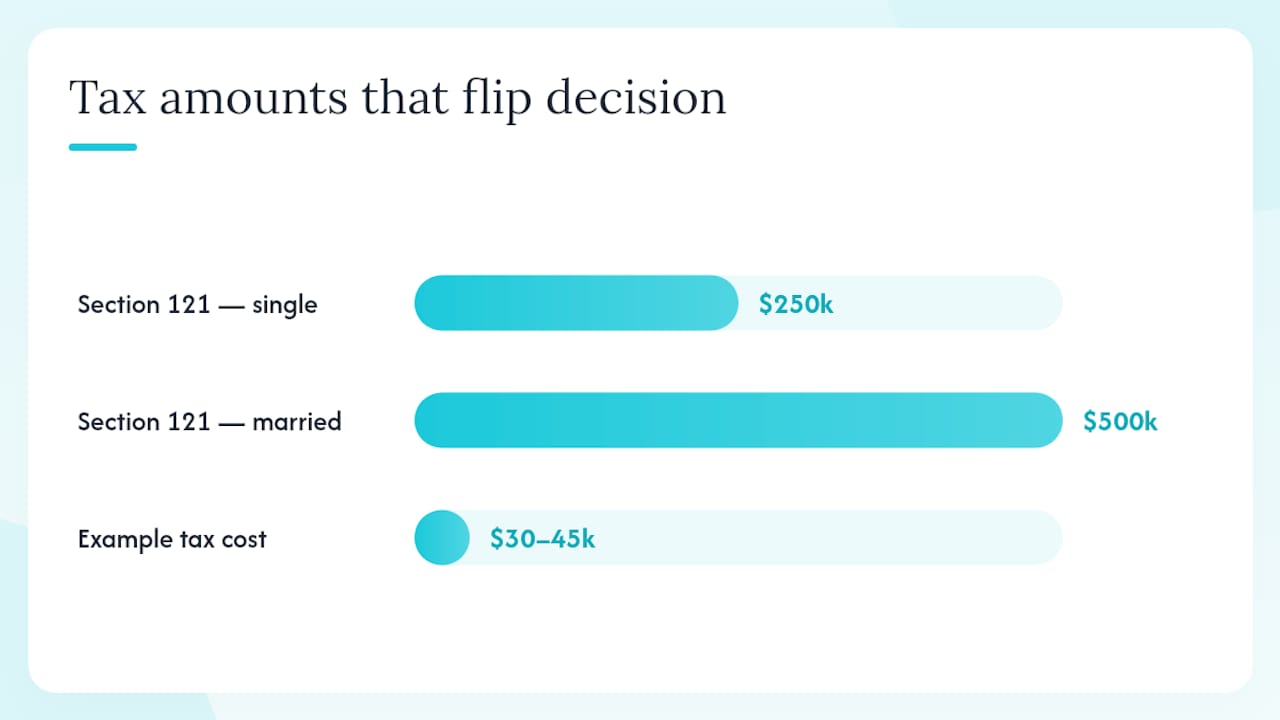
The first is the Section 121 exclusion. If you've lived in the home as your primary residence for two of the last five years, you can exclude up to $250,000 of capital gains from taxation, or $500,000 if you're married filing jointly, according to IRS Topic No. 701. Once you move out and start renting, that five-year lookback clock keeps running. In practice, that gives you a window of roughly three years after moving out to sell and still qualify for the exclusion in full.
The second is depreciation recapture. While you rent the property, you deduct depreciation against your taxable rental income, which lowers your tax bill year to year. When you eventually sell, the IRS claws that benefit back as unrecaptured Section 1250 gain, taxed at a rate up to 25%. Owners frequently forget this is coming because it never shows up as an expense while they're collecting rent.
Here's a simplified version of how much this matters. Say you'd net $150,000 in gain on a home sold today, fully covered by the Section 121 exclusion, so you owe nothing. Rent the property for four years instead, and if you sell just outside the three-year window, that same $150,000 gain could face capital gains tax plus recapture on any depreciation claimed, potentially costing you $30,000 to $45,000 depending on your bracket and state. That single tax difference can erase several years of rental cash flow.
- Track your move-out date and calendar the three-year mark immediately.
- Keep depreciation records from day one of renting; your accountant will need them at sale.
- Factor state income tax rules into the math, since they vary widely and some states tax capital gains differently than the federal government does.
This is not a place for guesswork. A tax professional or CPA who specializes in real estate can model your specific exclusion timeline and recapture exposure before you commit to renting long-term.
What Landlords Underestimate About Cash Flow
Most owners run their first rent vs sell comparison using gross rent as if it were profit. It never is. The real number that matters is what's left after every recurring cost, and that number is almost always lower than homeowners expect going in.
Your monthly and annual expense list should include vacancy allowance, routine maintenance, a capital expenditure reserve, landlord insurance, property taxes, HOA dues if applicable, and property management fees if you're not self-managing. Skip any one of these and your projected cash flow is fiction.
Beyond the predictable costs, a few surprises tend to blindside first-time landlords:
- Turnover costs between tenants. Cleaning, repainting, re-listing, and lost rent during the vacancy add up fast, often equal to a full month's rent or more.
- Emergency repairs that can't wait. A failed water heater or HVAC system in July doesn't care about your budget timeline.
- Legal and eviction costs. A single contested eviction can run into thousands of dollars in court fees and lost rent, and timelines vary significantly by state.
A few quick filters help you sanity-check whether a property makes sense as a rental at all. The 1% rule, monthly rent should equal roughly 1% of the purchase price, is a rough screen more relevant to investors buying new properties than to homeowners converting an existing one, but it's still a useful gut check. A healthy single-family rental typically targets a cap rate in the 5% to 8% range, and management fees usually run 8% to 12% of collected rent if you hire it out.
Pro Tip: If your honest cash-flow projection comes out negative or barely breakeven before you've even budgeted for vacancy or a capital reserve, that's usually a sign to sell rather than rent. Hoping appreciation bails you out is not a plan.
Two Real-World Scenarios: Rent vs Sell Side by Side
Numbers settle arguments better than opinions do. Here are two compact five-year comparisons, one where renting comes out ahead and one where selling clearly wins, using the same modeling approach outlined earlier.
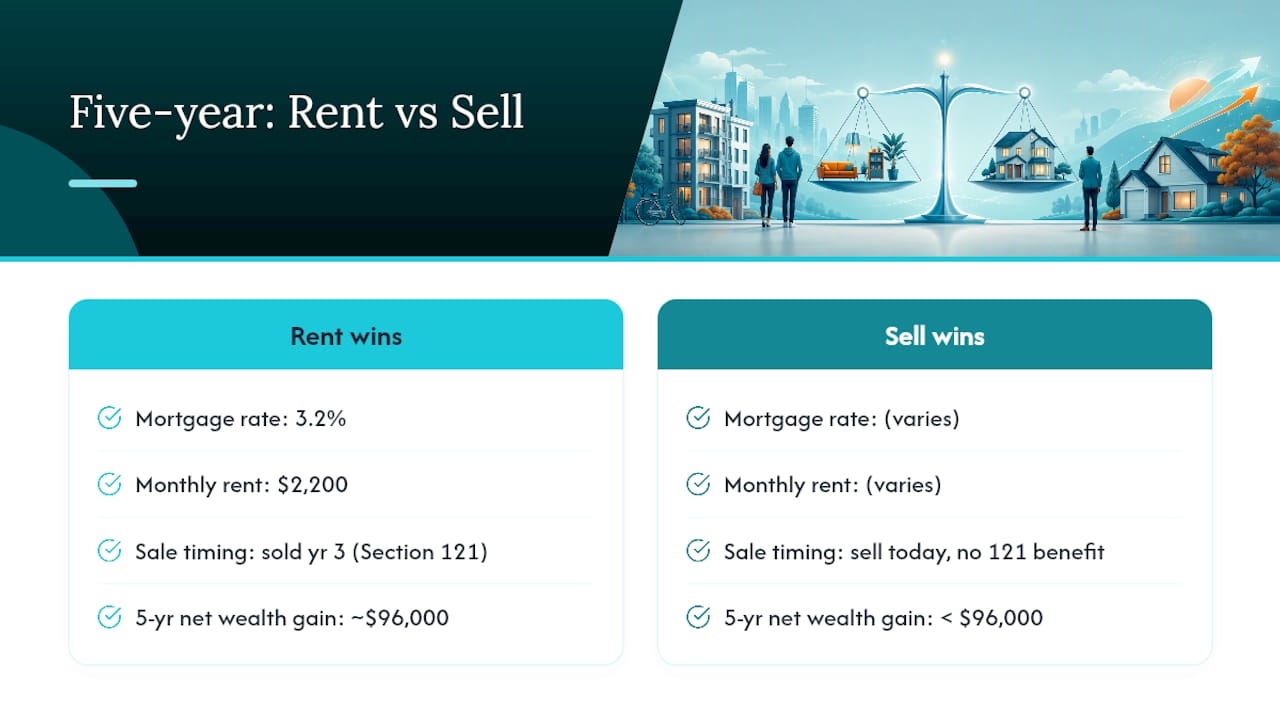
Scenario A: The low-rate rental that pays for itself. A homeowner locked a 3.2% mortgage rate in 2021 and now rents the property for $2,200 a month. Because the owner sells within the Section 121 window at year three of renting, the full gain stays tax-free. Total five-year net wealth gain: roughly $96,000, notably higher than selling today and investing the proceeds at a comparable return.
After realistic vacancy and a capital reserve, monthly cash flow runs negative $150. Over five years that's a cumulative loss of roughly $9,000, even before factoring in one likely major repair.
The gap between these two owners comes down to exactly three levers: mortgage rate, real monthly cash flow, and whether the Section 121 clock has run out. Change any one of them, push Scenario A's vacancy rate to 10% or Scenario B's rent up by $300, and the winner can flip. That's why rerunning your own numbers with your actual rate and rent matters more than trusting a generic example.
When a Fast Cash Sale Makes More Sense Than Either Option
Sometimes the honest answer isn't rent or a traditional listing. It's neither. Homeowners facing foreclosure, a property with a repair list too long to finance, an inherited house nobody in the family wants to manage, or a job relocation with a tight timeline often can't afford to wait out a five-year model or a six-month listing process.
There are services that buy homes, condos, duplexes, and inherited properties in as-is condition for cash, with no repairs, no cleaning, and no owner-paid closing costs. Some sellers close very quickly, sometimes in under a week.
If you're in this position, the practical next steps are simple: gather your mortgage payoff statement, any title or estate documents if the property was inherited, and a rough idea of your timeline. A fast, no-repair sale removes the entire rent vs sell calculation from the table when speed and certainty matter more than maximizing every last dollar.
Why the "Just Run the Numbers" Advice Misses the Point
The calculator-led approach in this article is the right way to think about rent vs sell, but most guides stop at the spreadsheet and never mention where that spreadsheet breaks down. Every projection is only as good as its vacancy assumption and its appreciation guess, and both are educated guesses dressed up as inputs. Treat any five-year number as a range, not a fact.
Where conventional advice really falls short is the tax section. Plenty of homeowners run a full cash-flow model, feel good about the rental math, and never check their Section 121 clock until it's already expired. That single oversight can cost more than a year of positive cash flow ever earned them.
If you take one thing from this, prioritize the calendar before the cash flow. Know your exact move-out date, mark the three-year mark, and decide your exit timeline before you sign a lease with a tenant. For owners who run the numbers honestly and land on "sell," a direct cash sale is often the cleanest way to lock in that outcome without gambling another five years on assumptions that might not hold.
— Daniel
Get a Cash Offer If Selling Is Your Answer
If your rent-vs-sell math points to selling, a direct home buying service can help you avoid the months a traditional listing demands. There is often no agent commission, no owner-paid closing costs, and no repair list to tackle before anyone will make an offer, unlike a standard sale where you're footing renovation costs before you see a dime.

The process starts with a quick property walkthrough, followed by a no-obligation cash offer, usually within 24 hours. From there, you pick the closing date, and some sellers close in as little as five days. Before reaching out, pull together your mortgage payoff amount, any liens on the property, and estate paperwork if you inherited the home. To see how the buying process works and what to expect at each stage, or to get your offer started, visit the Sell Your House For Cash page and submit your property details.
Where to Verify These Numbers Yourself
For the tax mechanics behind Section 121 and the home-sale exclusion, IRS Topic No. 701 is the primary source. For running your own projections, the NARPM rent vs sell calculator walks through the same inputs covered above. Because tax exposure and local rental demand vary by state and market, confirm your specific numbers with a CPA and a local property manager before making a final call.
Sources
- Rent vs Sell Calculator: Should You Rent or Sell Your Property? (NARPM)
- IRS Topic No. 701 Sale of Your Home
- Renting vs. Selling Your Home: The 2026 Decision Framework (RealCostIQ)
FAQ
Is It Better to Keep a Rental or Sell It?
It depends on whether your cash flow is positive, your mortgage rate is low, and you're still inside your Section 121 window. If all three line up, keeping the rental often builds more after-tax wealth; if any one fails, selling usually comes out ahead.
How Long Do I Have to Sell After Moving Out to Keep My Tax Exclusion?
You generally have about three years after moving out to sell and still qualify for the Section 121 exclusion, since it requires living in the home two of the last five years before the sale date.