
Yes, you can sell a house with tenants in it, and the lease usually survives the sale intact. The buyer steps into your shoes as landlord, inheriting the lease terms and the obligations that come with them. Your options depend heavily on whether tenants have a fixed-term lease or a month-to-month arrangement. If you need speed or want to avoid tenant friction altogether, negotiating an early move-out or selling to a cash buyer are the two most common workarounds.
TL;DR:
- Selling a property with tenants in place can reduce the buyer pool to mainly investors unless the lease is short-term or rent is at market rate.
- Fixed-term leases transfer the remaining lease terms to the new owner, limiting your ability to evict early unless specific clauses allow it or the tenant agrees.
- Proper legal notice, documentation, and respectful communication are essential to minimize tenant-landlord conflicts during showings and the sale process.
- Gathering investor-specific documents or providing clear vacancy timelines is crucial based on whether you target investors or owner-occupants.
- Using buying programs like Dan Buys Houses offers a quick, no-hassle alternative for selling occupied properties, especially under tight timelines or difficult tenant situations.
Table of Contents
- Should You Sell a Rental Property With Tenants in Place?
- How Lease Type and Tenant Rights Control Your Options
- Notice, Showings, and Respecting Tenant Rights During the Sale
- Marketing a Tenant-Occupied Property: Investors vs. Owner-Occupants
- Practical Options to Get the Property Vacant
- Closing Logistics When Tenants Occupy the Property
- Tax and Financial Considerations Before You Sell
- Quick Seller Checklist: What to Do and When
- How Dan Buys Houses Handles Tenant-Occupied Sales
- When a Fast Cash Sale Makes More Sense Than Listing
- Sources
Should You Sell a Rental Property With Tenants in Place?
Selling occupied comes down to a tradeoff between speed and price, and the right call depends on your tenant, your lease, and your market.
An occupied property markets well to investors looking for immediate cash flow. There's no vacancy gap, no re-leasing costs, and the numbers are already proven on paper. Investor buyers often move faster too, since they're not waiting on financing tied to owner-occupancy or worrying about move-in dates.
The tradeoff is a smaller buyer pool. Owner-occupants, who typically make up the bulk of retail buyers and often pay the highest prices, are largely out of the running unless you can deliver vacant possession. Showings get harder to schedule around a tenant's life, and if the rent is below market, investors will price that gap into their offer.
Selling occupied works best when:
- The tenant pays reliably and keeps the property in good condition
- Rent is at or near market rate, so an investor's numbers pencil out cleanly
- The lease has enough term left to make the property attractive as a turnkey income stream, a positioning that can shorten time on market even with a narrower buyer pool
A flaky tenant or a lease that's about to expire tilts the math toward pursuing vacancy first.
How Lease Type and Tenant Rights Control Your Options
Your lease document is the single biggest factor in what you can and can't do, and it's worth rereading before you list anything.
With a fixed-term lease, the buyer inherits the full remaining term. You can't force the tenant out early just because ownership is changing hands, unless the lease itself contains a sale clause or the tenant agrees voluntarily. This is the arrangement that most limits your flexibility, but it also gives buyers the most predictable cash flow, which some investors specifically want.
With a month-to-month tenancy, you have more room to maneuver. Most states let a landlord end the arrangement with proper written notice, typically 30 to 60 days depending on the state. The catch is that the delivery method matters as much as the timeline. Some states require certified mail, others allow hand delivery with a witness, and getting the format wrong can invalidate the entire notice and cost you weeks.
A few legal wrinkles deserve attention before you assume you know your options:
- Just-cause eviction ordinances. A growing number of cities and some states restrict ending a tenancy even with proper notice unless you meet specific criteria, sale of the property is one common exception, but the rules vary widely.
- Rent control jurisdictions. These can cap what a new owner can charge and layer on additional notice or relocation-payment requirements that standard landlord-tenant law doesn't require.
- Foreclosure-related protections. If the sale stems from foreclosure, federal protections under the Protecting Tenants at Foreclosure Act framework generally require honoring the existing lease term, with limited exceptions.
Check your state and municipal rules before setting a timeline. A rental agreement's specific clauses around assignment, early termination, and sale notification can also open or close doors you didn't know existed.
Notice, Showings, and Respecting Tenant Rights During the Sale
Showings are where most tenant-landlord relationships sour during a sale, and it's almost always preventable with better communication.
Most states require 24 to 48 hours' written notice before entering an occupied unit, even for a scheduled showing. Verbal notice might feel easier in the moment, but it leaves you with nothing to point to if a dispute arises later. Put every notice in writing, text message, email, or a formal notice form, and keep a copy.
Here's a sequence that keeps showings moving without provoking a fight:
- Tell the tenant in writing, as soon as you decide to list, that the property is going on the market.
- Propose a batching schedule, one or two defined windows per week, rather than random one-off requests.
- Confirm each showing at least 24 to 48 hours ahead, per your state's minimum.
- Offer a small goodwill gesture, a cleaning service or a gift card, in exchange for flexibility on scheduling.
- Document every notice and every showing date in a simple log.
Pro Tip: Send a single written "showing plan" at the start of the listing period covering expected frequency, standard notice windows, and how you'll confirm appointments. Tenants cooperate more when they know what to expect instead of getting surprise texts every few days.
Interfering with a tenant's quiet enjoyment, showing up unannounced, scheduling excessive showings, or pressuring a tenant to be absent, can expose you to liability regardless of how close you are to closing. Early, transparent communication consistently comes up as the difference between a smooth sale and a legal headache.
Marketing a Tenant-Occupied Property: Investors vs. Owner-Occupants
Your marketing approach should match your buyer target, and trying to appeal to both at once usually satisfies neither.
If you're targeting investors, assemble a documentation package before you list:
- A current rent roll showing what each unit or the property collects monthly
- A copy of the active lease, including any addenda or side agreements
- A rent ledger showing payment history, ideally 12 months or more
- Repair and maintenance records, since investors underwrite on real numbers, not projections
Buyers move faster and negotiate less when the numbers are documented rather than estimated.
If you're targeting owner-occupants, you need a different pitch entirely: a clear vacancy timeline. Spell out when the lease ends or when you expect to negotiate an early move-out, and be upfront that financing timelines for owner-occupied purchases often require a firm possession date.
Pricing follows the buyer type. Investors pay for yield, they're calculating cap rate and cash-on-cash return, not admiring the kitchen. Owner-occupants pay for possession and the ability to move in on their own terms. A property priced for one audience often looks wrong to the other, which is why knowing your buyer before you set your number matters more than most sellers realize.
Practical Options to Get the Property Vacant
If you've decided vacant possession is worth pursuing, three tactics come up again and again, each with its own paperwork and risk profile.
- Cash-for-keys. You pay the tenant a lump sum in exchange for a voluntary early move-out. Typical offers range from one to three months' rent, depending on remaining lease term and local rental conditions. Always put the agreement in writing, including the move-out date, the payment amount, and the condition the unit must be left in, and pay only after keys are returned and you've confirmed the unit's condition.
- Early-termination agreements. These formalize a mutual decision to end the lease ahead of schedule. Key clauses to nail down: the exact move-out date, how the security deposit will be handled (returned, applied to damages, or partially forfeited), and a walkthrough condition standard both parties agree to upfront.
- Selling directly to the tenant. If your tenant has expressed interest in owning, this can skip marketing entirely. You'll want a market-based valuation, ideally from an independent appraisal, and a realistic timeline for the tenant to secure financing.
Pro Tip: A verbal cash-for-keys promise is worth nothing in a dispute. Get signatures on a one-page agreement before any money changes hands, and note that payment is contingent on keys being returned and the unit passing a walkthrough.
Closing Logistics When Tenants Occupy the Property
Buyers of occupied property lean on a specific set of documents to protect themselves, and missing one can stall your closing by weeks.
The tenant estoppel certificate is the centerpiece. It's a signed statement from the tenant confirming the rent amount, lease expiration date, deposit held, and whether any side agreements exist outside the written lease. Buyers request this because it protects them from undisclosed arrangements, a verbal rent reduction you never wrote down, for example, that could surface after closing.

The security deposit needs careful handling at closing. In most states, the deposit transfers to the buyer along with a written notice to the tenant identifying who now holds it and confirming the amount. Skipping this notice, or failing to properly account for any deductions, can leave you on the hook even after you no longer own the property.
Beyond the estoppel and deposit accounting, hand the buyer a complete tenant packet: the signed lease, the rent ledger, repair receipts, and all keys and access devices. This anticipates the questions a buyer's attorney or lender will ask and keeps underwriting moving instead of stalling on document requests.
Tax and Financial Considerations Before You Sell
Selling an investment property triggers tax consequences that a primary-residence sale doesn't, so this is the point to loop in a CPA rather than guess.
Capital gains tax applies to the profit on sale, and depreciation recapture adds another layer, the depreciation you claimed over the years gets taxed separately when you sell. These calculations depend on your basis, holding period, and income bracket, which is exactly why a blanket answer online won't serve you as well as an accountant who can run your actual numbers.
Cash-for-keys payments and other concessions to tenants come straight out of your net proceeds, so factor them into your bottom line before you counter an offer. On the recordkeeping side, a clean rent roll and organized expense history don't just speed up a sale, they also support your tax filings and give you a paper trail if questions come up later.
Quick Seller Checklist: What to Do and When
Getting the order right matters almost as much as getting each step right.
- Pull your lease and check local law first. Confirm lease type, remaining term, and any notice or rent-control rules specific to your city or state.
- Notify your tenant in writing that you plan to sell, before you list, not after a showing request catches them off guard.
- Assemble your rent ledger and lease copies so you're ready the moment a buyer asks.
- Decide your buyer target. Investor-ready documents if you're staying occupied, or a vacancy plan if you're pursuing an owner-occupant sale.
- Prepare your estoppel certificate template, document your deposit-transfer plan, and have a cash-for-keys agreement ready in case negotiations move toward early vacancy.
Working through this list before your first showing saves you from scrambling once an offer lands and a closing date starts the clock.
How Dan Buys Houses Handles Tenant-Occupied Sales
Selling occupied property the traditional way asks a lot of a landlord: coordinating showings around a tenant's schedule, assembling investor-grade documentation, and hoping the right buyer shows up before the lease situation changes. Dan Buys Houses buys properties as-is, tenants included, which removes most of that operational load. There's no staging, no showings to coordinate, and no waiting on a buyer's financing to clear.
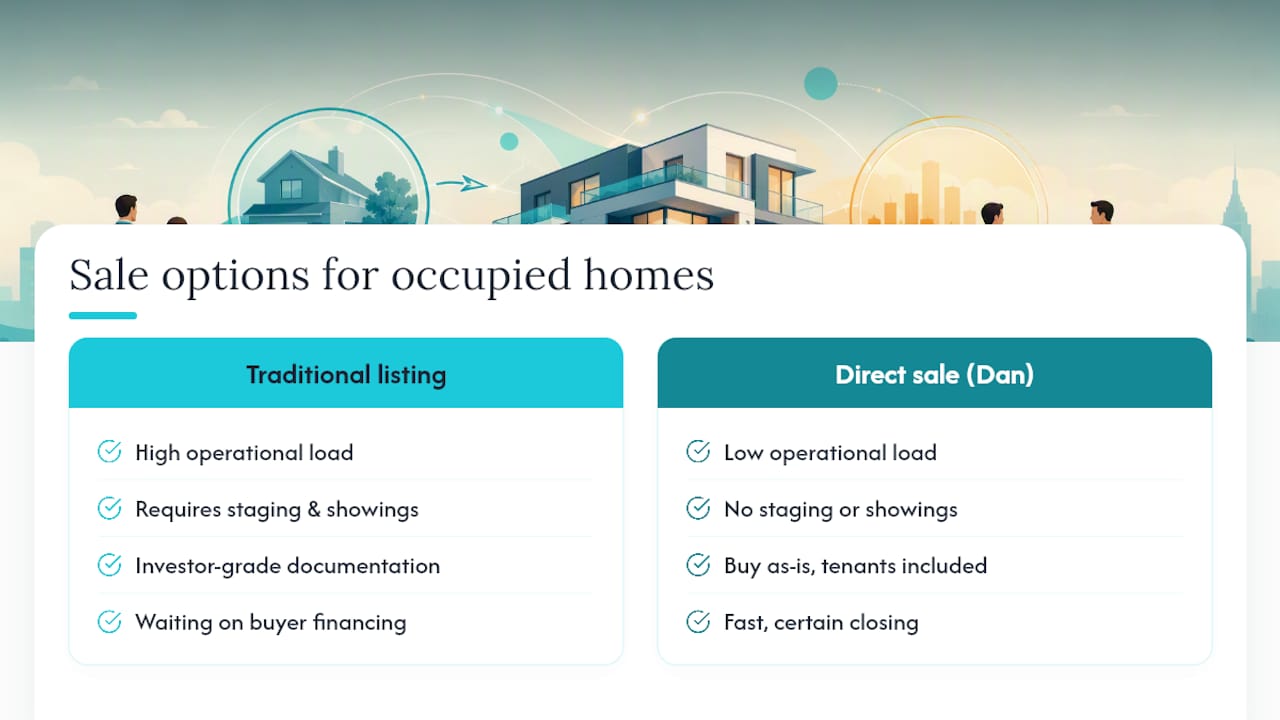
The tradeoff is straightforward and worth stating plainly: a direct sale trades some of the upside you might get from a competitive, owner-occupant-driven listing for speed and certainty. If your tenant situation is stable and your timeline is flexible, the open market can net you more. If you're dealing with a difficult tenant, mounting repairs, or a deadline you can't move, the calculus shifts.
For landlords weighing that tradeoff, it helps to see how the process actually works before deciding either way.
— Daniel
When a Fast Cash Sale Makes More Sense Than Listing
If your tenant situation is complicated, non-paying, uncooperative, or mid-dispute, or your timeline is tight because of foreclosure, an inherited property, or a relocation deadline, the traditional listing path often adds stress without adding proportional value. Dan Buys Houses purchases occupied properties directly in Northwest Indiana, in as-is condition, without requiring repairs, cleanouts, or staged showings around a tenant's schedule.

The tradeoff is transparent: a direct cash offer typically comes in below top-of-market retail pricing, but it removes financing contingencies, agent commissions, and the weeks of showings and negotiation that come with listing occupied. Some sellers report closing in as little as five days once terms are agreed. If you're weighing that tradeoff, the process for selling as-is walks through what to expect. To request an offer, have your lease, rent ledger, and a rough idea of your desired closing timeline ready. From there, Dan Buys Houses' process can give you a clear, no-cost cash offer without listing the property or coordinating a single showing.
Sources
For deeper legal detail on your specific state's landlord-tenant statutes, start with your state's official landlord-tenant law page or a law-school-hosted legal resource, since these outline notice periods and just-cause requirements that vary by jurisdiction. For practical selling guidance, HomeLight, Redfin, Nolo, and LegalClarity each cover different pieces of the process in more depth. Estoppel certificate and cash-for-keys agreement templates are widely available through reputable legal-document services if you need a starting draft.
- Can I Sell My Rental Property With Tenants in It? - HomeLight
- Selling a rental property with tenants - Redfin
- I'm a Landlord Selling a House: How Do I Handle Renters Living in It? - Nolo