
A home buyout company is a business that purchases homes directly from sellers for cash, typically buying properties in any condition and closing far faster than a traditional sale. These companies, also called direct cash buyers or investor buyers, skip the open houses, agent commissions, and repair demands that define conventional real estate transactions. Sellers facing foreclosure, sudden relocation, or an inherited property they cannot maintain are the clearest fit for this model. Dan buys houses operates exactly this way in Northwest Indiana, offering cash offers with closings reported in as little as five days.
What is a home buyout company and how does it work?
A home buyout company buys your property directly, paying cash without requiring you to list it on the open market. The industry term for this category is "direct cash buyer," and it covers both individual investors and organized companies that maintain capital reserves to close quickly. Unlike a traditional sale, there is no waiting for a buyer's mortgage approval, no staging, and no negotiating over a leaky faucet. The company makes an offer, you accept or decline, and the deal moves to closing on a timeline that works for you.
The as-is purchase model is the defining feature. Home buyout companies purchase properties in the condition they are in, relieving sellers of preparation work entirely. That means no repairs, no cleaning, and no contractor quotes before you can sell. For a seller dealing with a distressed property or a tight deadline, that single feature removes weeks of stress.

How does the home buyout process work?
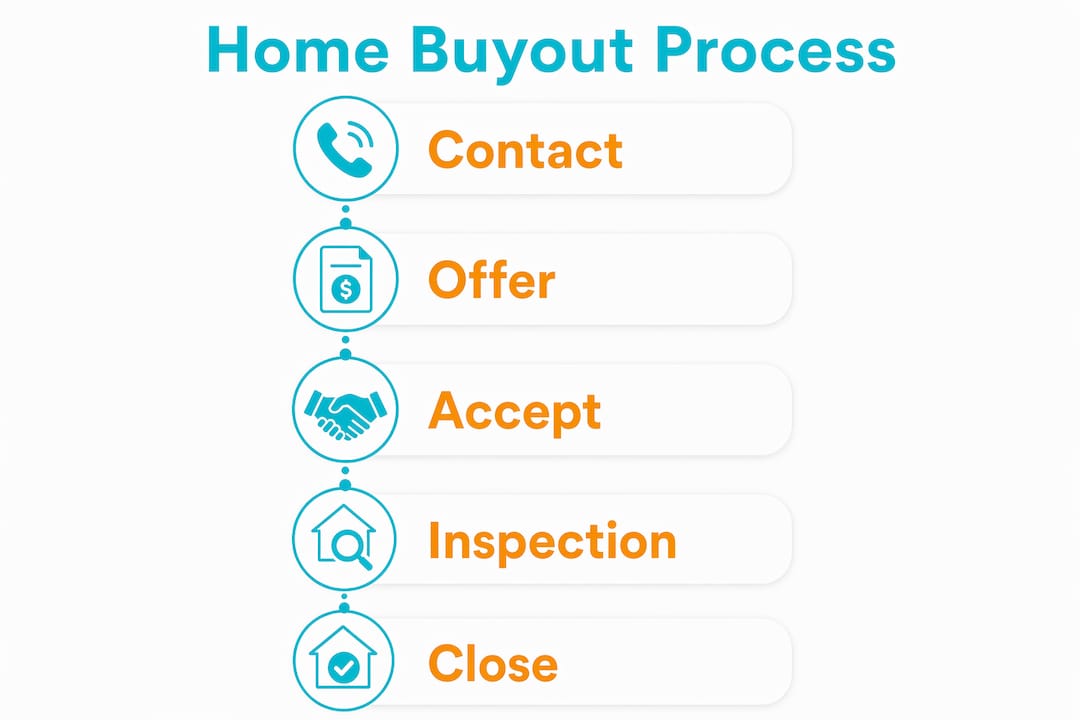
The home buyout process follows a straightforward sequence from first contact to funded closing.
- Initial inquiry. You contact the company and share basic details about your property, including location, size, and condition.
- Property evaluation. The company reviews your home, either through a brief walkthrough or a remote assessment using public records and photos.
- Cash offer. You receive a written offer, usually within 24–48 hours of the evaluation.
- Offer review and acceptance. You review the offer, ask questions about fees and closing costs, and sign if you agree.
- Title and paperwork. The company coordinates title search, escrow, and all closing documents. You do not need to hire a real estate attorney, though you may choose to.
- Closing and payment. Funds transfer on the agreed date. Traditional home sales take about 42 days to close, while home buyout companies often finalize sales in as little as 5 to 21 days. That difference matters enormously when a foreclosure deadline or a job start date is fixed on the calendar.
Pro Tip: Always request written proof of funds before signing any contract. Some independent cash buyers lack proof of funds, causing last-minute deal failures that leave sellers scrambling.
What are the benefits and risks of selling to a home buyout company?
The benefits of home buyout sales are real, but so are the trade-offs. Understanding both sides protects your financial outcome.
Core advantages
- Speed. Closing in 5–21 days versus the 42-day average for traditional sales gives sellers a concrete timeline they can plan around.
- No agent commissions. Traditional agent sales carry a 5–6% commission. Eliminating that fee can offset some of the price difference in a cash sale.
- As-is condition. You sell the property exactly as it stands. No repairs, no staging, no open houses.
- Flexible closing dates. Most home buyout companies let you choose a closing date that fits your schedule, including delayed closings if you need time to move.
- Certainty. Cash offers do not fall through because a lender denied a mortgage. The deal is as firm as the buyer's capital.
Key risks to understand
Home buyouts benefit sellers prioritizing speed and convenience over maximizing profit, but that trade-off is real and measurable. Fast cash offers typically come with a lower purchase price than what the open market would produce. Assessing net proceeds requires looking beyond the offer price to include fees, repair estimates, and closing costs. A headline offer that looks attractive can shrink considerably once service fees and closing charges are factored in.
Financial analysts warn sellers to read contracts carefully, as some fees may be hidden even when commissions are advertised as zero. That is not a reason to avoid home buyout companies. It is a reason to ask for a full fee disclosure in writing before signing anything.
How do home buyout companies compare to traditional sales and iBuyers?
Three main paths exist for sellers who want to exit a property: traditional agent sales, iBuyers, and home buyout companies. Each serves a different priority.
iBuyers use technology and data algorithms to generate instant offers but exclude certain types of homes, particularly distressed or unusual properties. Home buyout companies often specialize in purchasing more diverse or distressed properties at deeper discounts. That distinction matters if your home needs significant work or sits outside the price range iBuyer platforms prefer.
| Method | Typical timeline | Fee structure | Property condition accepted |
|---|---|---|---|
| Traditional agent sale | 42+ days | 5–6% commission | Move-in ready preferred |
| iBuyer platform | 7–14 days | 7–18% in service and repair fees | Good condition, limited property types |
| Home buyout company | 5–21 days | Varies; often no commission | Any condition, including distressed |
iBuyers typically charge service and repair fees between 7% and 18% of the home's value. That is notably higher than the 5–6% commission in traditional agent sales. The speed advantage of an iBuyer comes at a real cost. Home buyout companies often charge no commission at all, though their offer prices reflect the condition and risk they are absorbing.
iBuyers offer on average about 11% less than traditional market sale prices. Home buyout companies serving distressed properties may offer a larger discount, though the exact gap depends on local market conditions and property state. Sellers who prioritize maximum sale price should pursue a traditional listing. Sellers who prioritize speed, certainty, or condition flexibility will find home buyout companies and iBuyers more practical, with home buyout companies holding the edge for distressed or time-sensitive situations.
What should sellers consider before choosing a home buyout company?
Choosing the right buyer protects both your timeline and your net proceeds. Several factors separate a reliable home buyout company from one that will waste your time or cost you money.
- Verify proof of funds. Ask for a bank statement or letter from a financial institution confirming the buyer has capital to close. This single step eliminates most unreliable buyers.
- Request a full fee disclosure. Get every charge in writing: service fees, closing costs, and any repair deductions. Compare the net payout, not just the offer price.
- Check closing date flexibility. Confirm whether the company can close on your preferred date and what happens if the timeline shifts.
- Read the contract for contingencies. Some contracts include inspection contingencies that allow the buyer to reduce the offer after signing. Know what triggers a price change before you commit.
- Gather your documents early. Title deed, mortgage payoff statement, property tax records, and any HOA documents speed up the closing process significantly.
- Consider market timing. A seller's market may produce better open-market offers. A buyer's market or a distressed property often tips the balance toward a direct cash sale.
Pro Tip: Get at least two cash offers before accepting one. Comparing offers from multiple home buyout options gives you a realistic sense of your property's cash value and negotiating room.
Sellers dealing with inherited properties face an additional layer of complexity. Estate paperwork, probate timelines, and shared ownership among heirs can delay any sale. A home buyout company experienced with estate sales can navigate those requirements faster than a traditional listing. The ways to sell an estate home quickly vary, but direct cash buyers consistently rank among the fastest options when probate is already resolved.
Key Takeaways
A home buyout company delivers speed and certainty in exchange for a lower sale price, making it the right choice when time, condition, or urgency outweighs the goal of maximizing profit.
| Point | Details |
|---|---|
| Speed advantage is real | Home buyout companies close in 5–21 days versus 42+ days for traditional sales. |
| As-is sales remove prep costs | No repairs, staging, or cleaning required before closing. |
| Net proceeds matter most | Compare offers after all fees and closing costs, not just the headline price. |
| Verify funds before signing | Always request written proof of funds to avoid last-minute deal failures. |
| Best fit for urgent sellers | Foreclosure, relocation, and inherited properties are the clearest use cases. |
My honest read on when a home buyout company makes sense
I have seen sellers agonize over the price difference between a cash offer and a traditional listing, and I understand why. The gap is real. But the calculation changes completely when you factor in carrying costs, repair bills, agent commissions, and the emotional weight of a sale that drags on for months.
The sellers who benefit most from a home buyout company are not the ones leaving money on the table. They are the ones who correctly value their time, their stress tolerance, and their specific deadline. A seller facing foreclosure in 30 days does not have the luxury of waiting for the right retail buyer. A person who inherited a property three states away cannot afford to manage showings and contractor visits remotely for four months.
Where I urge caution is with sellers who have time and a market-ready property. If your home is in good shape and you have 60 days, a traditional listing will almost certainly net you more money. The home buyout model is a tool, not a universal answer.
Due diligence is non-negotiable regardless of which path you choose. Ask for proof of funds. Read every line of the contract. Understand what fees reduce your payout. A legitimate home buyout company will answer every one of those questions without hesitation. If a buyer pushes back on transparency, that is your answer.
— Daniel
Selling your home fast in Northwest Indiana
Sellers in Northwest Indiana who need a fast, fair cash offer have a local option built specifically for that situation.

Dan buys houses purchases homes in any condition across Northwest Indiana, with no repairs required and no agent commissions. The process is direct: you share your property details, receive a cash offer, and choose your closing date. Some sellers close in as little as five days. Whether you are dealing with foreclosure, a relocation deadline, or an inherited property you need to move quickly, Dan buys houses handles the paperwork and coordinates the closing so you can focus on what comes next. Sellers in Hammond can get a fast cash offer and see exactly how the process works from first contact to funded closing.
FAQ
What is a home buyout company in simple terms?
A home buyout company is a business that buys your home directly for cash, usually without requiring repairs, open houses, or agent commissions. The sale closes faster than a traditional listing, often in 5–21 days.
How much less will I get from a home buyout company?
The discount varies by company and property condition. iBuyers, a related category, offer on average about 11% less than traditional market prices. Home buyout companies serving distressed properties may offer a larger discount depending on repair needs and local market conditions.
Are home buyout companies legitimate?
Established home buyout companies with verifiable proof of funds and transparent fee disclosures are legitimate. The risk comes from unverified individual buyers who may lack capital to close. Always confirm proof of funds in writing before signing a contract.
What fees do home buyout companies charge?
Fee structures vary. Many home buyout companies charge no agent commission but may include service fees or closing cost deductions. Reading the contract carefully is the only way to identify all charges before committing to a sale.
Is selling to a home buyout company worth it?
Selling to a home buyout company is worth it when speed, certainty, or property condition makes a traditional listing impractical. Sellers with time and a market-ready home will typically net more through a traditional agent sale.