
Yes, you can sell a house with code violations in nearly every U.S. state, and buyers do it every year. The catch is disclosure and title. You must tell buyers what's wrong, and any recorded lien tied to the violation typically has to be resolved before the title transfers clean. Your first move: find out exactly what violations exist by checking your local building department's records and scheduling a pre-listing inspection.
TL;DR:
- A property with code violations can often be sold, but buyers must be informed, and liens related to violations generally need resolution before closing.
- Common violations include unpermitted additions, electrical code breaches, missing egress windows, structural issues, mold, and HVAC failures, which vary in severity and impact.
- Identifying violations involves checking permit history, ordering inspections, running title searches, and collecting documentation to ensure transparency and accurate pricing.
- Disclosing violations is legally mandatory, and unresolved liens can prevent clear title transfer, requiring negotiation with municipal agencies for payoff or extensions.
- Buyers, especially those seeking financing, strongly prefer properties without recorded violations, making repairs or selling as-is key decisions based on costs, timelines, and market conditions.
Table of Contents
- What Counts as a Code Violation That Can Affect a Home Sale?
- How Do You Identify and Document Violations on Your Property?
- What Are Your Legal Obligations When Disclosing Violations?
- How Do Code Violations Affect Financing, Appraisal, and Title?
- Fix It, Credit It, or Sell As-Is: Which Option Actually Fits Your Situation?
- How Do You Estimate Repair Costs and Timeline Before Deciding?
- How Do You Negotiate and Close When Violations Are on the Table?
- How Does Dan Buys Houses Handle Homes With Code Violations?
- What I've Learned Watching These Sales Play Out
- Ready to Get a No-Obligation Offer on Your House?
- Where to Learn More
- Sources
What Counts as a Code Violation That Can Affect a Home Sale?
A code violation is any condition on the property that fails to meet the building, electrical, fire, or safety standards your local jurisdiction has adopted. Most municipalities base their rules on model codes published by the International Code Council, then modify them locally. That's why a garage conversion that's perfectly legal in one county can be a violation two towns over.
Not every violation carries the same weight. Some are paperwork problems. Others are safety hazards that will scare off buyers and lenders alike.
The issues that most often derail a sale include:
- Unpermitted additions or room conversions (finished basements, converted garages, added bedrooms without permits)
- Electrical work that doesn't meet National Electrical Code standards, including overloaded panels or outdated wiring
- Missing or blocked egress windows in bedrooms, especially in finished basements
- Structural problems like foundation cracks, sagging rooflines, or unsupported load-bearing walls
- Significant mold growth tied to moisture intrusion
- Failed or condemned HVAC systems
There's a real distinction between a paperwork gap and a safety hazard. An addition built to code but never officially permitted is usually fixable with a retroactive inspection and fee. A hazard like exposed wiring or a rotted structural beam is a different animal entirely. When enforcement escalates, municipalities often record a formal notice or lien against the property, which shows up in a title search and follows the house, not the owner.
How Do You Identify and Document Violations on Your Property?
You can't disclose what you haven't found, and guessing wrong costs you more than finding out the truth. Here's the sequence that actually works:
- Pull your permit history. Most local building departments now have online portals where you can search past permits, inspections, and any open violation notices tied to your address.
- Order a pre-listing inspection. Ask the inspector to specifically flag anything that looks unpermitted, along with standard safety items like electrical panels, roof condition, and foundation. A pre-listing inspection gives you a paper trail that protects you legally and helps you price the home honestly.
- Run a title search. This surfaces recorded liens tied to code enforcement, unpaid fines, or special assessments that a simple visual walkthrough won't reveal.
- Request payoff figures from the municipality. If a lien exists, call the code enforcement office directly and ask for the exact amount owed and what's required for release.
- Gather your paperwork. Collect permits, contractor receipts, and any remediation records so buyers see you've been transparent, not evasive.
Pro Tip: Call the building department before you call a real estate agent. Getting the actual violation language and case number in hand takes ten minutes and saves you from guessing during negotiations later.
What Are Your Legal Obligations When Disclosing Violations?
Most states require you to disclose known material defects, and that includes code violations and any liens tied to them. Failing to disclose can expose you to lawsuits after closing, and courts have unwound sales entirely when sellers knowingly hid serious problems.
The risk isn't theoretical. Buyers who discover concealed violations after closing can pursue remedies including:
- Rescission of the sale (forcing you to take the house back and return the funds)
- Monetary damages equal to the cost of repairs
- In some states, statutory penalties on top of actual damages
A recorded code enforcement lien is its own separate problem. These liens attach to the property itself and generally must be paid or formally released before title can transfer cleanly. In many municipalities, that lien is recorded as a special assessment that accrues interest the longer it sits unpaid, so the number on the notice today isn't necessarily the number you'll owe at closing.
There's some room to negotiate. Some code enforcement offices will accept a payment plan, reduce a fine for early compliance, or issue a compliance extension tied to a pending sale. It depends entirely on the jurisdiction and the nature of the violation.
Sellers who resolve a recorded lien before listing often net more than sellers who accept a steep as-is discount to avoid dealing with it, simply because clean title attracts more buyers and financing options. Talk to a real estate attorney when you're facing an open lien with an unclear payoff amount, a fine large enough to threaten your equity, or a violation where "grandfathering" (being exempt because the work predates the current code) is in question. That's not a call to make on a guess, and a good disclosure checklist will help you get the language right either way.
How Do Code Violations Affect Financing, Appraisal, and Title?
Violations don't just complicate paperwork. They change who can actually buy your house and how much cash you walk away with.
Government-backed loans are the strictest. FHA, VA, and USDA loans require the property to meet minimum safety standards, and an appraiser flagging exposed wiring, a missing handrail, or a failed roof can stop the loan cold until it's fixed. Conventional loans give a little more flexibility, but a lender's appraiser can still require repairs before funding. Cash buyers are the exception. They can close on a property in whatever condition it's in, violations and all, which is exactly why distressed properties attract investor interest.
Financing problems tend to cluster in predictable ways:
- Appraisers who spot safety hazards can require repairs be completed before the loan closes, sometimes with a follow-up inspection
- Homeowners insurance can be denied or priced far higher on a home with known electrical or structural issues, which then affects the buyer's ability to close
- Title companies routinely refuse to issue a clean policy while a recorded lien sits unresolved, since the lien becomes the new buyer's problem otherwise
- Every dollar owed on an open lien comes straight out of your proceeds at closing, on top of any negotiated price reduction
This is the practical reason your buyer pool shrinks the moment a violation gets discovered mid-transaction. Financed buyers need the house to qualify for the loan. Cash buyers don't.
Fix It, Credit It, or Sell As-Is: Which Option Actually Fits Your Situation?
You have three real paths once you know what's wrong with the house, and picking the right one comes down to time, cash on hand, and how badly the buyer pool would shrink if you left the problem in place.
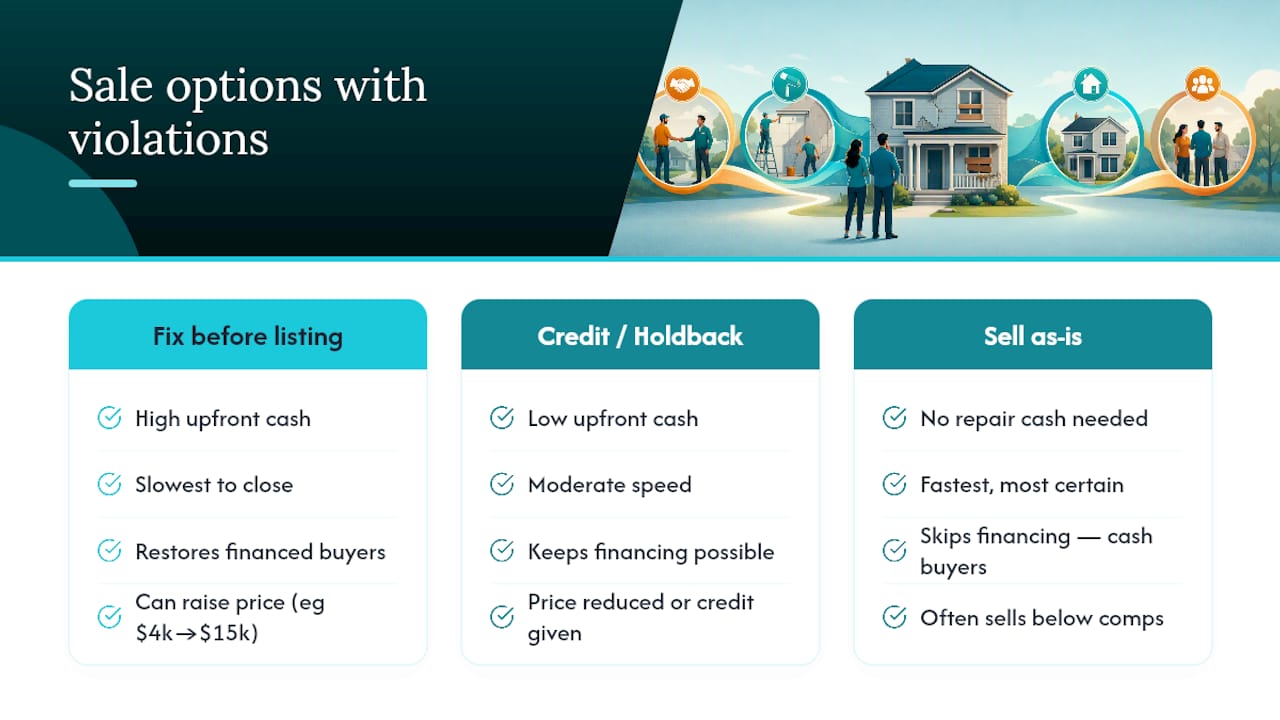
1. Fix it before listing. This makes sense when the repair cost is modest relative to the value it unlocks, and when leaving it unfixed would knock out financed buyers entirely (an electrical panel replacement, for instance, is usually worth doing). It's the slowest option, and it requires cash up front before you see a dime back.
2. Offer a credit, price reduction, or escrow holdback. A repair credit or lower asking price keeps the transaction moving without you managing contractors. An escrow holdback goes a step further: part of the sale proceeds gets held by the title company, and the seller (or buyer, depending on the agreement) completes repairs after closing to release the funds. Escrow holdbacks are a recognized closing tool precisely for situations where repairs are certain but can't realistically happen before the closing date. The catch: they require the lender's signoff, and the release terms (which invoices, which inspections, which permits) need to be spelled out in writing or the closing stalls.
3. Sell as-is to a cash buyer or investor. This is the fastest, most certain path. You skip repairs, inspections tied to financing, and the appraisal contingency entirely. The tradeoff is price. Homes needing major repairs commonly sell significantly below comparable move-in-ready properties, with the exact discount driven by remediation scope, permitting risk, and how strong the resale market is for renovated homes in your area.
The decision rule is simple math: compare what the repair actually costs against how much value it adds to the sale price, then weigh that against how long you can afford to wait. If a $4,000 electrical fix opens the door to FHA buyers and adds $15,000 to your sale price, fix it. If the violation is structural, expensive, and you need to close in three weeks, selling as-is to a cash buyer is the option that actually gets you to a closing table.
How Do You Estimate Repair Costs and Timeline Before Deciding?
Get this part wrong and you'll either overpay for repairs that don't add value, or underprice a sale you didn't need to discount. The fix is a repeatable process, not a gut feeling.
Start by getting two to three contractor bids for every major repair category. Bids vary more than most sellers expect, sometimes by thousands of dollars for the identical scope of work, so a single quote tells you almost nothing. Prioritize whichever fixes unblock financing or insurability first (electrical, structural, egress) since those affect your entire buyer pool, not just your asking price.
Once you have real numbers, the math is straightforward: take your expected as-repaired sale price, subtract repair costs, subtract closing costs, and compare that net figure against what an as-is cash offer would net you today. That single comparison, run on a simple spreadsheet, usually makes the decision obvious.
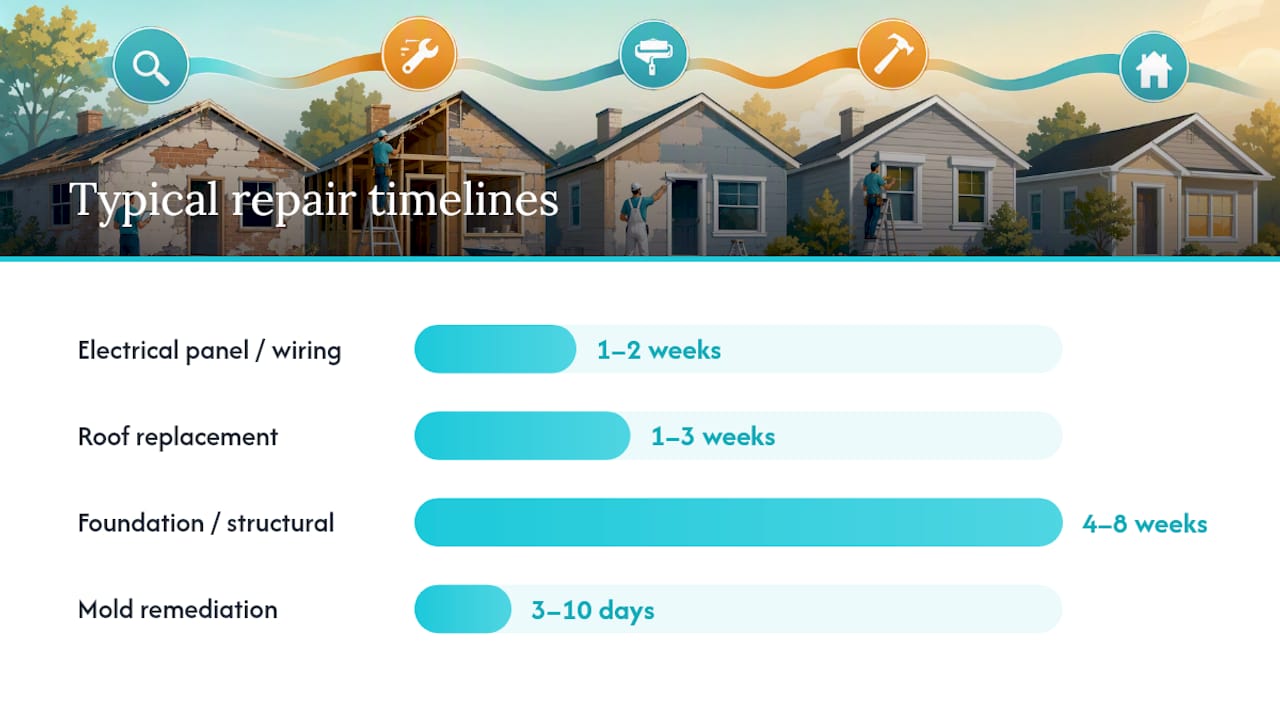
Timelines vary widely by category:
- Electrical panel or wiring repairs: often 1 to 2 weeks
- Roof replacement: 1 to 3 weeks depending on scope and weather
- Foundation or structural work: 4 to 8 weeks, sometimes longer with permitting delays
- Mold remediation: 3 to 10 days for contained cases, longer if it's extensive
Permits get delayed. Inspectors find a second problem once they open a wall. Learn more about selling a home that needs work if repair-versus-sell math is the piece you're still stuck on.
Pro Tip: Get your contractor bids before you set your list price, not after. A price based on guesswork almost always needs correcting mid-negotiation, and that looks worse to buyers than pricing it right the first time.
How Do You Negotiate and Close When Violations Are on the Table?
Once a violation is disclosed, the negotiation becomes about who pays for what and how the paperwork protects both sides.
- Write disclosure language that's specific, not vague. "Sold as-is" doesn't erase your legal duty to disclose known defects in most states. Name the violation, its status (open, cited, in remediation), and any documentation you have.
- If using an escrow holdback, spell out the release milestones in the contract. Specify exactly which completed repairs, paid invoices, and closed permits trigger the funds release, and get the lender's written acceptance of the arrangement before you rely on it.
- Loop in the title company early. They'll need the lien payoff figure, the municipal release documentation, and confirmation the violation notice has been resolved or is being handled through escrow.
- Expect the lender, if one is involved, to ask for proof the repair either happened or is fully funded through the holdback. Missing this step is a common reason closings get delayed at the last minute.
Every party in this transaction wants documentation, not promises. The seller who shows up with permits, bids, and a title report closes faster than the one who shows up hoping nobody asks.
How Does Dan Buys Houses Handle Homes With Code Violations?
We evaluate the property, make a cash offer, and if you accept, we run a title check while coordinating the paperwork to clear it. Closings often happen within days to a few weeks, not months, because there's no lender-required repair list and no appraisal contingency standing between an offer and a closing date.
Have this ready before you reach out: your address, any known violation notices or citations, mortgage payoff information if applicable, recent photos, and copies of any permits or contractor estimates you already have. It speeds up the offer and helps us give you a number that reflects the real condition of the house, not a guess.
A direct sale makes the most sense when the repair cost is high relative to your timeline, when a lien is complicating title, or when you simply don't have the cash or patience to manage contractors before listing.
What I've Learned Watching These Sales Play Out
The sellers who come out ahead follow roughly the same sequence every time: confirm exactly what the violations are, get a real inspection instead of relying on memory, pull every permit and receipt you can find, then price the home to its actual condition rather than what you wish it were worth. Choosing the right buyer type comes last, and it should match your timeline, not the other way around.
The mistake I see most often isn't dishonesty. It's optimism. Sellers assume a violation is smaller than it is, skip the title search, and get blindsided by a lien payoff that's grown with interest. Others assume "as-is" language protects them from disclosure duties, and it usually doesn't. The sellers who avoid both traps are the ones who treat documentation as leverage, not paperwork.
— Daniel
Ready to Get a No-Obligation Offer on Your House?
If your home has an open violation, a lien you haven't resolved, or repairs you simply don't have time to manage, a cash sale skips the entire fix-it-first cycle. Some home buying companies buy homes in as-is condition, no repairs, no cleaning, and no owner-paid closing costs, which matters most when a violation has already narrowed your buyer pool and you need certainty more than a bidding war.

This fits homeowners facing foreclosure risk, heirs who inherited a property with unresolved permit issues, and landlords dealing with tenant damage or code citations they don't want to chase down. Have your address, a rough description of the violations or liens involved, and any documentation you've already gathered ready when you reach out. From there, the property is evaluated and a cash offer may be given, sometimes with a closing date flexible enough to match your timeline. If a fire-damaged or storm-damaged property is part of what you're dealing with, our guide on selling fire-damaged homes as-is covers a similar path. Start by requesting your offer at Nwibuyers.
Where to Learn More
- ICC (International Code Council) for model building code standards
- NFPA 70 / National Electrical Code for electrical safety requirements
- How to handle liens before selling for a deeper look at lien payoff mechanics
- Local code enforcement basics for how municipalities track and record violations
This article is general information, not a substitute for advice from a qualified lawyer. Consult a qualified legal professional about your own circumstances before acting on anything here.
Sources
- Selling a House With Code Violations? Review Your Options
- Selling a House With an Open Code Violation in Florida | The Code Clinic
- ICC (International Code Council)
- NFPA 70 / National Electrical Code