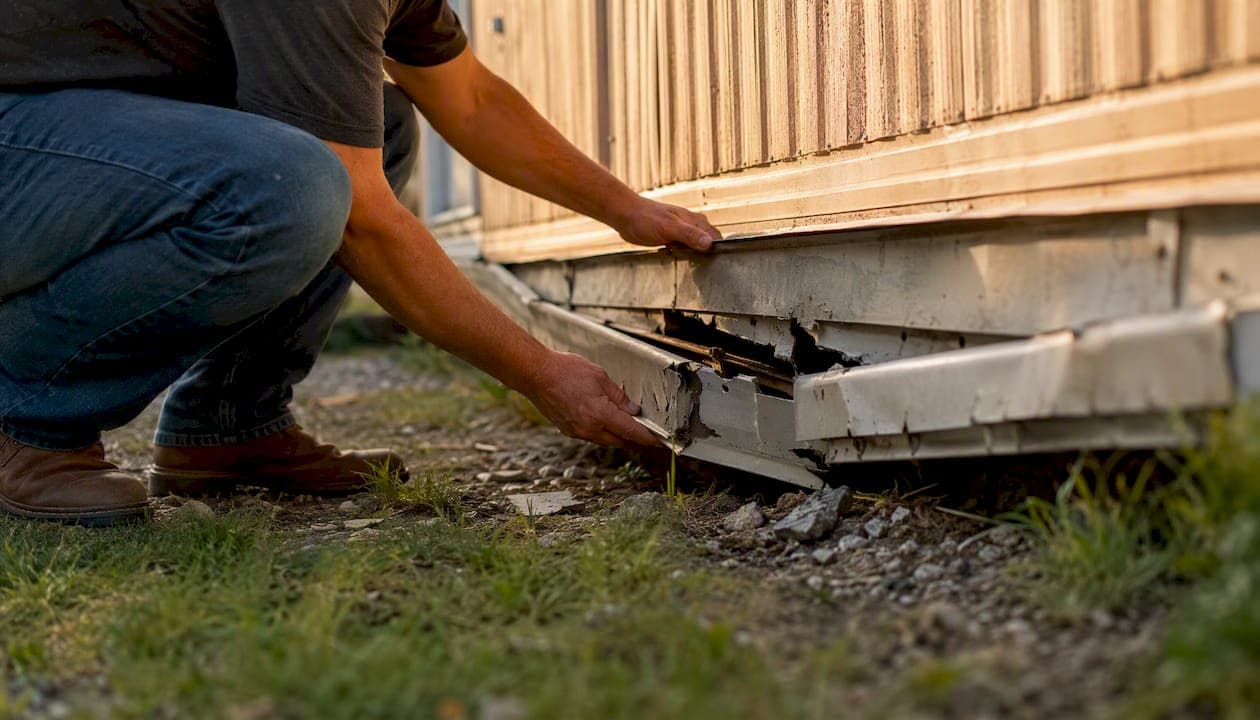
Yes, you can sell a mobile home as-is, and buyers for it exist right now: cash buyers, investors, mobile home dealers, and even people willing to pay to have it moved. You don't need to fix the roof, replace the skirting, or repaint a single wall before someone makes an offer. The fastest next move is simple: confirm your title status, figure out whether the sale includes the land underneath the home or just the structure, and get a cash offer or a quick comparison of local sale prices so you know what you're working with.
That's the short version. The longer version, the one that keeps deals from falling apart three weeks in, involves knowing exactly what paperwork a buyer will ask for and what a park manager might block.
Before you make a single call, gather these:
- The title or manufacturer's certificate of origin (proves you legally own the home)
- Your HUD tag number, if the home was built after June 15, 1976
- Any lien payoff statement from a lender, if you're still financing the home
- Photo ID and, if the home is titled jointly, the other owner's information
- Park lease or lot rent agreement, if the home sits on rented land
Pro Tip: Take five minutes right now to find your HUD tag and title before you do anything else. Sellers who stall on paperwork lose buyers who move on to the next listing.
Key Takeaways
Selling a mobile home as-is is realistic for most owners, but success depends on knowing your title status, pricing to local comps, and matching your sale route to how fast you actually need to close.
| Point | Details |
|---|---|
| As-is sales are common | Cash buyers, investors, and dealers routinely purchase mobile homes in current condition without requiring repairs. |
| Title status decides your options | A clear title, HUD tag, and lien payoff confirmation determine which buyers and routes are available to you. |
| Price from local comps | Adjust comp values down for condition, moving costs, and lot rent before setting your walk-away minimum. |
| Cash buyers offer speed and certainty | Expect faster closings and fewer contingencies compared to private sales or agent listings, in exchange for a lower net price. |
| Dan buys houses handles complications directly | Their process covers title issues and park approvals for Northwest Indiana sellers who want a fast, as-is cash sale with no repairs required. |
Table of Contents
- What "Selling As-Is" Actually Means for a Mobile Home
- What Are the Main Ways to Sell a Mobile Home As-Is?
- How Do You Price a Mobile Home You're Selling As-Is?
- What Paperwork Do You Need to Close an As-Is Sale?
- Should You Repair Anything Before Selling As-Is?
- Where Should You List an As-Is Mobile Home?
- What Mistakes Cost Sellers the Most Money?
- What Do Investors Actually Look For in an As-Is Offer?
- Do You Owe Taxes When You Sell a Mobile Home?
- Your Action Plan for the Next Two Weeks
- What Happens After You Accept a Cash Offer?
- If You Want a Fast, As-Is Sale: How Dan Buys Houses Works
- Sources
What "Selling As-Is" Actually Means for a Mobile Home
"As-is" means you're selling the home in its current condition, with no promise to repair anything before closing. It does not mean you get to hide a leaking roof or a failed water heater and call it the buyer's problem later. Most states still require sellers to disclose known material defects, even in an as-is sale. As-is changes who fixes the problem, not whether you have to admit the problem exists.
The bigger issue for most owners isn't the condition of the home. It's what kind of property they're actually selling.
Mobile homes fall into one of two legal buckets: chattel (personal property, like a car or a boat) or real property (permanently affixed to land you own, with the title retired into the property deed). A chattel home sale moves through your state's motor vehicle or manufactured housing title office, similar to selling a car. A real property sale goes through a standard real estate closing, with a deed transfer and often a title company involved. Buyers, lenders, and even park managers treat these two situations very differently, and mixing them up is one of the fastest ways to stall a sale.
If your home was built after June 15, 1976, it should carry a HUD tag, a small metal plate confirming it meets federal manufactured housing construction standards. HUD's manufactured housing guidance notes that lenders and local authorities commonly require this tag for financing or legal transfer. No tag doesn't mean the home is unsellable. It usually means you're limited to cash buyers who don't need bank financing, and it can knock down your asking price.
Location matters just as much as paperwork. If your home sits on a rented lot in a manufactured home community, the park almost always has to approve the new owner before the sale finalizes, and some parks require income verification or even cosmetic upgrades. If your home sits on land you own outright, you're dealing with a real estate transaction that follows your state's standard closing process. A detailed breakdown of what an as-is sale means for sellers covers how these classifications shift your disclosure obligations too.
Pro Tip: Check the exterior wall near the rear of the home, typically on the tongue end or one of the back corners, for your HUD tag. If it's missing entirely, order a verification letter from HUD's Institute for Building Technology and Safety before you list. It's cheaper than losing a buyer at the finish line.
What Are the Main Ways to Sell a Mobile Home As-Is?
You have five realistic paths, and each one trades speed for price differently.
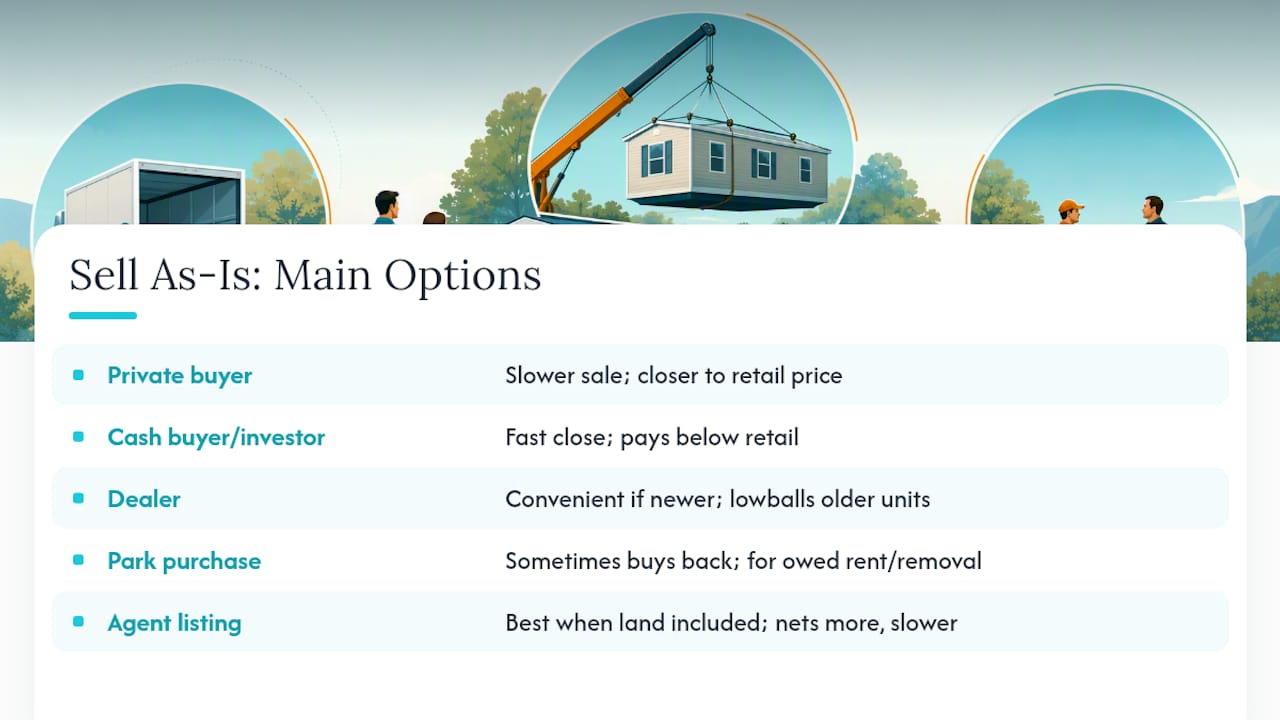
A private buyer purchasing the home to live in it, either on your lot (if the park allows a transfer) or somewhere else, tends to pay closer to retail value but takes longer to find and often wants a bank loan, which mobile homes on rented land rarely qualify for. A cash buyer or investor closes fast, sometimes in a week or two, skips inspections and repair demands, but pays below retail because they're pricing in resale risk and their own profit margin. A dealer who buys used units for resale offers convenience if your home is newer or well-maintained, though dealers typically lowball units older than 15 to 20 years. Selling directly to the park works when the park wants to control who lives in its community and will sometimes buy back a unit outright, especially if lot rent is owed or the home needs to be removed. Listing with an agent makes sense mainly when the home includes land, since agents and MLS platforms are built around real estate, not chattel sales.
If you're facing an eviction date, an inherited home you never wanted, or a title with a lien you can't easily pay off, the cash buyer route consistently gets you to a closing table the fastest. If you own the land and the home is in decent shape, a private sale or agent listing usually nets more money, assuming you can wait.
How Do You Price a Mobile Home You're Selling As-Is?
Start with local comps, then adjust down for condition and location. Pull three to five recent sale prices for homes matching your year, make, model, and square footage within your county or region. Mobile-home-specific listing sites and local classifieds usually show more realistic comps than national real estate portals, which skew toward homes on owned land.
From that comp baseline, subtract for condition: a home needing a new roof, flooring, or HVAC typically loses several thousand dollars off comp value, not dollar-for-dollar repair cost, since buyers price in their own labor markup and risk. If the home needs to be moved, subtract estimated transport and setup costs, which commonly run into the thousands depending on distance and size. If lot rent is high or the park has a poor reputation, expect further downward pressure since that affects resale value for whoever buys next.
Here's a simplified example. Say a 1998 single-wide, 14x70, in fair condition, comps at $18,000 in your area based on three recent sales. Deduct $3,000 for a needed roof replacement and dated flooring. Deduct another $1,500 because the park's lot rent runs above the local average, making the unit less attractive to buyers weighing ongoing costs. That lands you around $13,500 as a realistic asking price, with room to negotiate down to a walk-away minimum of maybe $11,000, factoring in what you're already paying monthly in lot rent while it sits unsold.
Set that walk-away number before you talk to a single buyer. It keeps you from panic-accepting a lowball offer or holding out for a number the market won't pay.
Before you price anything, collect:
- Year, make, and model
- Square footage and floor plan
- HUD tag number or serial number
- Current title status (clear, liened, or missing)
- Park rules on transfers and any pending lot rent balance
- Three to five comparable local sales from the past six months
What Paperwork Do You Need to Close an As-Is Sale?
Five documents make or break most mobile home closings: the title, a bill of sale, lien payoff confirmation, photo ID, and notarized transfer forms where your state requires them. Missing even one of these is the single most common reason a deal that looked done falls apart at the last minute.
| Document | What it proves | Common snag |
|---|---|---|
| Title or certificate of origin | Legal ownership of the home | Lost titles require a duplicate request through your state's DMV or housing authority |
| Bill of sale | Records the transaction terms and sale price | Must match the title info exactly, including VIN/serial |
| Lien payoff statement | Confirms any loan balance is cleared | Lenders can take 1-2 weeks to issue payoff letters |
| Photo ID | Confirms seller identity for notarization | Joint owners both need to be present or provide power of attorney |
| Notarized transfer forms | Legally finalizes the ownership change in many states | Some counties require in-person notarization at the recorder's office |
If you inherited the home and never had the title transferred into your name, you'll need to handle that step first, often through a small estate affidavit or probate process depending on your state and the home's value. Selling a home for an estate quickly covers this path in more depth if you're the one settling a relative's property.
If you're still paying off a loan on the home, contact your lender for a payoff statement before you list anything. That number tells you your real minimum sale price. Redfin's guidance on selling a mobile home confirms that proper title transfer and notarized documentation are non-negotiable steps in nearly every state's process.
If the buyer plans to keep the home in your current park, expect a residency application, a background or income check, and sometimes an inspection before the park approves the transfer. Skipping this step is one of the fastest ways to have a sale collapse after you've already accepted an offer. A full checklist of documents for a quick home sale walks through what to have ready before you even list.
Pro Tip: Call your county recorder's office before closing day and ask exactly what notarization they require. Some counties want the buyer and seller notarized together in person, which means you'll need to schedule that appointment days in advance, not the morning of.
Should You Repair Anything Before Selling As-Is?
Skip the remodel. Do the cleanup. That's the entire strategy in six words, and it's the part most first-time sellers get backward.

Deep cleaning, decluttering, and taking clear, well-lit photos cost you almost nothing and directly affect how many serious inquiries you get. A tidy exterior, trimmed skirting, and a swept-off deck signal to buyers that the home has been cared for even if the carpet is dated. Documenting known issues honestly, in writing, before you ever get an offer, prevents the single most common deal-killer in as-is sales: a buyer discovering something during their walk-through that you didn't mention and using it to renegotiate or walk away entirely.
What's usually a waste of money on an older mobile home: a full kitchen remodel, new flooring throughout, or exterior siding replacement. Those upgrades rarely return their cost in the sale price, especially on homes over 15 years old where buyers are already expecting some wear. Guidance on selling homes without repairs backs this up: sellers commonly compare repair costs against projected price increases and find the math doesn't favor major work, particularly when speed matters more than squeezing out the last few thousand dollars.
Take photos in daylight, from multiple angles, including any problem areas. A buyer who sees the water stain in your listing photo isn't surprised by it during inspection, and that removes a major point of friction later. If you're unsure which conditions cash buyers actually accept without hesitation, a guide to home conditions cash buyers accept breaks down what typically scares off buyers versus what they expect to see in an as-is unit.
Quick cost-to-benefit list for pre-sale prep:
- Deep clean interior and appliances: low cost, high impact on first impressions
- Mow, trim, and clear exterior clutter: low cost, high impact on curb appeal
- Fix a broken door lock or window latch: low cost, removes an easy negotiation point
- Full kitchen or bathroom remodel: high cost, rarely recovers value on older units
- New roof unless actively leaking during showings: high cost, better handled as a price adjustment
Where Should You List an As-Is Mobile Home?
Go where the buyers who actually want fixer-uppers already are, not where general home shoppers browse. Mobile-home-specific marketplaces and classified sites draw buyers who understand the as-is trade-off already, which saves you from fielding offers contingent on repairs you never promised. Local Facebook groups built around manufactured housing communities, investor networks that specifically buy distressed or as-is units, and even a notice posted at your park's community board can surface a buyer faster than a generic listing site buried among thousands of traditional homes.
If your home includes land, an agent listing on the MLS makes sense since that's where buyers with mortgages are searching. If it's chattel property on a rented lot, skip the MLS entirely; most agents won't even take the listing since it doesn't fit standard real estate commission structures.
Your ad needs to answer the questions a serious buyer asks first: is the title clear, what's the HUD tag status, what's the lot rent, does the home stay in place or need to move, and are there recent photos. Leaving any of these out just means more back-and-forth messages before you get a real offer.
Before you go further with anyone who responds, run through a quick screening:
- Ask for proof of funds if they claim to be paying cash
- Ask how soon they can close and whether they've bought a mobile home before
- Watch for buyers who refuse to meet in person or view the home before offering
- Never share your full title or Social Security number before you have a signed agreement
- Be wary of anyone offering more than your asking price with a story about needing you to wire back "overpayment," a classic overpayment scam
An investor cash offer breakdown walks through what a legitimate offer typically looks like, which makes it easier to spot one that isn't.
What Mistakes Cost Sellers the Most Money?
Overpricing tops the list, and it's not close. Sellers who set their asking price based on what they paid years ago, rather than what similar homes are actually selling for now, sit on the market for months and eventually accept a lower offer than if they'd priced accurately from day one.
Hiding known defects instead of disclosing them ranks second. It doesn't just risk a legal dispute after closing; it wastes your own time when a buyer's inspection turns up the issue and they walk. Not checking your title status before listing is the third major mistake, since a lien you forgot about or a title that's still in a deceased relative's name can add weeks to a deal you thought was nearly done. Ignoring park approval requirements, assuming the buyer can just move in once you shake hands, is the fourth, and it's one of the most common reasons a signed deal falls apart at the last step.
Watch for these red flags once offers start coming in:
- Vague payment terms or a buyer who won't specify exactly how and when funds will transfer
- Anyone asking you to pay an upfront "processing fee" before they'll make an offer
- Buyers who push to skip escrow or a title company entirely and handle everything "directly"
- Refusal to provide identification or proof of funds when asked
Insist on proof of funds before you take a home off the market for any buyer. Use a title company or real estate attorney to handle the actual funds transfer whenever possible, even in a private sale, since that adds a layer of protection neither side gets by handling cash directly.
What Do Investors Actually Look For in an As-Is Offer?
Transparency shortens the path to a real offer. Providing a short, honest condition report along with clear photos upfront removes the guesswork that makes investors lowball or walk away entirely; when a buyer doesn't know what's wrong, they price in the worst-case scenario to protect themselves.
Investors and cash buyers typically evaluate four things before they even calculate a number: the home's age and HUD tag status, whether it's realistically transportable if it needs to move, whether the park will approve a transfer, and how clean the title is. Address all four explicitly in your listing and you'll get fewer time-wasting inquiries and more serious offers, faster.

Honesty and clear documentation reduce failed offers substantially, since the biggest reason deals collapse after an initial handshake is a buyer discovering something during due diligence that wasn't disclosed upfront.
When negotiating, present your walk-away price as firm and ask buyers to break out any removal or relocation costs separately from their offer for the home itself. That keeps offers apples-to-apples instead of comparing a $9,000 offer that includes free removal against an $11,000 offer where you'd still owe $3,000 to have it hauled away.
Pro Tip: If you have some flexibility, offer a closing date within the buyer's preferred window, or agree to cover a small administrative fee like a title transfer charge. Investors often weigh these small conveniences as heavily as the price itself, since certainty and speed are exactly what they're buying.
Do You Owe Taxes When You Sell a Mobile Home?
It depends on your situation, and this is one area where a quick call to a tax professional beats guessing. If the mobile home was your primary residence, you may qualify for capital gains exclusions similar to a traditional home sale. If it was a rental, an inherited property, or you're selling below what you originally paid, the tax treatment shifts.
Sellers navigating an estate sale, a foreclosure situation, a sale with a significant gain over the original purchase price, or a complicated lien payoff arrangement are the ones who most often need professional guidance rather than a general answer. The rules also vary depending on whether your home is classified as chattel or real property, which affects how the sale gets reported.
This isn't legal or tax advice, just a heads-up: talk to a licensed tax professional about your specific situation before you file, especially if any of the above applies to you.
Your Action Plan for the Next Two Weeks
Selling an as-is mobile home fast comes down to sequencing. Do these roughly in order:
- Within 24 to 72 hours: Locate your title, HUD tag number, and any lien documents. Photograph the home inside and out, including problem areas. Confirm your park's transfer rules if you're on a rented lot.
- Within the first week: Pull three to five local comps and calculate your asking price and walk-away minimum using the method above. Write your listing with all the key facts a buyer needs upfront.
- Within one to two weeks: Contact two or three buyer channels at once, a mobile-home marketplace, a local cash buyer or investor, and your park manager if selling to the park is an option. Request proof of funds from anyone who makes an offer.
A short outreach script works better than a long email. Something like: "I'm selling my [year, make] mobile home as-is, currently in [park name/city]. Title is clear, HUD tag confirmed. Looking for a cash offer or fast closing. Photos and details available on request." Keep it factual and short. Buyers who deal in as-is sales respond faster to specifics than to a sales pitch.
What Happens After You Accept a Cash Offer?
Most fast, as-is sales follow a predictable rhythm once you accept. You'll typically sign a purchase agreement, provide the title and any lien payoff documentation, and schedule a closing date, often within one to three weeks depending on whether your title is clear or needs correction first. On closing day, you sign the title transfer and bill of sale, the buyer or their title company handles the funds transfer, and you walk away with payment, sometimes the same day.
You generally get to decide what happens to items left inside the home. Many sellers negotiate leaving furniture or appliances behind rather than paying to move or dispose of them, and a straightforward buyer will usually work that into the agreement rather than treat it as a sticking point. Move-out timing gets coordinated as part of the closing conversation, not left as a vague afterthought, so you know exactly when you need to be out.
Compared to listing on the open market, where you might wait months for a qualified buyer, deal with financing fall-throughs, and pay agent commissions, the as-is cash route trades some top-line dollars for something a lot of sellers value more once they're actually in the process: knowing the exact date you'll be paid and the exact date you need to be moved out.
If You Want a Fast, As-Is Sale: How Dan Buys Houses Works
If speed and certainty matter more to you than chasing every last dollar through a drawn-out private sale, a direct buyer solves the two biggest headaches in this whole process: repairs and title complications. Dan buys houses purchases mobile homes in Northwest Indiana in their current condition, no repairs, no cleanout, no waiting for a buyer's bank to approve financing that mobile homes on rented lots rarely qualify for anyway.

What sets this apart from a private sale or a general classifieds listing is local title expertise. Missing titles, lien payoffs, estate transfers, and park approval requirements are exactly the kind of snags that stall deals for weeks with an unfamiliar buyer. Dan buys houses works through those issues directly instead of leaving you to chase down a title specialist on your own. Offers come with no hidden fees and no owner-paid closing costs, and closing dates flex around your timeline rather than forcing you into someone else's schedule.
If you're ready to see what a no-obligation cash offer looks like for your situation, see how the process works and find out what information you'll need to get started. Title complications can add time to any sale, direct or otherwise, but you'll know upfront what to expect rather than finding out three weeks in.
Sources
This article is general information, not a substitute for advice from a qualified financial advisor. Consult a qualified financial professional about your own circumstances before acting on anything here.