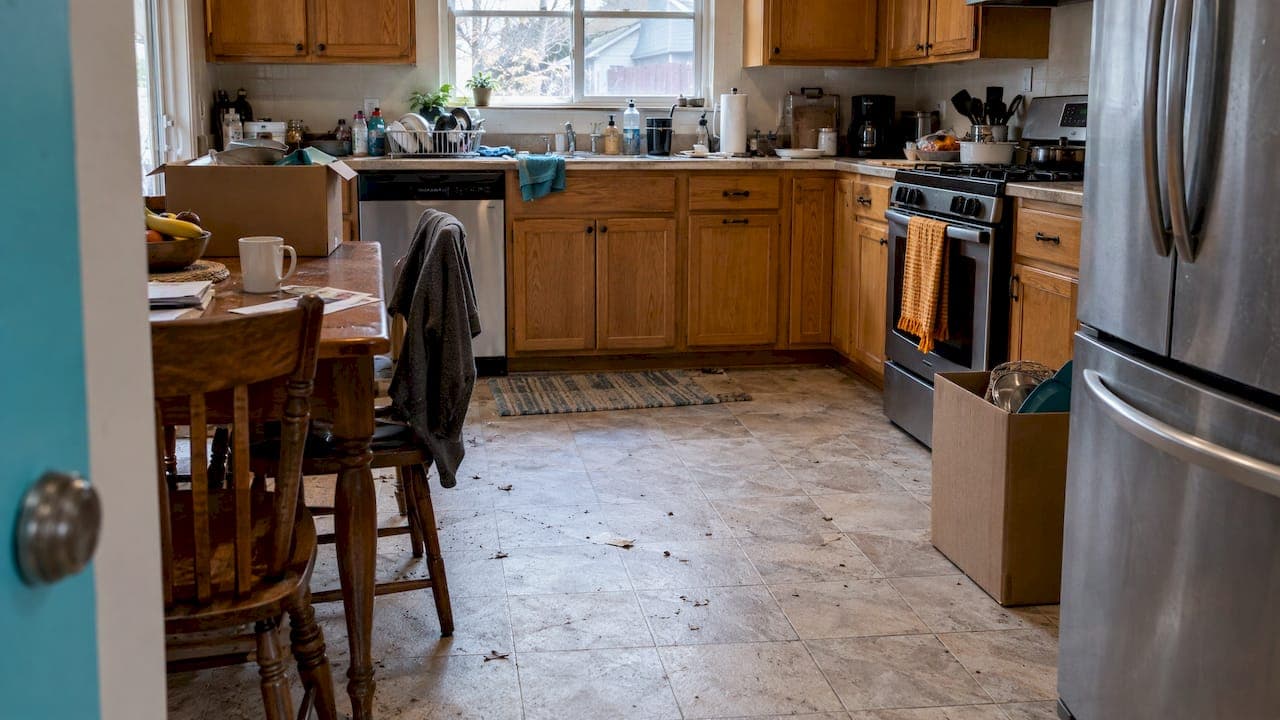
Yes, you can sell a house without cleaning it. No law requires a spotless home, and a cash buyer who purchases as-is takes the house with the belongings, the dust and the clutter. What you can't skip is the paperwork: the contract decides what must be gone at closing, and you still have to disclose problems you know about. Here is how each route works, so you can pick the one that fits your situation.
TL;DR
- No law says you must clean before selling. The purchase contract sets the standard, and it is often "broom clean" or nothing at all.
- An as-is sale to a cash buyer lets you leave furniture, junk and mess behind if the contract says so.
- Selling as-is does not erase your duty to disclose known defects such as leaks, mold or foundation trouble.
- A messy house usually does not change an appraisal. Damage caused by the mess can.
- In Northwest Indiana, we buy houses in any condition for cash, with no fees, no commissions and no cleaning required.
Table of Contents
- Do you have to clean a house before you sell it?
- What "broom clean" means
- Your options when you don't want to clean
- What an as-is sale means for you
- What you still must disclose
- Does a messy house affect the appraisal?
- Before you sell a messy house: a short checklist
- Special situations: foreclosure, inheritance, tenants and relocation
- Perspective: why we buy houses the way they are
- Selling to us: what to expect
- Ready to sell the house as it is?
- FAQ
- Sources
Do you have to clean a house before you sell it?
No. Realtor.com says sellers have no real requirement to clean when moving out, but buyers expect your belongings to be gone and a contract may require certain items to be removed. A Missouri brokerage makes the same point: there is no law against selling a dirty house, and no standard legal definition of what "clean" means.
So the real question is not "what does the law say?" It is "what does my contract say?" Three situations come up most often:
- A traditional sale with an agent. Buyers expect a clean, staged home. You can skip cleaning, but you will likely get fewer showings and lower offers. The contract usually asks for broom-clean condition at closing.
- An as-is sale to an investor or fixer-upper buyer. These buyers expect to deal with the condition themselves. The contract can say you leave the contents.
- A direct cash sale to a local home buyer. The offer is built around the house as it stands, belongings included.
What "broom clean" means
If your contract asks for broom-clean, the bar is low. Per Realtor.com's guidance, remove clutter, then sweep or vacuum. That means no trash, no leftover items you didn't agree to leave, and floors free of loose debris.
Some contracts go further in the seller's favor. In Northern Virginia's standard addendum, for example, the as-is option includes a line saying the seller will not clean or remove debris, even though the default standard is trash-free and broom clean. Forms differ by state and region, so check the language in your own contract. In Indiana, a title company or a real estate attorney can tell you how your contract should read.
Get it in writing
If you want to leave belongings behind, the contract should say so plainly. Use words like "seller will leave all contents and debris in place; buyer accepts the property with contents." Without that sentence, the buyer can expect an empty house at the final walk-through, and a dispute can hold up closing.
Your options when you don't want to clean
| Route | Cleaning needed | Typical fit | Main trade-off |
|---|---|---|---|
| List with an agent | Strongly encouraged, at least decluttering | Move-in-ready homes | More prep, showings and negotiation |
| Sell as-is on the open market | Optional, but it affects offers | Homes with modest issues | Smaller buyer pool, inspections still possible |
| Hire a cleanout crew, then sell | The crew does it | Sellers with budget and time | Upfront cost and scheduling |
| Sell directly to a cash buyer | None | Hoarded, inherited, damaged or tenant-worn homes | The offer reflects the home's condition |
The fourth row is where we work. But the other rows are real choices, and the right one depends on your timeline, your budget and how much work the house needs.
What an as-is sale means for you
Selling as-is changes who handles the condition. You don't repair or prepare. The buyer takes the house as it is.
Rocket Mortgage notes that as-is listings often attract cash buyers, investors and fixer-upper buyers, who usually don't depend on traditional mortgage approval. That is one reason as-is sales can move faster. Zillow adds that selling as-is removes the need for pre-sale repairs and can cut costs like a professional cleaner and stager.
Two things to know going in:
- Buyers may still inspect. As-is does not automatically mean no inspection. Zillow explains that buyers can still schedule one and agree to pay for needed repairs if they move forward.
- Price reflects condition. On the open market, Redfin reports that buyers tend to expect 10 to 30% below market value to account for repairs and risk. A direct cash offer works from the same logic: the buyer prices in the work they will take on, and you skip the cost, time and stress of doing it yourself.
For more on how these deals are structured, see our guide on what an as-is home sale means for sellers and the paperwork involved.
What you still must disclose
Not cleaning is fine. Hiding known problems is not. Rocket Mortgage is clear that selling as-is does not remove the duty to disclose known issues like foundation problems, mold, roof leaks or outdated wiring. Redfin says the same: in most states, sellers must disclose known issues such as a leaky roof, foundation damage or past flooding, even when selling as-is.
The details vary by state. Maryland, for example, has sellers complete a form that lists conditions and defects, and even under its disclaimer option sellers must still mention known latent defects that threaten health or safety. Indiana has its own rules and forms, so ask a real estate attorney or your title company what applies to your sale before you sign.
A practical rule: if you know about it, write it down. Water in the basement, a past roof leak, a failing furnace, a mold smell. Disclosing these protects you after closing. If the problem is structural, our guide on disclosing foundation issues first walks through the choice between repairing and selling for cash.

Does a messy house affect the appraisal?
Usually not, and this matters if your buyer is using a mortgage. One appraisal firm explains that a professional appraiser should be objective, so clothes on the floor or an unmopped kitchen don't enter the valuation.
The exception is when the mess becomes damage. A mess that causes water damage to hardwood floors, for instance, does affect value. And condition still counts: SoFi lists structural weaknesses, deferred maintenance and safety issues as things that can pull an appraisal down. Another appraisal service says a home should be accessible and easy to evaluate, so the appraiser can walk every room.
So if an appraiser is coming, clear a path to each room, the attic hatch and the utility areas. You don't need to deep clean. If you want to see how condition and repairs get priced into a value, this walkthrough on how to adjust comps for repairs shows the logic investors use.
A cash purchase from us has no mortgage appraisal step, which removes this concern entirely.

Before you sell a messy house: a short checklist
You don't need to clean, but a few small steps make any as-is sale go smoother.
- Find the valuables and papers. Look for jewelry, documents, photos, keys and anything with sentimental value. This is the only sorting that truly matters.
- Note known problems. List leaks, mold, pest issues or structural trouble for your disclosure.
- Gather your paperwork. Mortgage statement, tax bills, any lien notices, and the deed.
- Decide what stays. Appliances, furniture, vehicles and hazardous items like paint or chemicals should be addressed in the contract.
- Set a move-out date. Tell the buyer when you will be out, so closing and possession line up.
Rocket Mortgage suggests that as-is sellers can also get a pre-listing inspection and repair estimates and market to cash buyers and investors. That helps if you plan to list on the open market. If you go straight to a direct buyer, you can skip those steps.
Special situations: foreclosure, inheritance, tenants and relocation
Cleaning is rarely the real obstacle. Time and logistics are. Here is how the common situations differ.
Facing foreclosure
When a lender's clock is running, a cleanout can eat weeks you don't have. A direct sale lets you skip it and focus on the numbers: what you owe, what the house can sell for and how fast you need to close. Talk to your lender or a housing counselor about your timeline, and ask the buyer whether the closing date can be set to fit it. Our guide to why cash buyers close faster explains what shortens the process.
Inherited property
Heirs often live far away and face a house full of a lifetime of belongings. Going through everything while grieving is hard, and carrying costs such as taxes, insurance and utilities keep running. Selling with the contents in place lets you take the items that matter and leave the rest. Because probate rules and who has authority to sell depend on the estate, check with the estate's attorney first. Our article on ways to sell an estate home quickly covers the options.
Rental properties and tenants
Tenant-worn units may have damage, junk left behind or both. Landlords tired of the cycle can sell the property as-is without turning it over first. Follow your lease and Indiana's landlord-tenant rules when it comes to occupants, and talk to a local attorney if a tenant is still in place. More detail is in our guide to selling a rental property without repairs. If it is a two-unit building, see how to sell a duplex as-is.
Relocating
If a new job or family move sets your deadline, staging and cleaning for showings is the part you can least afford. A direct sale with a flexible move-out date lets you leave on your schedule rather than the market's.
Perspective: why we buy houses the way they are
We see the same thing over and over. A homeowner is ready to sell, then freezes when they picture the cleanout. The basement full of boxes, the garage nobody has opened in a decade, a parent's belongings, a tenant's leftovers. People put off the sale for months because they think the house has to be perfect first.
It doesn't. We are a local buyer, not a hedge fund or a national investor. We purchase homes in Northwest Indiana in any condition, for cash, and you don't clean, repair or pay closing costs. We don't charge fees or commissions either. Our offers are designed to be honest and competitive, and some sellers close in as little as five days.
We believe the most useful thing we can do is take the work off your plate. You keep what matters to you, and we handle the rest. If you need more time to move out, we can work out a flexible schedule.
Daniel
Selling to us: what to expect
We buy houses, condos, duplexes, townhomes, mobile homes, commercial properties, apartment complexes and land in as-is condition. The process is built to be short.
- Tell us about the property. Share the address and the situation, such as foreclosure, inheritance, relocation, divorce or a rental problem.
- Receive a cash offer. We make an offer based on the property as it stands, with no cleaning or repairs expected from you.
- Pick your closing date. You choose a date that fits, including a fast one if you need it.
- Close and move on. There are no fees or commissions to you, and we cover the closing costs.
You can see the steps in more detail on how our process works in Indiana. If the house needs more than cleaning, our guide to selling a home that needs work and the overview of a quick sale for cash will help you compare routes.
Ready to sell the house as it is?
If your house is full of belongings, in rough shape or just not worth the effort of a cleanout, we'll make you a cash offer for it exactly as it stands. No cleaning, no repairs, no fees. Start at our page to sell your house for cash, or see our page for sellers in Highland, Indiana.

Have questions first? Reach out and describe your situation. There is no cost to ask.
FAQ
Can I sell my house without cleaning it?
Yes. No law requires you to clean before selling, and you can sell to a buyer who accepts the home with its contents. Your contract sets the standard, so spell out what stays and what goes. You must still disclose known defects.
Do appraisers care if your house is messy?
Generally no. Appraisers are expected to value the property objectively, so clutter alone shouldn't change the number. Damage from the mess, or deferred maintenance and safety problems, can lower it. A cash sale to us involves no mortgage appraisal.
Do sellers clean the house before selling?
Most sellers on the open market do, because a clean, decluttered home shows better. It is a choice, not a requirement. In an as-is sale to a direct buyer, you can skip it. Many contracts ask only for broom-clean condition at closing.
What does broom clean mean?
It means the house is free of trash and leftover items, with the floors swept or vacuumed. Realtor.com describes it as removing clutter and then sweeping. If you sell to us, you don't need to do even that.
Can a buyer still inspect an as-is house?
Often yes. As-is usually means you won't make repairs or negotiate credits, but buyers can still inspect. With a direct cash buyer, the inspection simply informs the offer, and you don't carry the repair work.
Sources
- Broom Clean Condition: What Does It Mean If You're Moving Out (Realtor.com)
- How Much Cleaning Is Necessary When Selling a Home? (BHHS Select STL)
- Ask Eli: What does selling as-is actually mean? (ARLnow)
- Selling a house as is: What to know (Rocket Mortgage)
- How Much Do You Lose Selling a House As-Is? (Zillow)
- Yes, You Can Sell A House As-Is, No Inspection Needed (Redfin)
- What Home Sellers Must Disclose to Maryland Buyers (Nolo)
- Does a Messy House Affect an Appraisal? (Houston House Appraisal)
- 30 Tips to Avoid a Low Value On Your Home Appraisal (ContractorQuotes)
- Home Appraisal Checklist (SoFi)
- How to Prepare for Home Appraisal (Connect Appraisal)
- Appraisal Grade Workflow to Adjust Comps for Repairs